Visual summary
When the goal does not fit safely, review time and treatment planning rather than simply increasing the rate.
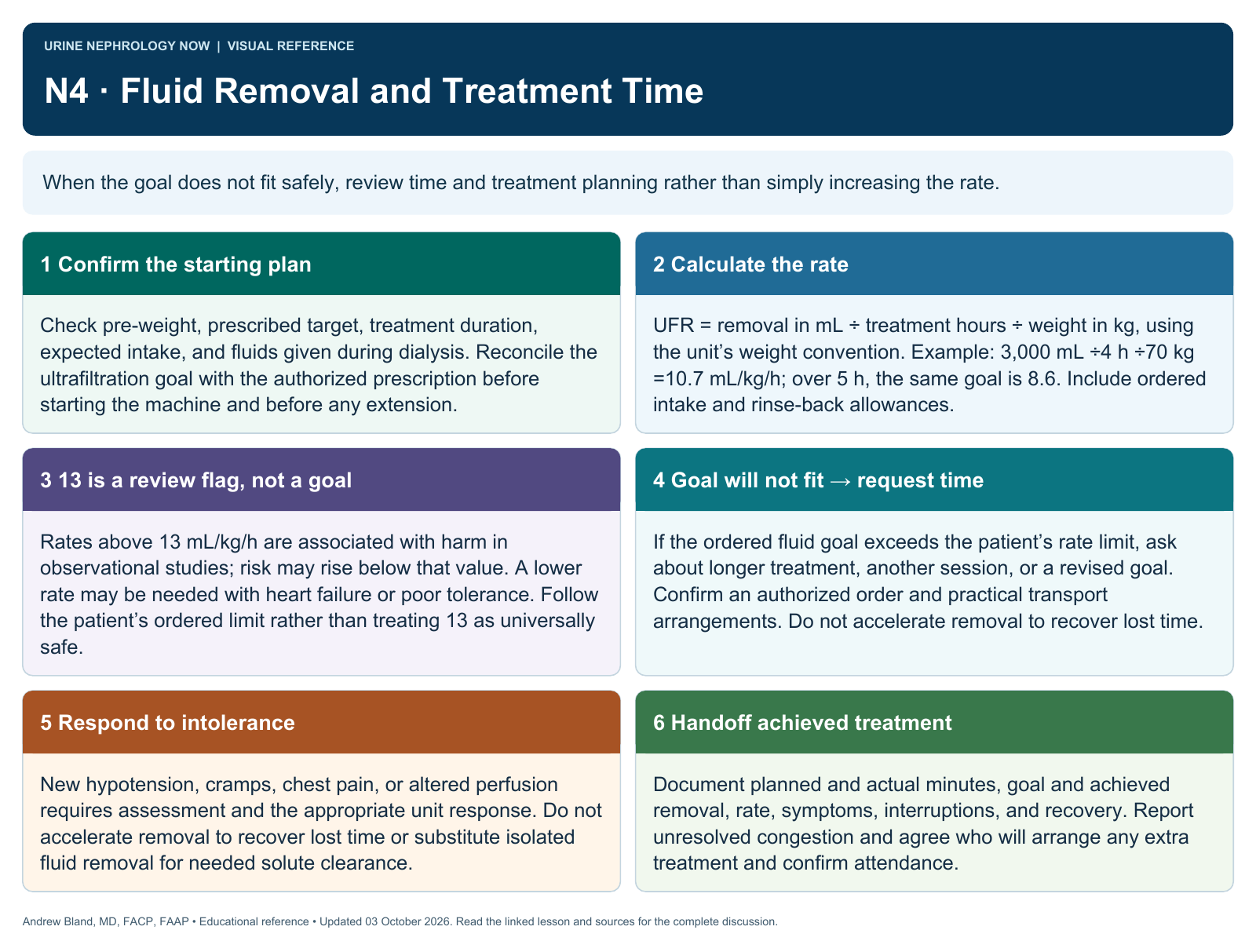
Text version
Confirm the starting plan
Check pre-weight, prescribed target, treatment duration, expected intake, and fluids given during dialysis. Reconcile the ultrafiltration goal with the authorized prescription before starting the machine and before any extension.
Calculate the rate
UFR = removal in mL ÷ treatment hours ÷ weight in kg, using the unit’s weight convention. Example: 3,000 mL ÷4 h ÷70 kg =10.7 mL/kg/h; over 5 h, the same goal is 8.6. Include ordered intake and rinse-back allowances.
13 is a review flag, not a goal
Rates above 13 mL/kg/h are associated with harm in observational studies; risk may rise below that value. A lower rate may be needed with heart failure or poor tolerance. Follow the patient’s ordered limit rather than treating 13 as universally safe.
Goal will not fit → request time
If the ordered fluid goal exceeds the patient’s rate limit, ask about longer treatment, another session, or a revised goal. Confirm an authorized order and practical transport arrangements. Do not accelerate removal to recover lost time.
Respond to intolerance
New hypotension, cramps, chest pain, or altered perfusion requires assessment and the appropriate unit response. Do not accelerate removal to recover lost time or substitute isolated fluid removal for needed solute clearance.
Handoff achieved treatment
Document planned and actual minutes, goal and achieved removal, rate, symptoms, interruptions, and recovery. Report unresolved congestion and agree who will arrange any extra treatment and confirm attendance.