Visual summary
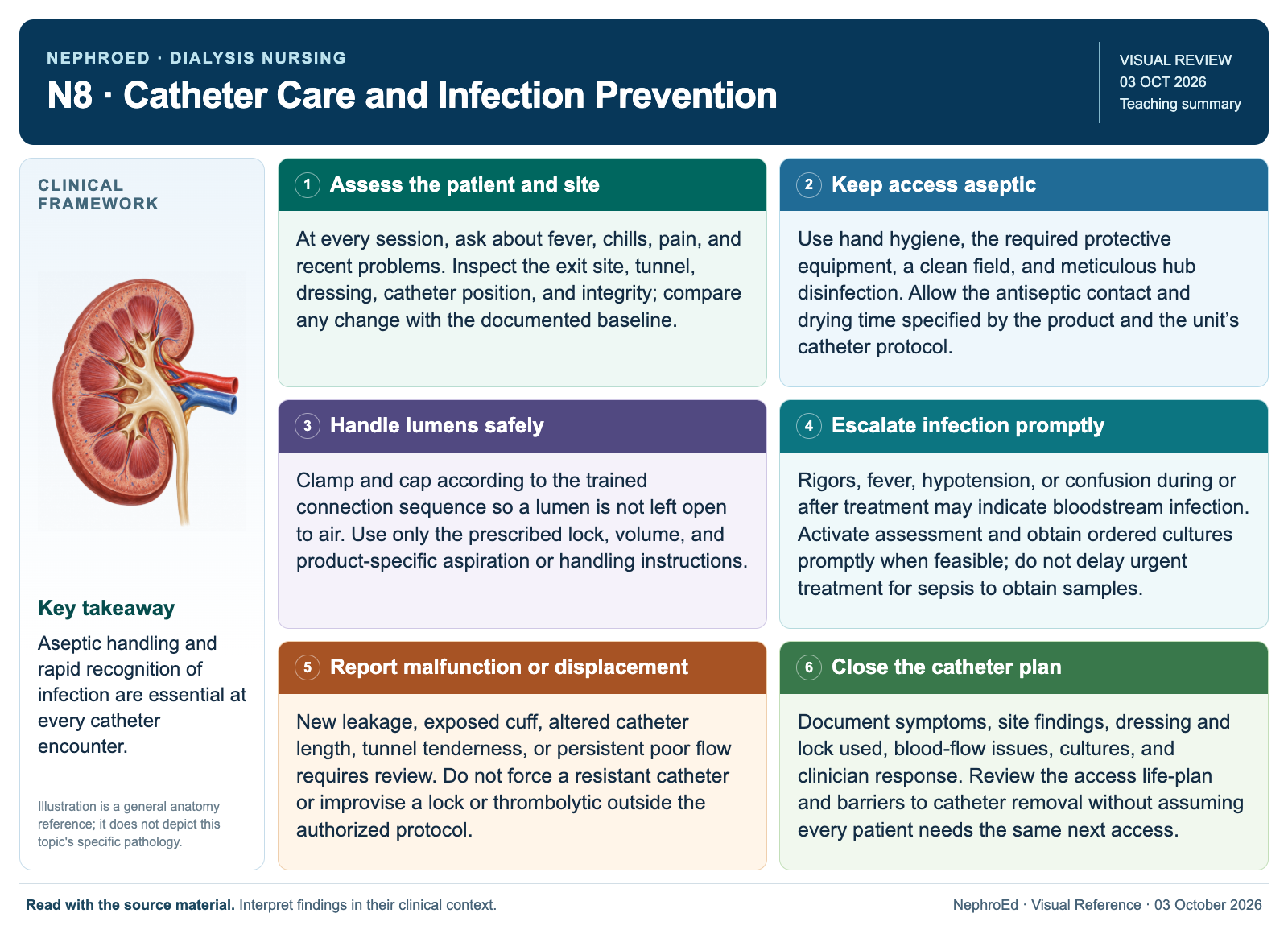
Aseptic handling and rapid recognition of infection are essential at every catheter encounter.
Text version
Assess the patient and site
At every session, ask about fever, chills, pain, and recent problems. Inspect the exit site, tunnel, dressing, catheter position, and integrity; compare any change with the documented baseline.
Keep access aseptic
Use hand hygiene, the required protective equipment, a clean field, and meticulous hub disinfection. Allow the antiseptic contact and drying time specified by the product and the unit’s catheter protocol.
Handle lumens safely
Clamp and cap according to the trained connection sequence so a lumen is not left open to air. Use only the prescribed lock, volume, and product-specific aspiration or handling instructions.
Escalate infection promptly
Rigors, fever, hypotension, or confusion during or after treatment may indicate bloodstream infection. Activate assessment and obtain ordered cultures promptly when feasible; do not delay urgent treatment for sepsis to obtain samples.
Report malfunction or displacement
New leakage, exposed cuff, altered catheter length, tunnel tenderness, or persistent poor flow requires review. Do not force a resistant catheter or improvise a lock or thrombolytic outside the authorized protocol.
Close the catheter plan
Document symptoms, site findings, dressing and lock used, blood-flow issues, cultures, and clinician response. Review the access life-plan and barriers to catheter removal without assuming every patient needs the same next access.
Continue learning
This graphic summarizes a topic. The full educational pages provide the broader discussion and references.