Visual summary
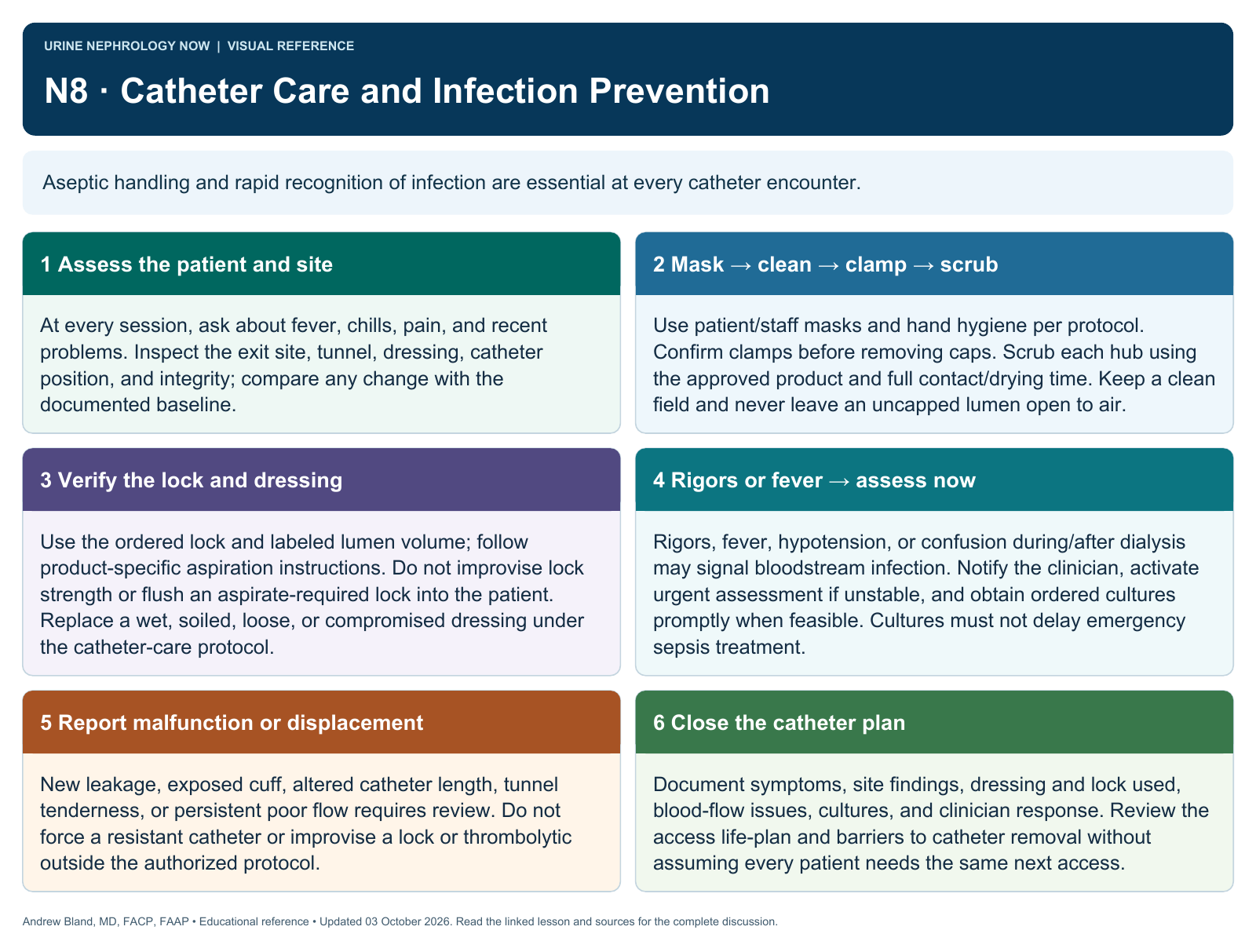
Aseptic handling and rapid recognition of infection are essential at every catheter encounter.
Text version
Assess the patient and site
At every session, ask about fever, chills, pain, and recent problems. Inspect the exit site, tunnel, dressing, catheter position, and integrity; compare any change with the documented baseline.
Mask → clean → clamp → scrub
Use patient/staff masks and hand hygiene per protocol. Confirm clamps before removing caps. Scrub each hub using the approved product and full contact/drying time. Keep a clean field and never leave an uncapped lumen open to air.
Verify the lock and dressing
Use the ordered lock and labeled lumen volume; follow product-specific aspiration instructions. Do not improvise lock strength or flush an aspirate-required lock into the patient. Replace a wet, soiled, loose, or compromised dressing under the catheter-care protocol.
Rigors or fever → assess now
Rigors, fever, hypotension, or confusion during/after dialysis may signal bloodstream infection. Notify the clinician, activate urgent assessment if unstable, and obtain ordered cultures promptly when feasible. Cultures must not delay emergency sepsis treatment.
Report malfunction or displacement
New leakage, exposed cuff, altered catheter length, tunnel tenderness, or persistent poor flow requires review. Do not force a resistant catheter or improvise a lock or thrombolytic outside the authorized protocol.
Close the catheter plan
Document symptoms, site findings, dressing and lock used, blood-flow issues, cultures, and clinician response. Review the access life-plan and barriers to catheter removal without assuming every patient needs the same next access.