Visual summary
The best access plan fits the person’s goals, expected benefit, and treatment burden.
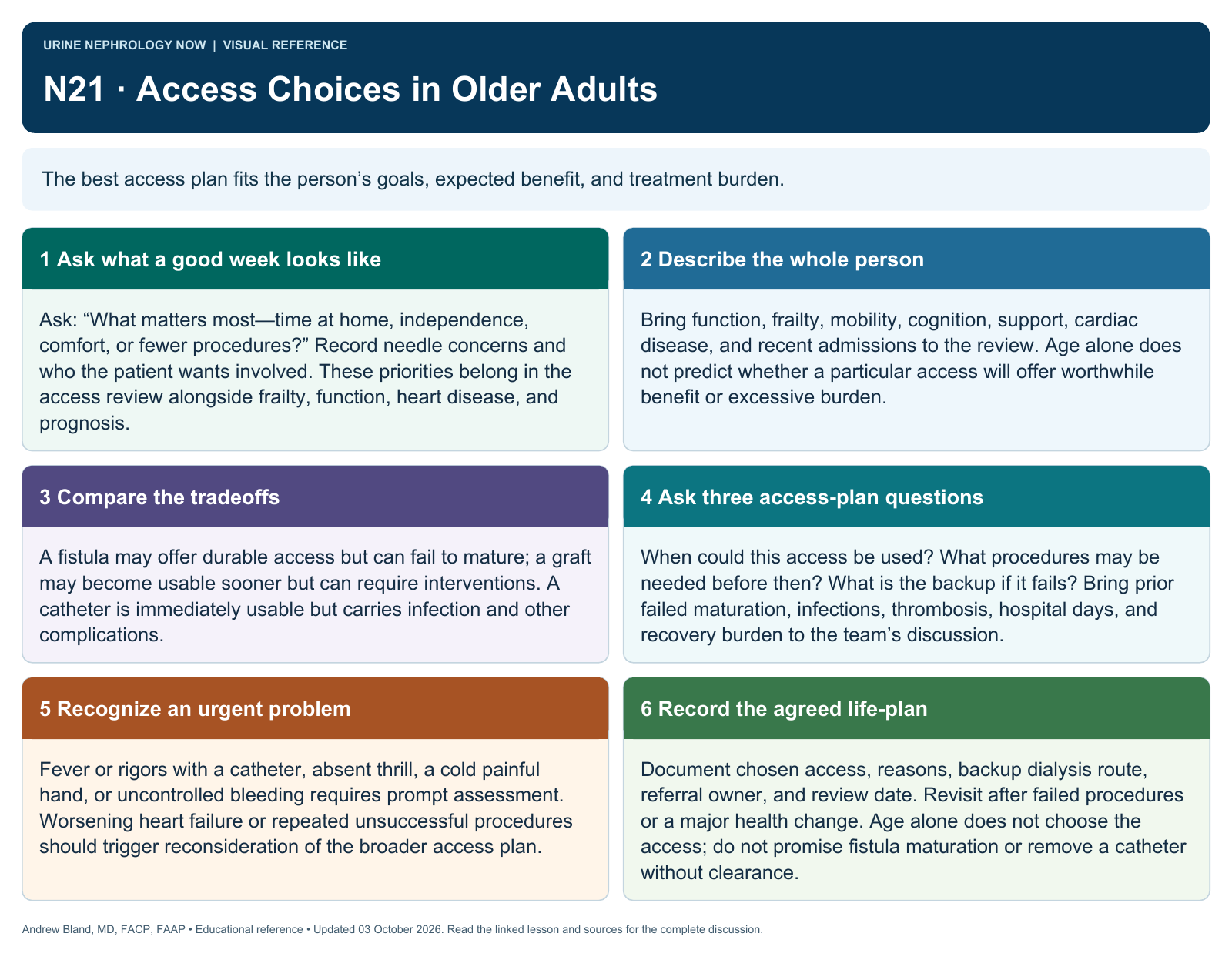
Text version
Begin with the patient’s goals
Ask about independence, comfort, needle concerns, time at home, and willingness to undergo procedures. Record the patient’s words and include their chosen support person in the access-planning discussion when desired.
Describe the whole person
Bring function, frailty, mobility, cognition, support, cardiac disease, and recent admissions to the review. Age alone does not predict whether a particular access will offer worthwhile benefit or excessive burden.
Compare the tradeoffs
A fistula may offer durable access but can fail to mature; a graft may become usable sooner but can require interventions. A catheter is immediately usable but carries infection and other complications.
Map the access history
Document existing catheter use, failed maturation, infections, thrombosis, procedures, and recovery burden. Ask the team about time to use, likely additional procedures, and how dialysis will continue while the plan is implemented.
Recognize an urgent problem
Fever or rigors with a catheter, absent thrill, a cold painful hand, or uncontrolled bleeding requires prompt assessment. Worsening heart failure or repeated unsuccessful procedures should trigger reconsideration of the broader access plan.
Handoff the agreed life-plan
Record priorities, alternatives discussed, chosen option, backup access, and review date. Confirm who will arrange referrals and reassess benefit; do not promise maturation or apply a blanket age cutoff or fistula-first rule.
Continue learning
This graphic summarizes a topic. The full educational pages provide the broader discussion and references.