Visual summary
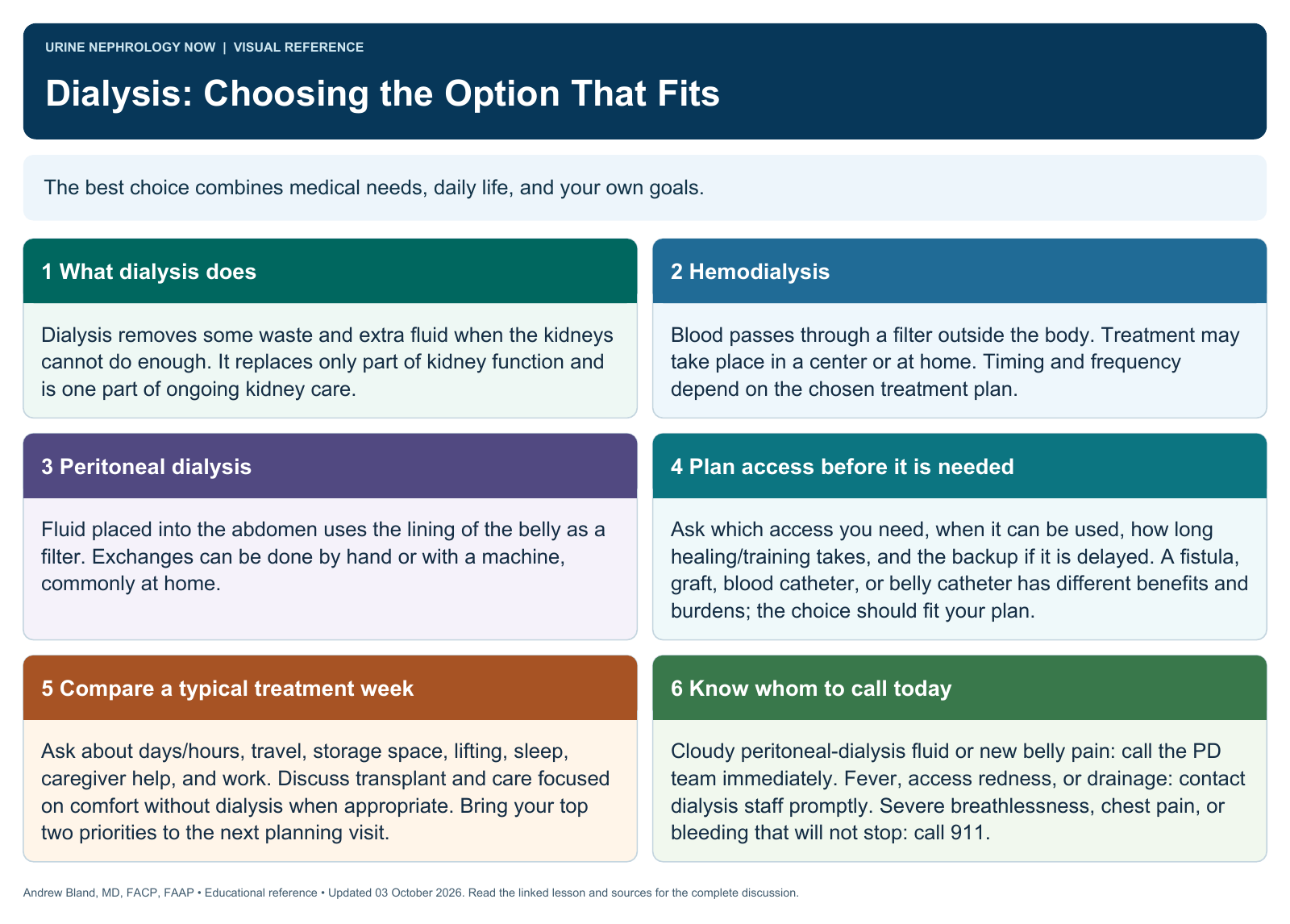
The best choice combines medical needs, daily life, and your own goals.
Text version
What dialysis does
Dialysis removes some waste and extra fluid when the kidneys cannot do enough. It replaces only part of kidney function and is one part of ongoing kidney care.
Hemodialysis
Blood passes through a filter outside the body. Treatment may take place in a center or at home. Timing and frequency depend on the chosen treatment plan.
Peritoneal dialysis
Fluid placed into the abdomen uses the lining of the belly as a filter. Exchanges can be done by hand or with a machine, commonly at home.
Prepare the access
Hemodialysis needs a blood access. Peritoneal dialysis needs an abdominal catheter. Planning ahead allows time for healing, training, and discussion of the safest option.
Talk about your priorities
Discuss work, travel, support at home, symptoms, and what matters most to you. Transplant and comprehensive conservative kidney care should also be part of an appropriate discussion.
Know warning signs
Report access redness, fever, cloudy peritoneal fluid, abdominal pain, or new breathing difficulty. Your dialysis team should give you clear daytime and after-hours contact instructions.
Continue learning
This graphic summarizes a topic. The full educational pages provide the broader discussion and references.