Visual summary
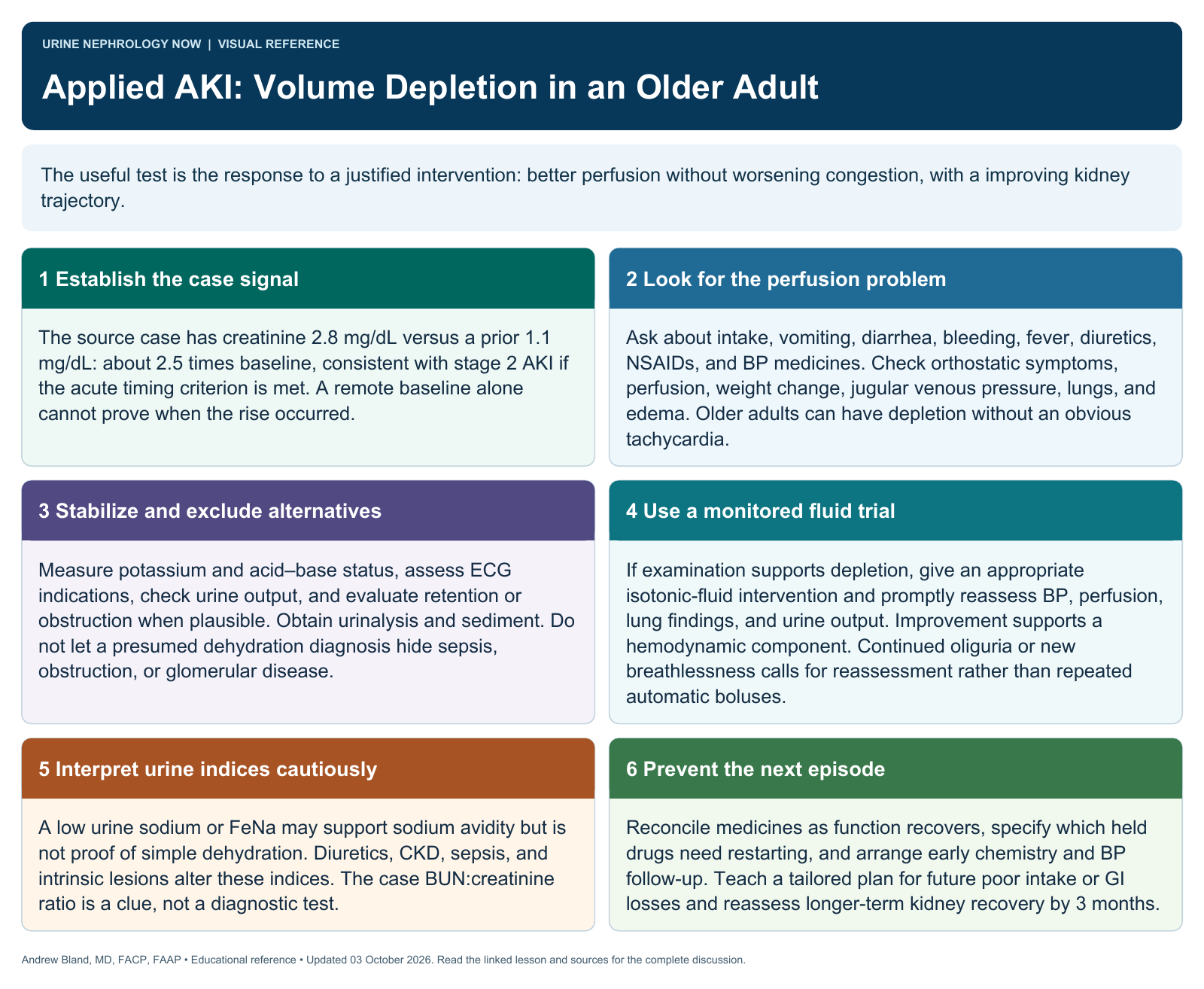
The useful test is the response to a justified intervention: better perfusion without worsening congestion, with a improving kidney trajectory.
Text version
Establish the case signal
The source case has creatinine 2.8 mg/dL versus a prior 1.1 mg/dL: about 2.5 times baseline, consistent with stage 2 AKI if the acute timing criterion is met. A remote baseline alone cannot prove when the rise occurred.
Look for the perfusion problem
Ask about intake, vomiting, diarrhea, bleeding, fever, diuretics, NSAIDs, and BP medicines. Check orthostatic symptoms, perfusion, weight change, jugular venous pressure, lungs, and edema. Older adults can have depletion without an obvious tachycardia.
Stabilize and exclude alternatives
Measure potassium and acid–base status, assess ECG indications, check urine output, and evaluate retention or obstruction when plausible. Obtain urinalysis and sediment. Do not let a presumed dehydration diagnosis hide sepsis, obstruction, or glomerular disease.
Use a monitored fluid trial
If examination supports depletion, give an appropriate isotonic-fluid intervention and promptly reassess BP, perfusion, lung findings, and urine output. Improvement supports a hemodynamic component. Continued oliguria or new breathlessness calls for reassessment rather than repeated automatic boluses.
Interpret urine indices cautiously
A low urine sodium or FeNa may support sodium avidity but is not proof of simple dehydration. Diuretics, CKD, sepsis, and intrinsic lesions alter these indices. The case BUN:creatinine ratio is a clue, not a diagnostic test.
Prevent the next episode
Reconcile medicines as function recovers, specify which held drugs need restarting, and arrange early chemistry and BP follow-up. Teach a tailored plan for future poor intake or GI losses and reassess longer-term kidney recovery by 3 months.