Pre-Case Assessment: Test Your Baseline Knowledge
Answer these questions before reviewing the case to assess your starting knowledge
According to KDIGO 2024 guidelines, which of the following BEST defines Stage 2 AKI?
Learning Point: Stage 2 AKI is defined by creatinine increase to 2.0-2.9× baseline. This is critical for determining monitoring intensity and need for nephrology consultation.
📚 Reference: KDIGO Staging Section
In the evaluation of AKI, which laboratory finding MOST reliably differentiates prerenal from intrinsic AKI?
Learning Point: Fresh urine microscopy (<2 hours) is the most reliable differentiator. Hyaline casts suggest prerenal, while muddy brown casts indicate ATN.
📚 Reference: Urinalysis Interpretation
Which combination of factors creates the highest risk for AKI in elderly patients?
Learning Point: The "triple threat" of ACE inhibitor + NSAID + volume depletion creates synergistic risk for AKI. This combination impairs autoregulation at both afferent and efferent arterioles.
📚 Reference: Drug-Induced AKI Module
Case Presentation
Patient: 82-year-old woman
Chief Complaint: Weakness, confusion, and decreased urine output for 3 days
History: 5-day history of profuse watery diarrhea following gastroenteritis. Poor oral intake. Lives alone, found by neighbor appearing confused and weak.
Past Medical History: Hypertension, type 2 diabetes, osteoarthritis
Home Medications: Lisinopril 10mg daily, metformin 1000mg BID, ibuprofen 600mg TID PRN pain
🤔 Initial Clinical Reasoning Questions
Based on the initial presentation, what is your PRIMARY working diagnosis?
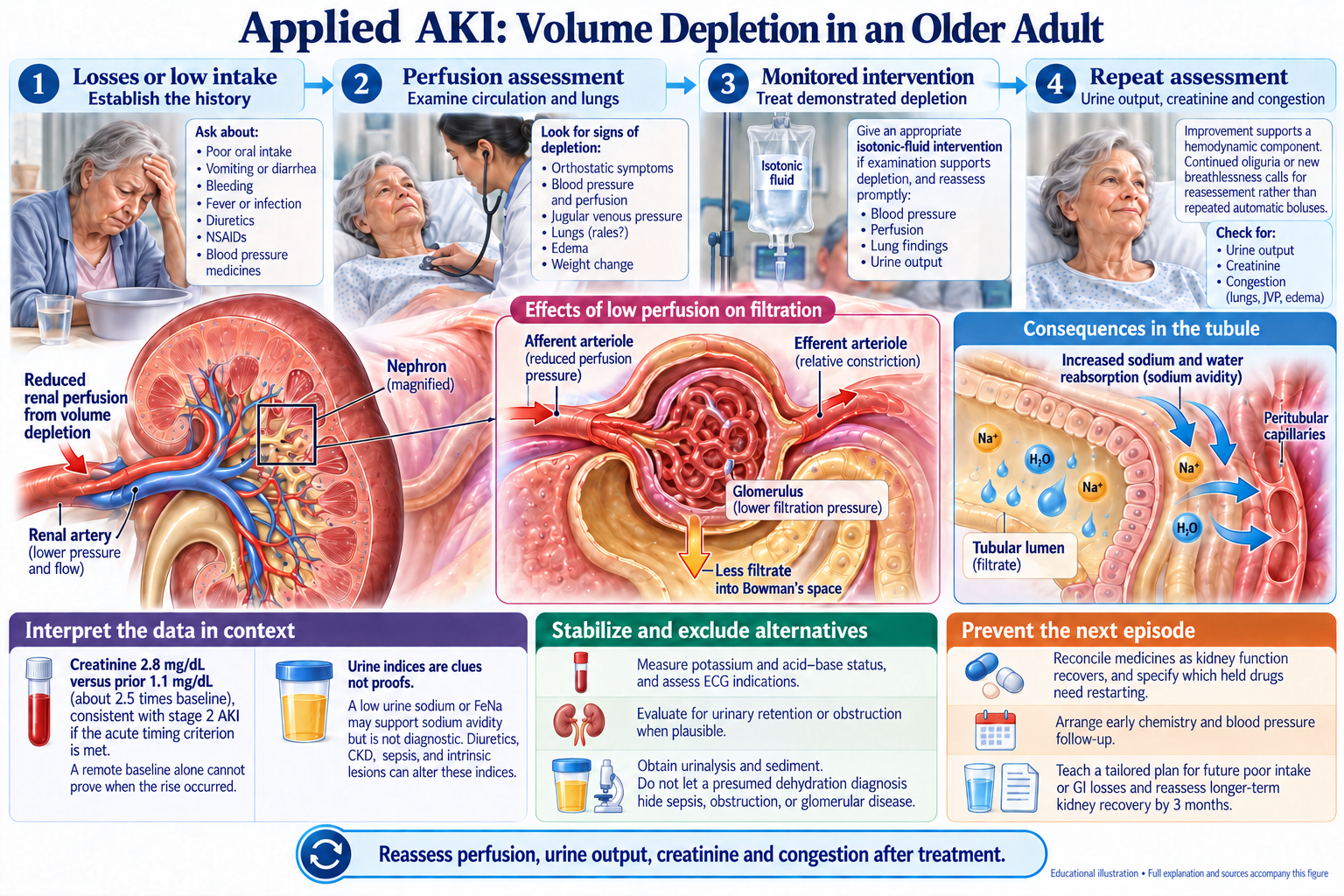
Clinical Reasoning: The combination of volume depletion (diarrhea, poor intake), ACE inhibitor use, and high-dose NSAIDs creates a classic setup for prerenal AKI. The timeline and clinical context strongly support this diagnosis.
📚 Learn More: AKI Overview & Classification
Which medication poses the HIGHEST nephrotoxic risk in this clinical scenario?
Learning Point: While ACE inhibitors contribute to risk, NSAIDs are the primary culprit in volume-depleted states. NSAIDs block prostaglandin E2, which is essential for afferent arteriolar dilation when volume depleted.
📚 Reference: NSAID-Induced AKI
Physical Examination
Vital Signs
- Blood Pressure: 95/60 mmHg (baseline 145/85)
- Heart Rate: 110 bpm
- Temperature: 37.8°C (100.0°F)
- Weight: 62 kg (down 4 kg from baseline)
Physical Findings
- General: Appears tired, mild confusion
- HEENT: Dry mucous membranes, decreased skin turgor
- Cardiovascular: Tachycardic, no murmurs
- Extremities: No peripheral edema
🩺 Physical Examination Analysis
The blood pressure drop from 145/85 to 95/60 mmHg in this patient most likely indicates:
Clinical Correlation: A 50-point systolic drop from baseline, combined with tachycardia and clinical signs of dehydration, indicates significant volume depletion. This supports the prerenal AKI diagnosis.
📚 Learn More: AKI Overview & Classification
This patient presents with tachycardia (HR 110) and hypotension (BP 95/60). What is the BEST initial fluid choice for resuscitation and why?
Clinical Rationale: Lactated Ringers (LR) is preferred over Normal Saline for volume resuscitation in AKI. LR contains 109 mEq/L chloride vs 154 mEq/L in NS. High chloride loads from NS can cause hyperchloremic metabolic acidosis and may worsen kidney function through afferent arteriolar vasoconstriction. Multiple studies suggest LR is less nephrotoxic than NS in critically ill patients.
Other options: Half-normal saline is hypotonic and inappropriate for hemodynamic instability. D5NS with KCl is contraindicated with hyperkalemia (K+ 5.2 mEq/L). Oral salt pills are inappropriate for acute hypotension.
📚 Learn More: AKI Management & Fluid Resuscitation
Laboratory Data
Initial Laboratory Values
| Parameter | Value | Normal Range | Clinical Significance |
|---|---|---|---|
| Serum Creatinine | 2.8 mg/dL | 0.6-1.2 mg/dL | Baseline 1.1 mg/dL (3 months ago) |
| BUN | 84 mg/dL | 8-20 mg/dL | BUN:Cr ratio = 30 (suggestive of prerenal) |
| Sodium | 148 mEq/L | 136-145 mEq/L | Hypernatremia from volume depletion |
| Potassium | 5.2 mEq/L | 3.5-5.0 mEq/L | Mild hyperkalemia from decreased GFR |
| Chloride | 118 mEq/L | 98-107 mEq/L | Hypochloremia from diarrheal losses |
| CO2 | 18 mEq/L | 22-28 mEq/L | Metabolic acidosis from diarrhea |
📊 Laboratory Analysis Questions
Calculate the KDIGO AKI stage for this patient:
Baseline creatinine: 1.1 mg/dL, Current creatinine: 2.8 mg/dL
Calculation: 2.8 ÷ 1.1 = 2.5× baseline creatinine increase. This meets criteria for Stage 2 AKI (2.0-2.9× baseline).
📚 Reference: Interactive KDIGO Calculator
The BUN:Creatinine ratio of 30:1 in this patient is elevated. Which factors can cause an elevated BUN:Cr ratio independent of prerenal azotemia?
Clinical Pearl: While BUN:Cr >20:1 suggests prerenal azotemia, multiple other factors can elevate this ratio:
• GI bleeding: Blood proteins are digested → increased urea production
• High protein intake: Increased amino acid metabolism → more urea
• Corticosteroids: Enhance protein catabolism and urea synthesis
• Tissue catabolism: Fever, infection, trauma, burns increase protein breakdown
• Dehydration: Concentrates BUN more than creatinine
• Tetracyclines: Anti-anabolic effects increase BUN
Key Teaching: Always interpret BUN:Cr ratio in clinical context. In this case, the combination of volume depletion history + elevated ratio supports prerenal azotemia, but other causes must be considered in different clinical scenarios.
📚 Learn More: Creatinine & GFR Interpretation
The combination of hypernatremia (148 mEq/L) and hypochloremia (118 mEq/L) in this patient indicates:
Learning Point: Diarrheal fluid has lower sodium and higher chloride than plasma. Loss of hypotonic fluid leads to hypernatremia, while chloride losses exceed sodium losses, causing hypochloremia.
📚 Reference: Sodium Disorders Module
Urinalysis Results
Dipstick Results
- Specific Gravity: 1.030 (high)
- Protein: Trace
- Blood: Negative
- Leukocyte Esterase: Negative
- Nitrites: Negative
Microscopy
- RBCs: 0-2/hpf
- WBCs: 0-5/hpf
- Casts: Occasional hyaline casts
- Crystals: None
- Bacteria: None
🔬 Urinalysis Interpretation Questions
The finding of "occasional hyaline casts" in this patient's urine microscopy is:
Learning Point: Hyaline casts are composed of Tamm-Horsfall protein and can be normal or seen in prerenal states. They distinguish from muddy brown granular casts seen in ATN.
📚 Reference: Microscopic Examination
The specific gravity of 1.030 in this urinalysis indicates:
Learning Point: High specific gravity (>1.020) indicates intact concentrating ability, supporting prerenal AKI. In ATN, specific gravity is typically around 1.010-1.012 (isosthenuria).
📚 Learn More: Urinalysis Dipstick Interpretation
Interactive Diagnostic Timeline
Work through the diagnostic process step-by-step by clicking on each time point
🚨 Emergency Department Arrival (Time 0)
Patient presents confused, hypotensive, and tachycardic. What are your immediate priorities?
Immediate Priorities:
- ABC Assessment: Ensure airway, breathing, circulation
- IV access: Large bore IV for fluid resuscitation
- STAT labs: BMP, CBC, urinalysis with microscopy
- ECG: Check for hyperkalemia (K+ 5.2 mEq/L)
- Bladder scan: Rule out urinary retention/obstruction
Clinical Pearl: In elderly patients with AKI, always check for obstruction first - it's the most rapidly reversible cause.
📊 Laboratory Results Available (Time 30 minutes)
Labs show creatinine 2.8 mg/dL (baseline 1.1), BUN 84, K+ 5.2. What's your next step?
Next Steps Based on Labs:
- Confirm AKI: 2.5× baseline increase = Stage 2 AKI
- Assess prerenal pattern: BUN:Cr ratio 30:1 suggests prerenal
- Monitor K+: 5.2 mEq/L - recheck in 4-6 hours, avoid potassium
- Order fresh urinalysis: Essential for differentiation
- Calculate FENa: Will help confirm prerenal vs intrinsic
⚠️ Key Learning: Don't just look at creatinine - the pattern of abnormalities tells the story!
🔬 Fresh Urinalysis Results (Time 60 minutes)
Urinalysis shows specific gravity 1.030, occasional hyaline casts, no muddy brown casts. What does this tell you?
Urinalysis Interpretation:
- Specific gravity 1.030: Intact concentrating ability → supports prerenal
- Hyaline casts only: Normal finding in prerenal states
- Absence of muddy brown casts: Does not exclude acute tubular injury; consider timing, specimen quality, and the clinical course
- No RBC casts: Does not exclude glomerulonephritis; assess hematuria, proteinuria, kidney-function trend, and systemic features
- No WBC casts: Does not exclude acute interstitial nephritis; review medication exposure and other causes of AKI
Conclusion: Urinalysis strongly supports prerenal AKI diagnosis.
📚 Reference: Urinalysis Interpretation Guide
💉 FENa Calculation (Time 90 minutes)
Additional urine studies: Urine Na+ 15 mEq/L, Urine Cr 45 mg/dL. Calculate and interpret FENa.
FENa Calculation:
Formula: FENa = (UNa × SCr) / (SNa × UCr) × 100
Calculation: (15 × 2.8) / (148 × 45) × 100 = 42/6660 × 100 = 0.6%
Interpretation:
- FENa <1%: Suggests prerenal AKI
- FENa >2%: Suggests intrinsic AKI (ATN)
- FENa 1-2%: Intermediate/indeterminate
⚠️ Important Caveat: FENa can be <1% in some cases of ATN (contrast, sepsis, burns). Clinical context is crucial!
📚 Interactive Tool: FENa Calculator with Clinical Caveats
Treatment Decision Making
Given the diagnosis of prerenal AKI, what is the MOST important initial treatment intervention?
Treatment Rationale: Prerenal AKI responds to volume repletion. In elderly patients, start with 250-500mL boluses with frequent reassessment to avoid volume overload.
📚 Learn More: AKI Management & Volume Resuscitation
Which medications should be immediately discontinued in this patient?
Comprehensive Medication Management in AKI:
• Lisinopril (ACE inhibitor): Hold - impairs efferent arteriolar autoregulation, can worsen GFR in volume-depleted states
• Ibuprofen (NSAID): Hold - blocks prostaglandin-mediated afferent arteriolar dilation, highly nephrotoxic in volume depletion
• Metformin: Hold — per FDA labeling (April 2016 update), metformin is contraindicated when eGFR <30 mL/min/1.73m², with reassessment of risk/benefit when eGFR is 30–45. The older creatinine-based cutoff (Cr >1.5 men / >1.4 women) was officially superseded. In this patient, AKI with rising creatinine 2.8 mg/dL means metformin must be held until renal function recovers and eGFR is reassessed.
Key Teaching: In AKI, comprehensive medication review is essential. All potentially nephrotoxic medications should be held, and renally eliminated drugs need dose adjustment. Metformin accumulation with decreased clearance can cause fatal lactic acidosis.
📚 Reference: Complete AKI Drug Management Guide
What is the target urine output for this 62 kg patient during initial resuscitation?
Calculation: Target urine output = 0.5 mL/kg/hr × 62 kg = 31 mL/hr minimum. This is the threshold below which oliguria is defined in AKI staging.
📚 Learn More: KDIGO AKI Staging Criteria
Clinical Course & Teaching Points
Hospital Day 1-6 Summary:
- Day 1-2: Total 2.5L normal saline over 24 hours, nephrotoxins discontinued
- Day 2: Creatinine peaked at 3.1 mg/dL, urine output improved to 1.2 mL/kg/hr
- Day 3-5: Progressive improvement, mental status cleared
- Day 6 Discharge: Creatinine 1.4 mg/dL (approaching baseline)
🎯 Final Assessment Questions
The fact that creatinine continued to rise to 3.1 mg/dL on Day 2 despite adequate resuscitation indicates:
Learning Point: Creatinine may continue to rise for 24-48 hours after adequate resuscitation in prerenal AKI due to the time needed for improved GFR to reflect in serum creatinine levels. Monitor urine output as an earlier indicator of response.
📚 Learn More: Creatinine Kinetics & GFR
When should ACE inhibitor therapy be resumed in this patient?
Management Strategy: Resume ACE inhibitor gradually once volume status is stable and kidney function has recovered. Start at low dose with close monitoring. The drug isn't permanently contraindicated but requires careful management.
📚 Learn More: AKI Recovery & Medication Resumption
What is the most important long-term prevention strategy for this patient?
Prevention Focus: Education is key - avoid NSAIDs permanently, hold ACE inhibitors during illnesses with poor oral intake, maintain adequate hydration during GI illnesses, and seek early medical attention for concerning symptoms.
📚 Learn More: NSAID-Induced AKI Prevention
Learning Objectives Assessment
Evaluate your mastery of the key learning objectives from this case
🎯 Learning Objective 1: KDIGO AKI Staging
Objective: Apply KDIGO criteria to stage AKI severity and determine appropriate monitoring and management strategies.
A 70-year-old man has baseline creatinine 1.5 mg/dL. Today his creatinine is 4.8 mg/dL. What KDIGO stage and immediate actions are indicated?
Rationale: 4.8 ÷ 1.5 = 3.2× baseline = Stage 3 AKI. Also, creatinine ≥4.0 mg/dL automatically qualifies as Stage 3. This requires urgent nephrology consultation and RRT readiness.
📚 Master This: KDIGO Interactive Calculator
🎯 Learning Objective 2: Prerenal vs Intrinsic AKI Differentiation
Objective: Use clinical presentation, laboratory findings, and urinalysis to distinguish prerenal from intrinsic AKI.
Which combination of findings MOST strongly suggests intrinsic AKI rather than prerenal?
Key Teaching: Muddy brown granular casts strongly support acute tubular injury in this clinical setting. FENa and BUN:creatinine ratio are supporting clues whose interpretation depends on medications, CKD, and perfusion; neither independently proves the mechanism.
📚 Master This: Urinalysis Interpretation Guide
🎯 Learning Objective 3: Drug-Induced AKI Prevention
Objective: Identify high-risk medication combinations and implement prevention strategies to reduce AKI risk.
An 75-year-old woman with CKD (eGFR 45) is prescribed vancomycin and piperacillin-tazobactam for pneumonia. What is the estimated AKI risk and best prevention strategy?
High-Risk Combination: Vancomycin + piperacillin-tazobactam has 25-40% AKI risk, especially in elderly with CKD. Consider vancomycin + cefepime or AUC-guided vancomycin dosing with extended-infusion piperacillin-tazobactam.
📚 Master This: Drug Nephrotoxicity Calculator
Integration Challenge: Cross-Module Synthesis
These advanced questions require synthesis across multiple knowledge domains
An 82-year-old woman on lisinopril 20 mg, ibuprofen 400 mg TID for osteoarthritis, and hydrochlorothiazide 25 mg presents with 3 days of diarrhea. Her creatinine is 4.2 mg/dL (baseline 1.1), BUN 68, K+ 5.9 mEq/L, and BP 88/54. Integrating AKI pathophysiology, pharmacology, and electrolyte management — what is the correct sequence of initial interventions?
Integration Synthesis: This patient has the classic "triple whammy" (ACE-I + NSAID + volume depletion from diarrhea + diuretic — Lapi BMJ 2013, PMID 23299844). The integration requires: (1) stopping all nephrotoxic agents immediately — the NSAID blocks prostaglandin-mediated afferent arteriolar dilation, the ACE-I blocks efferent arteriolar constriction, and HCTZ worsens volume depletion; (2) volume resuscitation as the primary intervention to restore renal perfusion; (3) addressing hyperkalemia. Calcium gluconate is reserved for ECG changes (peaked T waves, widened QRS, loss of P waves) or K+ >6.5 mEq/L per AHA 2020 hyperkalemia consensus — at K+ 5.9 with no ECG changes, treatment is insulin/D50 (intracellular shift) ± a binder (patiromer, Na-zirconium) ± loop diuretic if euvolemic; calcium is added only if ECG changes develop or K+ rises above approximately 6.5. Furosemide would worsen volume depletion in this prerenal patient. Dialysis is premature — most prerenal AKI recovers with intervention. [Note added 2026-05-03 — option C as written includes "calcium gluconate" up-front; the more nuanced AHA-aligned approach is to defer calcium gluconate unless ECG changes appear or K+ rises further.]
📚 Integrate: AKI Module + NSAID Nephrotoxicity + Hyperkalemia Management
After 48 hours of fluid resuscitation, the patient's creatinine improves to 2.8 mg/dL but has not returned to baseline. Her urine microscopy now shows muddy brown granular casts that were not present on admission. What does this finding change about the diagnosis, and how should you adjust the management plan?
Integration Synthesis: This question synthesizes urinalysis interpretation with AKI pathophysiology and pharmacology. Muddy brown granular casts are the hallmark of ATN — indicating that prolonged prerenal ischemia caused structural tubular damage. The initial presentation was prerenal (hyaline casts), but delayed treatment or severity allowed progression to intrinsic AKI. Management shifts from "restore perfusion and recover" to "support through tubular regeneration" — which takes days to weeks. All renally-cleared medications must be dose-adjusted. RBCs/dysmorphic RBCs would suggest glomerulonephritis; WBC casts would suggest AIN.
📚 Integrate: Urine Microscopy + AKI Staging and Prognosis + Creatinine and GFR
Before discharge, you design a "sick day" medication management plan for this patient. Which combination of instructions best integrates AKI prevention, pharmacology, and patient education principles?
Integration Synthesis: This question operates at the Create level — designing a prevention strategy that integrates pharmacology (which drugs reduce GFR during volume depletion), pathophysiology (why volume depletion + nephrotoxins = AKI), and patient education (actionable instructions patients can follow). The "sick day" concept is an evidence-based AKI prevention strategy increasingly adopted by KDIGO guidelines. It requires the student to synthesize knowledge from the drug, the kidney, and the patient into a practical tool.
📚 Integrate: Drug-Induced AKI + CKD Prevention
Case Reflection & Multi-Module Integration
🚨 AKI Module Integration
- KDIGO staging application in real patient
- Emergency recognition protocols
- Systematic diagnostic approach
- Prerenal AKI pathophysiology
- Furosemide stress test principles
🔬 Urinalysis Module Integration
- Microscopy prioritization over dipstick
- Fresh specimen importance (<2 hours)
- FENa calculation and limitations
- Hyaline vs granular cast differentiation
- Clinical context integration
💊 Drug Nephrotoxicity Integration
- NSAID mechanism in volume depletion
- ACE inhibitor effects on autoregulation
- "Triple threat" concept application
- Risk stratification tools
- Prevention strategies implementation
⚡ Electrolyte Module Integration
- Volume depletion assessment
- Hypernatremia from hypotonic losses
- Hypochloremia from diarrhea
- Metabolic acidosis evaluation
- Potassium monitoring in AKI
🎯 Key Integration Concepts
This case demonstrates how nephrology knowledge integrates across multiple domains. The systematic approach to AKI requires understanding kidney physiology, pharmacology, fluid and electrolyte balance, and laboratory interpretation. Real clinical excellence comes from synthesizing these different knowledge areas into coherent diagnostic and treatment strategies.
💡 Clinical Integration
How different body systems interact during illness and how medications can disrupt normal physiology
🔍 Diagnostic Integration
Using multiple data sources (history, exam, labs, urine) to build a complete clinical picture
🛡️ Prevention Integration
How understanding pathophysiology leads to effective prevention strategies for future episodes
📝 Case Summary & Clinical Pearls
This case exemplifies prerenal AKI in an elderly patient with the perfect storm of volume depletion, ACE inhibitor use, and NSAID nephrotoxicity. The systematic approach using KDIGO staging, laboratory interpretation, and evidence-based fluid resuscitation led to complete recovery.
🔑 Key Clinical Pearls from This Case:
- The "Triple Threat": ACE-I + NSAID + Volume Depletion = High AKI Risk
- Microscopy is King: Fresh urine microscopy differentiates AKI causes better than any other test
- Creatinine Lag: May continue rising 24-48 hours after successful treatment - don't panic!
- Prevention Focus: Patient education about sick day management prevents future episodes
- Cautious Resuscitation: Elderly patients need smaller, more frequent fluid boluses with close monitoring