Visual summary
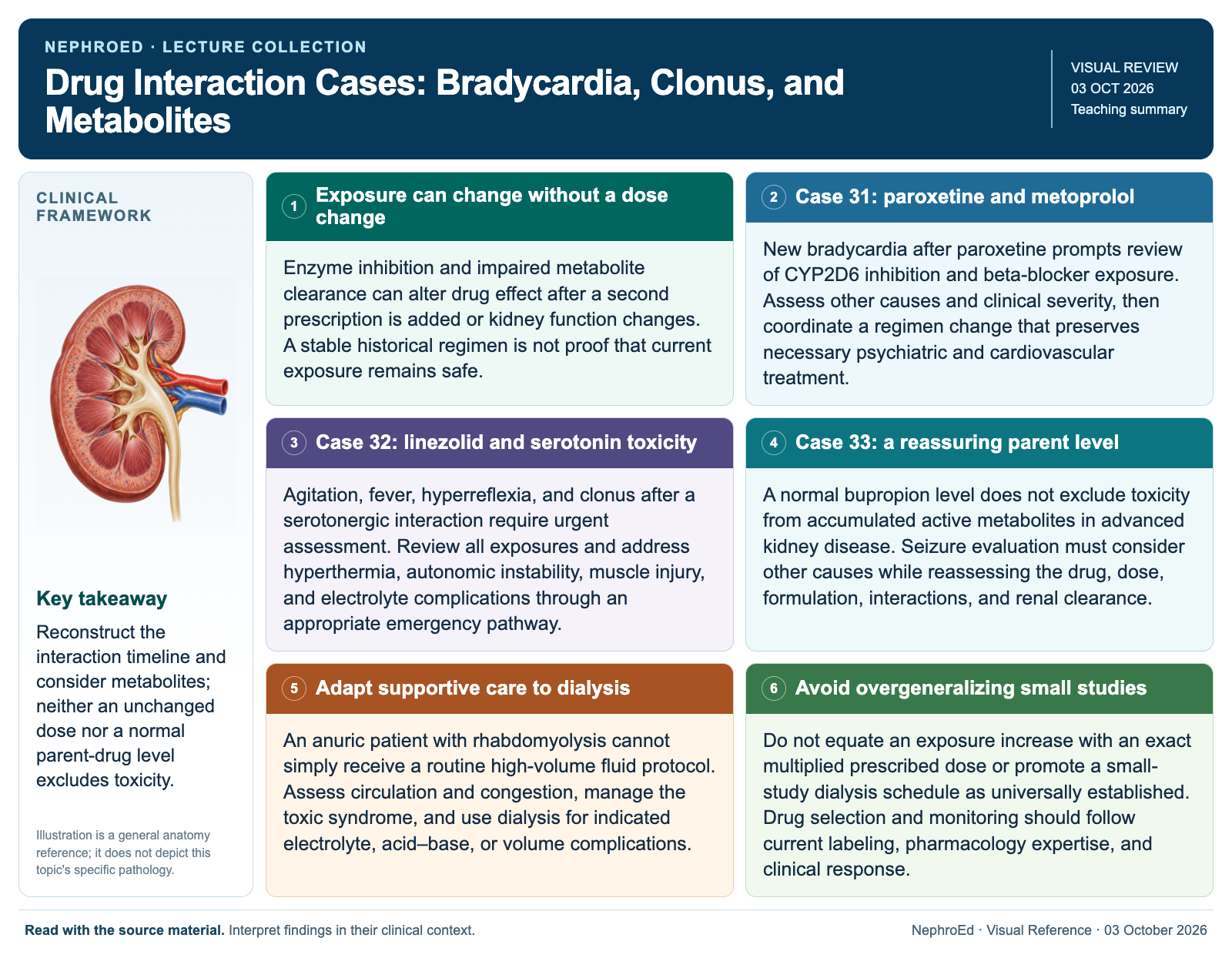
Reconstruct the interaction timeline and consider metabolites; neither an unchanged dose nor a normal parent-drug level excludes toxicity.
Text version
Exposure can change without a dose change
Enzyme inhibition and impaired metabolite clearance can alter drug effect after a second prescription is added or kidney function changes. A stable historical regimen is not proof that current exposure remains safe.
Case 31: paroxetine and metoprolol
New bradycardia after paroxetine prompts review of CYP2D6 inhibition and beta-blocker exposure. Assess other causes and clinical severity, then coordinate a regimen change that preserves necessary psychiatric and cardiovascular treatment.
Case 32: linezolid and serotonin toxicity
Agitation, fever, hyperreflexia, and clonus after a serotonergic interaction require urgent assessment. Review all exposures and address hyperthermia, autonomic instability, muscle injury, and electrolyte complications through an appropriate emergency pathway.
Case 33: a reassuring parent level
A normal bupropion level does not exclude toxicity from accumulated active metabolites in advanced kidney disease. Seizure evaluation must consider other causes while reassessing the drug, dose, formulation, interactions, and renal clearance.
Adapt supportive care to dialysis
An anuric patient with rhabdomyolysis cannot simply receive a routine high-volume fluid protocol. Assess circulation and congestion, manage the toxic syndrome, and use dialysis for indicated electrolyte, acid–base, or volume complications.
Avoid overgeneralizing small studies
Do not equate an exposure increase with an exact multiplied prescribed dose or promote a small-study dialysis schedule as universally established. Drug selection and monitoring should follow current labeling, pharmacology expertise, and clinical response.
Continue learning
This graphic summarizes a topic. The full educational pages provide the broader discussion and references.