Visual summary
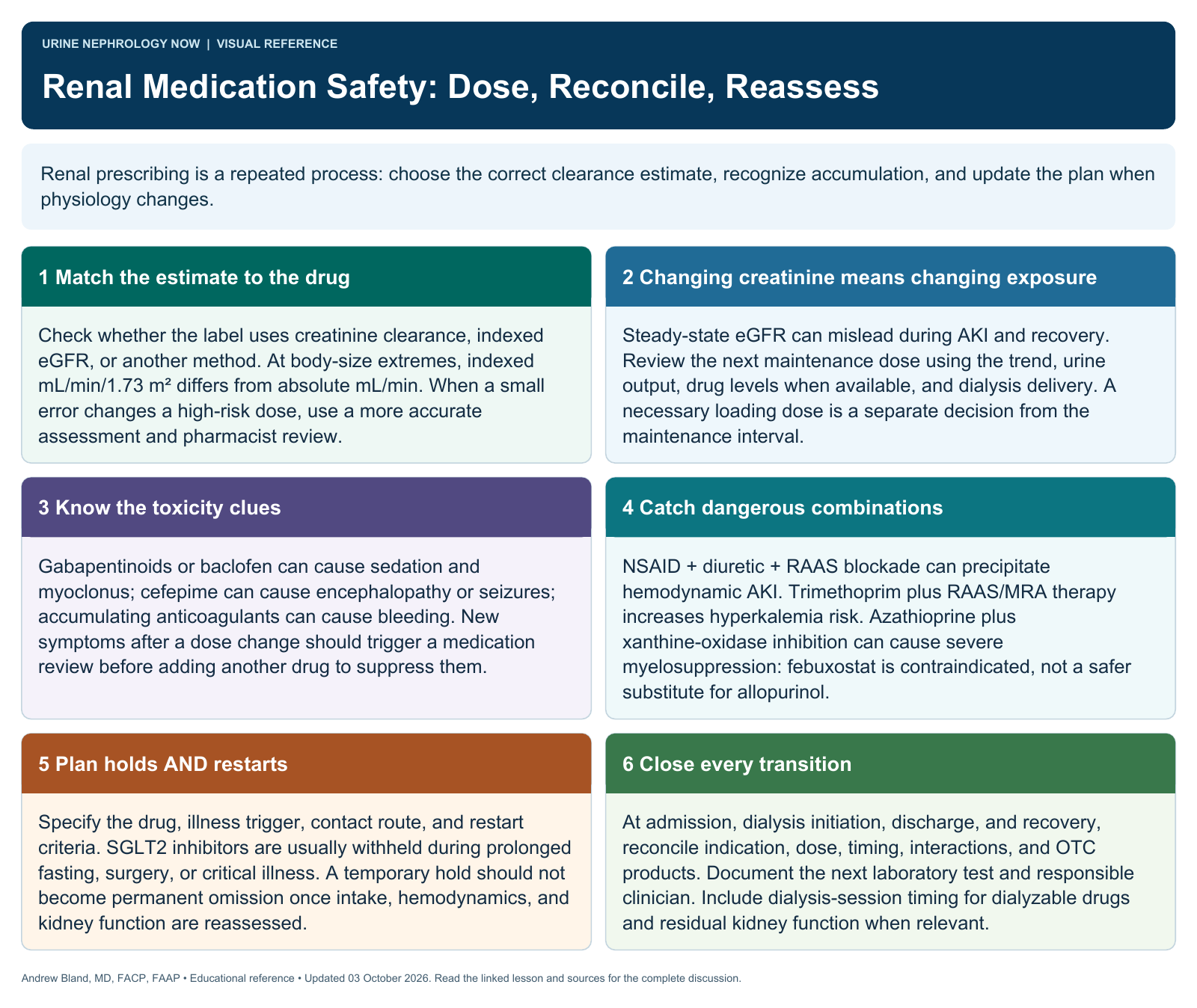
Renal prescribing is a repeated process: choose the correct clearance estimate, recognize accumulation, and update the plan when physiology changes.
Text version
Match the estimate to the drug
Check whether the label uses creatinine clearance, indexed eGFR, or another method. At body-size extremes, indexed mL/min/1.73 m² differs from absolute mL/min. When a small error changes a high-risk dose, use a more accurate assessment and pharmacist review.
Changing creatinine means changing exposure
Steady-state eGFR can mislead during AKI and recovery. Review the next maintenance dose using the trend, urine output, drug levels when available, and dialysis delivery. A necessary loading dose is a separate decision from the maintenance interval.
Know the toxicity clues
Gabapentinoids or baclofen can cause sedation and myoclonus; cefepime can cause encephalopathy or seizures; accumulating anticoagulants can cause bleeding. New symptoms after a dose change should trigger a medication review before adding another drug to suppress them.
Catch dangerous combinations
NSAID + diuretic + RAAS blockade can precipitate hemodynamic AKI. Trimethoprim plus RAAS/MRA therapy increases hyperkalemia risk. Azathioprine plus xanthine-oxidase inhibition can cause severe myelosuppression: febuxostat is contraindicated, not a safer substitute for allopurinol.
Plan holds AND restarts
Specify the drug, illness trigger, contact route, and restart criteria. SGLT2 inhibitors are usually withheld during prolonged fasting, surgery, or critical illness. A temporary hold should not become permanent omission once intake, hemodynamics, and kidney function are reassessed.
Close every transition
At admission, dialysis initiation, discharge, and recovery, reconcile indication, dose, timing, interactions, and OTC products. Document the next laboratory test and responsible clinician. Include dialysis-session timing for dialyzable drugs and residual kidney function when relevant.