Visual summary
Know what the biomarker measures, where it was validated, and which evidence-supported action its result can change.
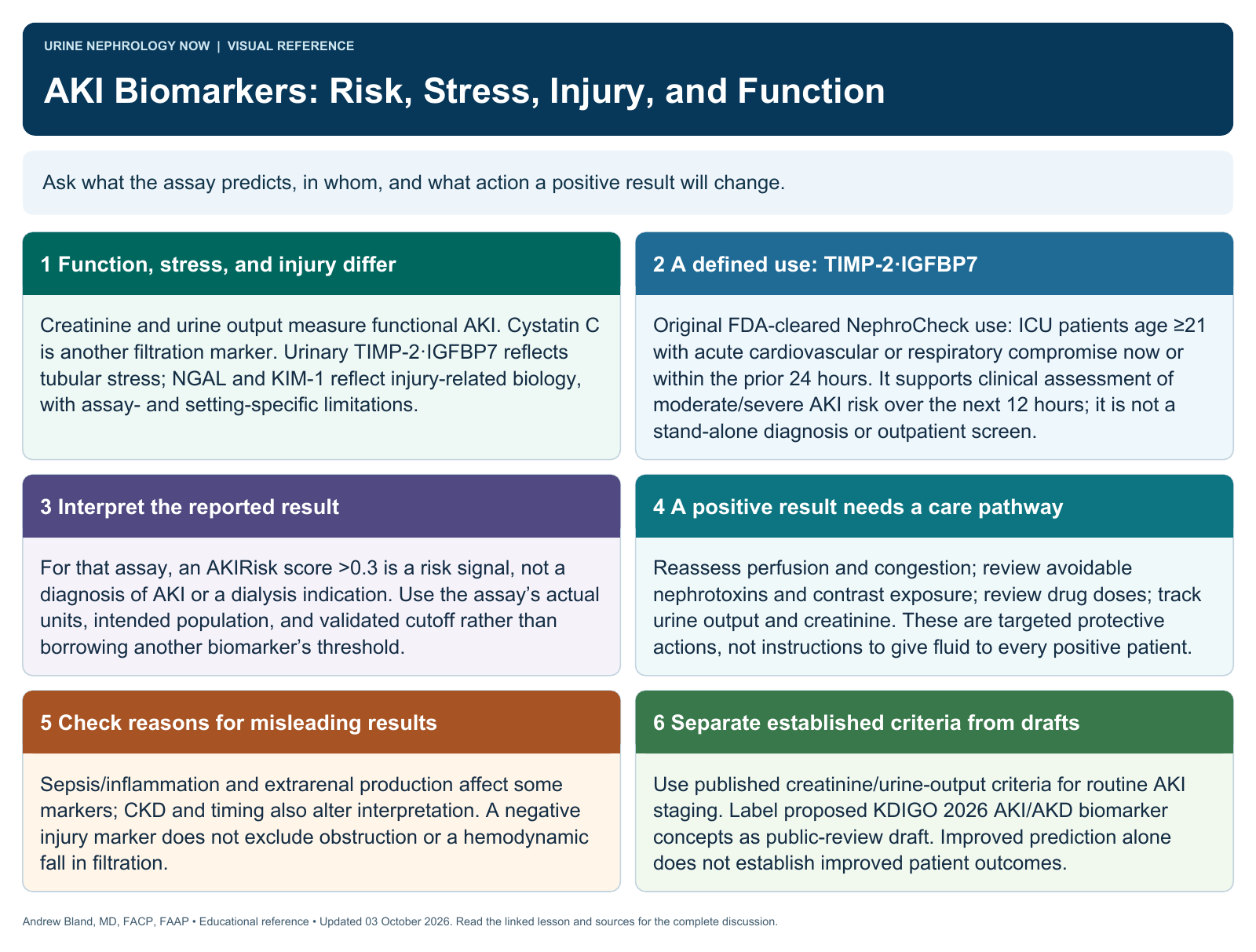
Text version
Markers answer different questions
Creatinine and urine output describe functional change, while selected biomarkers reflect stress or injury pathways. A marker may rise before creatinine, but earlier detection does not automatically mean an effective intervention has been proven.
Recognize context-dependent performance
Critical illness, infection, surgery, CKD, and extrarenal production can influence biomarker results. Test characteristics depend on the clinical setting, sampling time, chosen cutoff, and the outcome being predicted.
Choose a defined clinical use
Ask whether the test estimates future AKI risk, supports injury detection, or helps reassess another uncertainty. Use assays within their validated intended population and integrate results with routine clinical findings.
Act through a care pathway
A high-risk signal can prompt review of hemodynamics, medications, fluid balance, and monitoring where an evidence-supported protocol exists. Do not treat an isolated biomarker as a prescription for dialysis or immunotherapy.
Label the 2026 framework correctly
The KDIGO 2026 AKI/AKD update remains a public-review draft. Proposed biomarker and staging concepts should be labeled as draft and distinguished from established published criteria.
Keep utility separate from accuracy
A test that predicts AKI well may still fail to improve patient outcomes when used clinically. Check implementation trials, available actions, cost, and false-positive consequences before describing routine use as necessary.
Continue learning
This graphic summarizes a topic. The full educational pages provide the broader discussion and references.