Visual summary
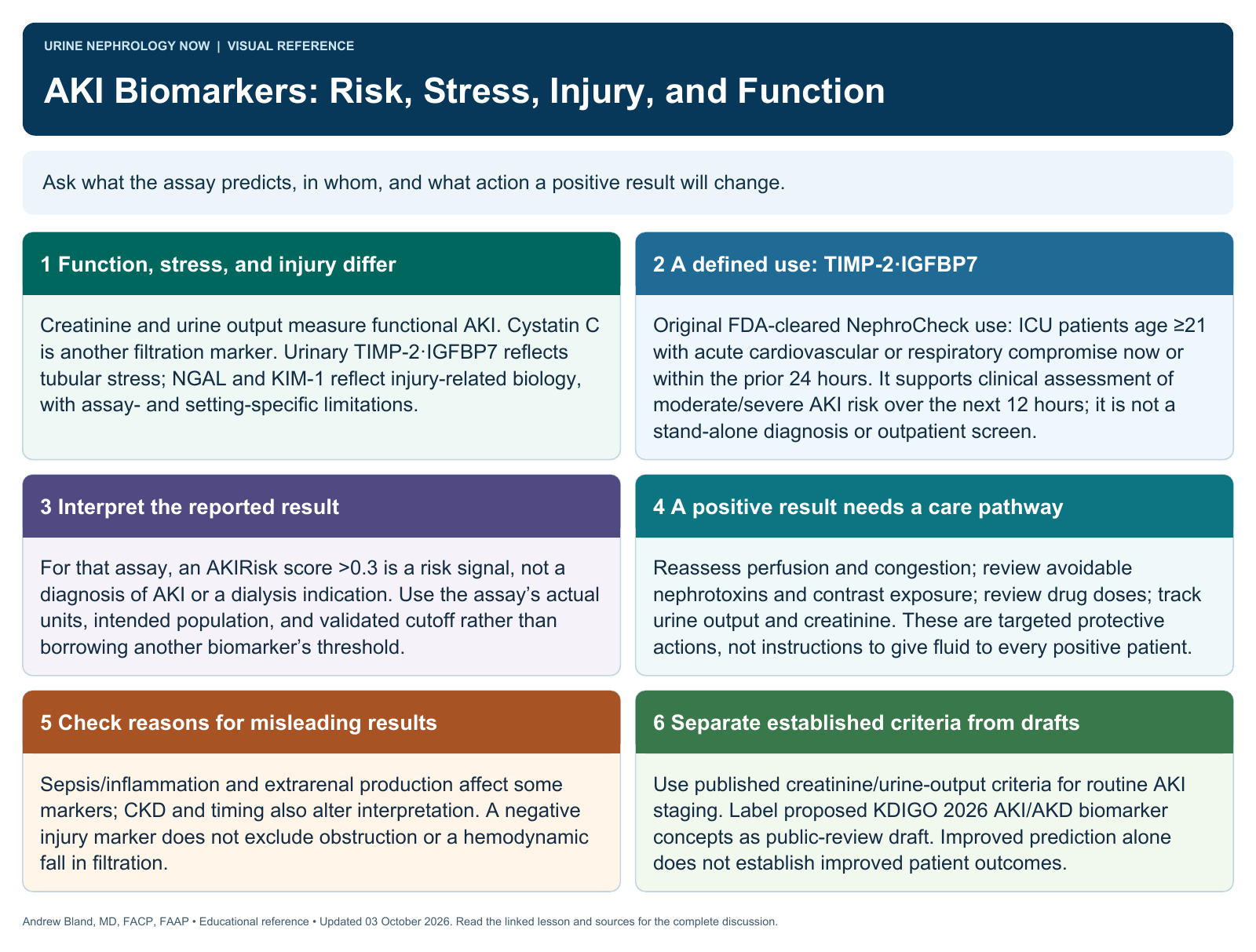
Ask what the assay predicts, in whom, and what action a positive result will change.
Text version
Function, stress, and injury differ
Creatinine and urine output measure functional AKI. Cystatin C is another filtration marker. Urinary TIMP-2·IGFBP7 reflects tubular stress; NGAL and KIM-1 reflect injury-related biology, with assay- and setting-specific limitations.
A defined use: TIMP-2·IGFBP7
Original FDA-cleared NephroCheck use: ICU patients age ≥21 with acute cardiovascular or respiratory compromise now or within the prior 24 hours. It supports clinical assessment of moderate/severe AKI risk over the next 12 hours; it is not a stand-alone diagnosis or outpatient screen.
Interpret the reported result
For that assay, an AKIRisk score >0.3 is a risk signal, not a diagnosis of AKI or a dialysis indication. Use the assay’s actual units, intended population, and validated cutoff rather than borrowing another biomarker’s threshold.
A positive result needs a care pathway
Reassess perfusion and congestion; review avoidable nephrotoxins and contrast exposure; review drug doses; track urine output and creatinine. These are targeted protective actions, not instructions to give fluid to every positive patient.
Check reasons for misleading results
Sepsis/inflammation and extrarenal production affect some markers; CKD and timing also alter interpretation. A negative injury marker does not exclude obstruction or a hemodynamic fall in filtration.
Separate established criteria from drafts
Use published creatinine/urine-output criteria for routine AKI staging. Label proposed KDIGO 2026 AKI/AKD biomarker concepts as public-review draft. Improved prediction alone does not establish improved patient outcomes.