Visual summary
Creatine can complicate creatinine interpretation; evaluate the person and the product before concluding either harm or safety.
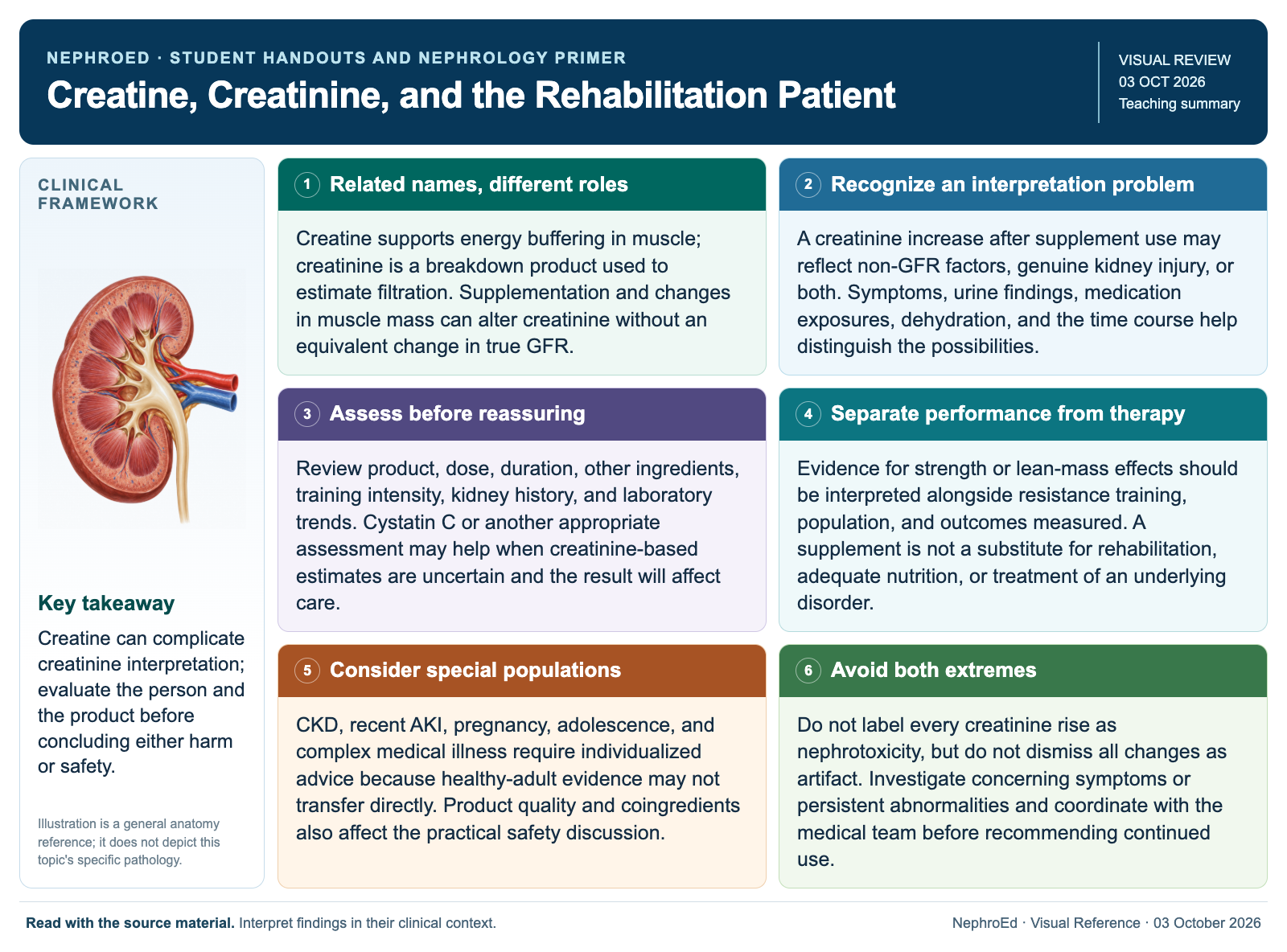
Text version
Related names, different roles
Creatine supports energy buffering in muscle; creatinine is a breakdown product used to estimate filtration. Supplementation and changes in muscle mass can alter creatinine without an equivalent change in true GFR.
Recognize an interpretation problem
A creatinine increase after supplement use may reflect non-GFR factors, genuine kidney injury, or both. Symptoms, urine findings, medication exposures, dehydration, and the time course help distinguish the possibilities.
Assess before reassuring
Review product, dose, duration, other ingredients, training intensity, kidney history, and laboratory trends. Cystatin C or another appropriate assessment may help when creatinine-based estimates are uncertain and the result will affect care.
Separate performance from therapy
Evidence for strength or lean-mass effects should be interpreted alongside resistance training, population, and outcomes measured. A supplement is not a substitute for rehabilitation, adequate nutrition, or treatment of an underlying disorder.
Consider special populations
CKD, recent AKI, pregnancy, adolescence, and complex medical illness require individualized advice because healthy-adult evidence may not transfer directly. Product quality and coingredients also affect the practical safety discussion.
Avoid both extremes
Do not label every creatinine rise as nephrotoxicity, but do not dismiss all changes as artifact. Investigate concerning symptoms or persistent abnormalities and coordinate with the medical team before recommending continued use.
Continue learning
This graphic summarizes a topic. The full educational pages provide the broader discussion and references.