Visual summary
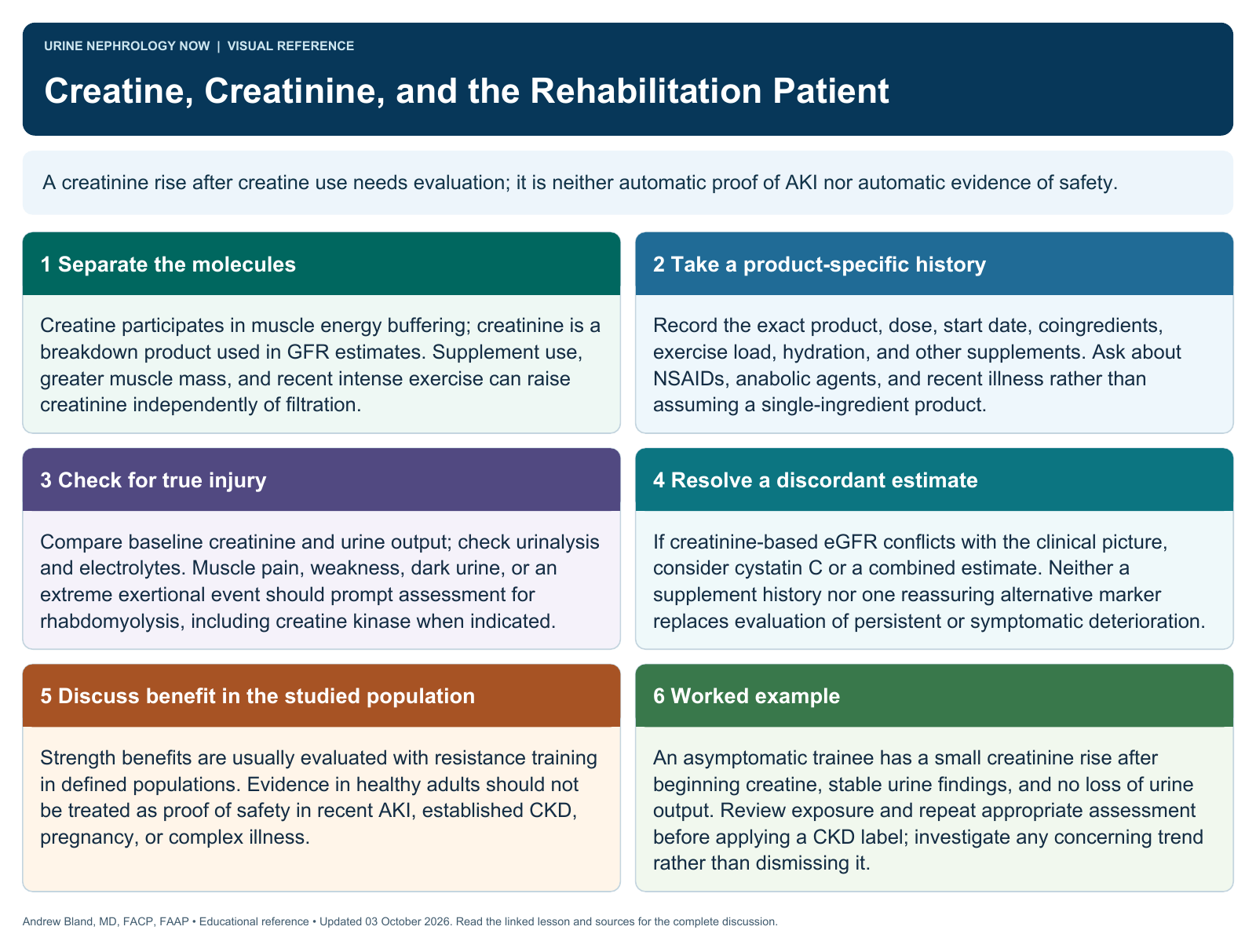
A creatinine rise after creatine use needs evaluation; it is neither automatic proof of AKI nor automatic evidence of safety.
Text version
Separate the molecules
Creatine participates in muscle energy buffering; creatinine is a breakdown product used in GFR estimates. Supplement use, greater muscle mass, and recent intense exercise can raise creatinine independently of filtration.
Take a product-specific history
Record the exact product, dose, start date, coingredients, exercise load, hydration, and other supplements. Ask about NSAIDs, anabolic agents, and recent illness rather than assuming a single-ingredient product.
Check for true injury
Compare baseline creatinine and urine output; check urinalysis and electrolytes. Muscle pain, weakness, dark urine, or an extreme exertional event should prompt assessment for rhabdomyolysis, including creatine kinase when indicated.
Resolve a discordant estimate
If creatinine-based eGFR conflicts with the clinical picture, consider cystatin C or a combined estimate. Neither a supplement history nor one reassuring alternative marker replaces evaluation of persistent or symptomatic deterioration.
Discuss benefit in the studied population
Strength benefits are usually evaluated with resistance training in defined populations. Evidence in healthy adults should not be treated as proof of safety in recent AKI, established CKD, pregnancy, or complex illness.
Worked example
An asymptomatic trainee has a small creatinine rise after beginning creatine, stable urine findings, and no loss of urine output. Review exposure and repeat appropriate assessment before applying a CKD label; investigate any concerning trend rather than dismissing it.