Visual summary
Confirm genuine recurrent infection, select an evidence-supported strategy, and judge success by the patient’s actual symptomatic course.
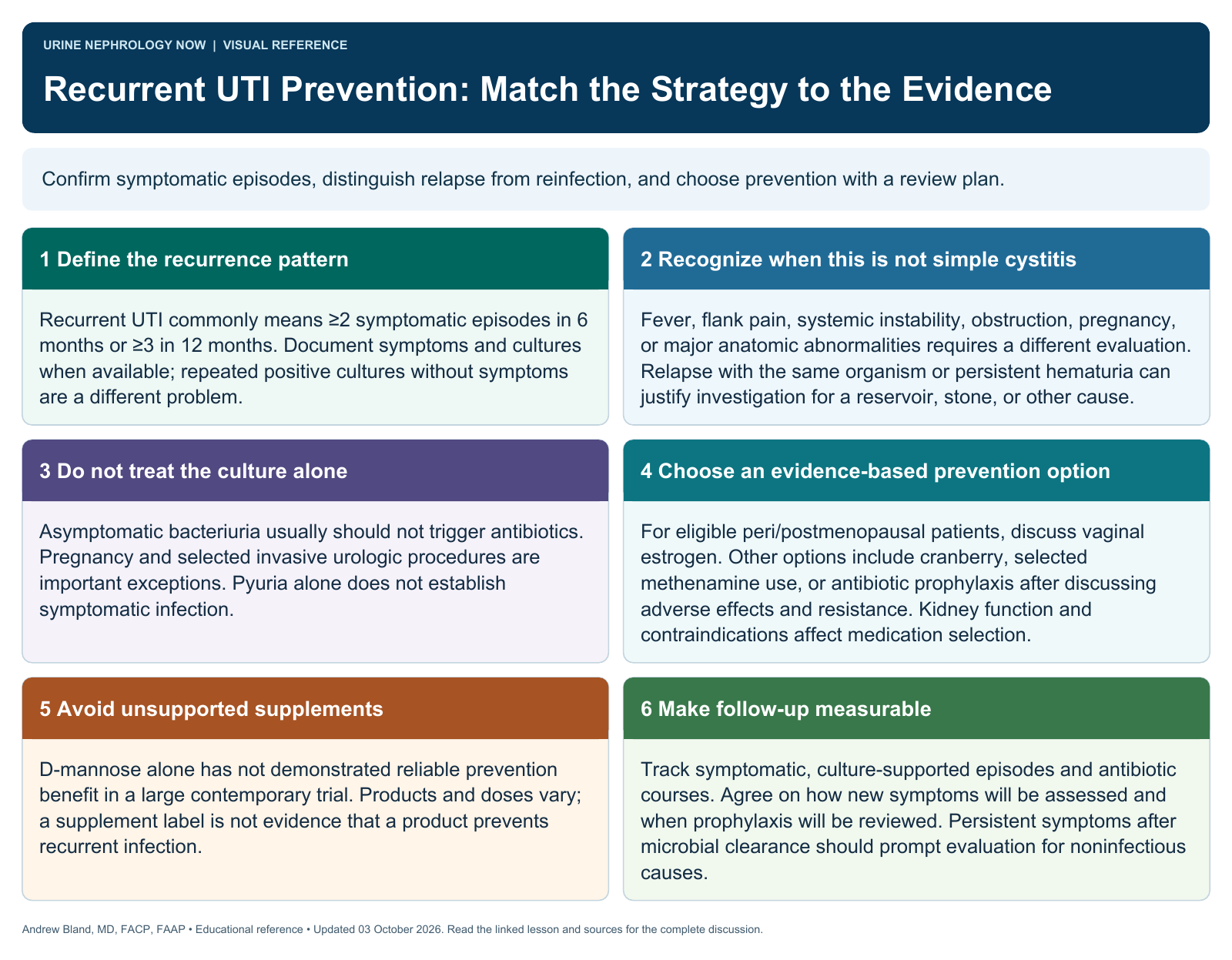
Text version
Recurrence has different explanations
Repeated urinary symptoms may represent new infection, persistence, contamination, or a noninfectious condition. Confirming the diagnosis is essential before committing a patient to long-term preventive medication.
Recognize a different syndrome
Fever, flank pain, systemic illness, obstruction, pregnancy, or complex anatomy can change the evaluation and treatment pathway. Prevention advice for uncomplicated recurrent cystitis does not automatically fit these settings.
Review the pattern
Document symptoms, culture results when appropriate, antibiotic response, sexual or hormonal associations, devices, and prior imaging. Distinguish recurrent symptomatic infection from asymptomatic bacteriuria, which usually should not be treated.
Choose prevention collaboratively
Options may include selected behavioral measures, vaginal estrogen when appropriate, and antibiotic or non-antibiotic strategies supported for the patient’s circumstances. Discuss benefits, adverse effects, resistance, cost, and preferences.
Read supplement claims critically
Cranberry products vary, and study findings do not establish that every formulation works equally. Recent evidence does not support automatically recommending D-mannose as an effective preventive treatment for all women.
Reassess rather than renew indefinitely
Track symptomatic episodes and treatment burden. Persistent relapse, hematuria, suspected stones or obstruction, or other atypical features may require further investigation. A preventive regimen should have an explicit review date and responsible clinician.
Continue learning
This graphic summarizes a topic. The full educational pages provide the broader discussion and references.