Visual summary
Safe prescribing follows the patient’s changing physiology and includes an explicit plan for monitoring and medication transitions.
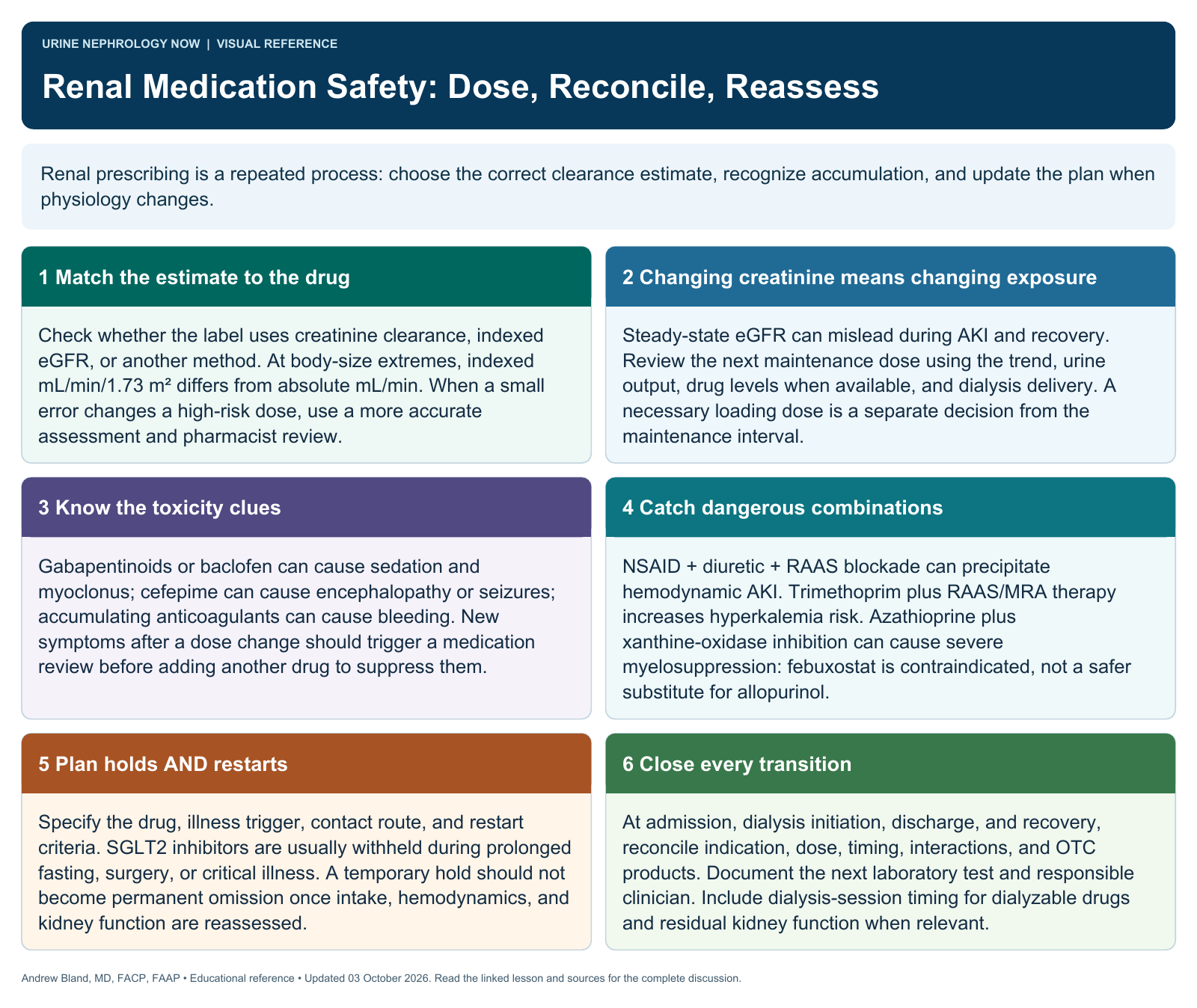
Text version
Kidney function changes exposure
Reduced renal clearance can increase parent-drug or metabolite exposure. Protein binding, volume of distribution, dialysis removal, and nonrenal clearance also matter, so renal dosing is more than reading one eGFR number.
Recognize high-risk transitions
AKI, hospital discharge, dialysis initiation, recovery, and dehydrating illness can make a previously reasonable prescription unsafe. Sedation, confusion, arrhythmia, bleeding, or seizures may represent medication toxicity rather than worsening kidney disease alone.
Choose the right estimate
Use the kidney function method appropriate to the drug’s evidence or label. Standard eGFR assumes relative stability; during AKI, integrate trajectory, clinical condition, drug monitoring, and pharmacist input rather than trusting a static estimate.
Reconcile the full regimen
Confirm indication, dose, timing, duplication, interactions, over-the-counter products, and patient understanding. Coordinate antimicrobial monitoring, avoid preventable nephrotoxic combinations, and reassess unnecessary long-term medications rather than continuing them automatically.
Make illness plans explicit
An individualized temporary-hold plan should state the illness triggers, contact route, and restart criteria. Distinguish medication-specific risks, and ensure that beneficial treatment is reviewed promptly when eating, drinking, and kidney function recover.
Do not forget metabolites
A normal parent-drug concentration does not exclude toxicity from active metabolites. Dialysis may remove some compounds poorly. Escalate unexplained neurologic or cardiovascular deterioration and check the pharmacology before adding symptomatic treatment.
Self-check: A drug dose was appropriate last month. Which changes in kidney function, dialysis, intake, or interacting medicines could make it unsafe today?
Continue learning
This graphic summarizes a topic. The full educational pages provide the broader discussion and references.