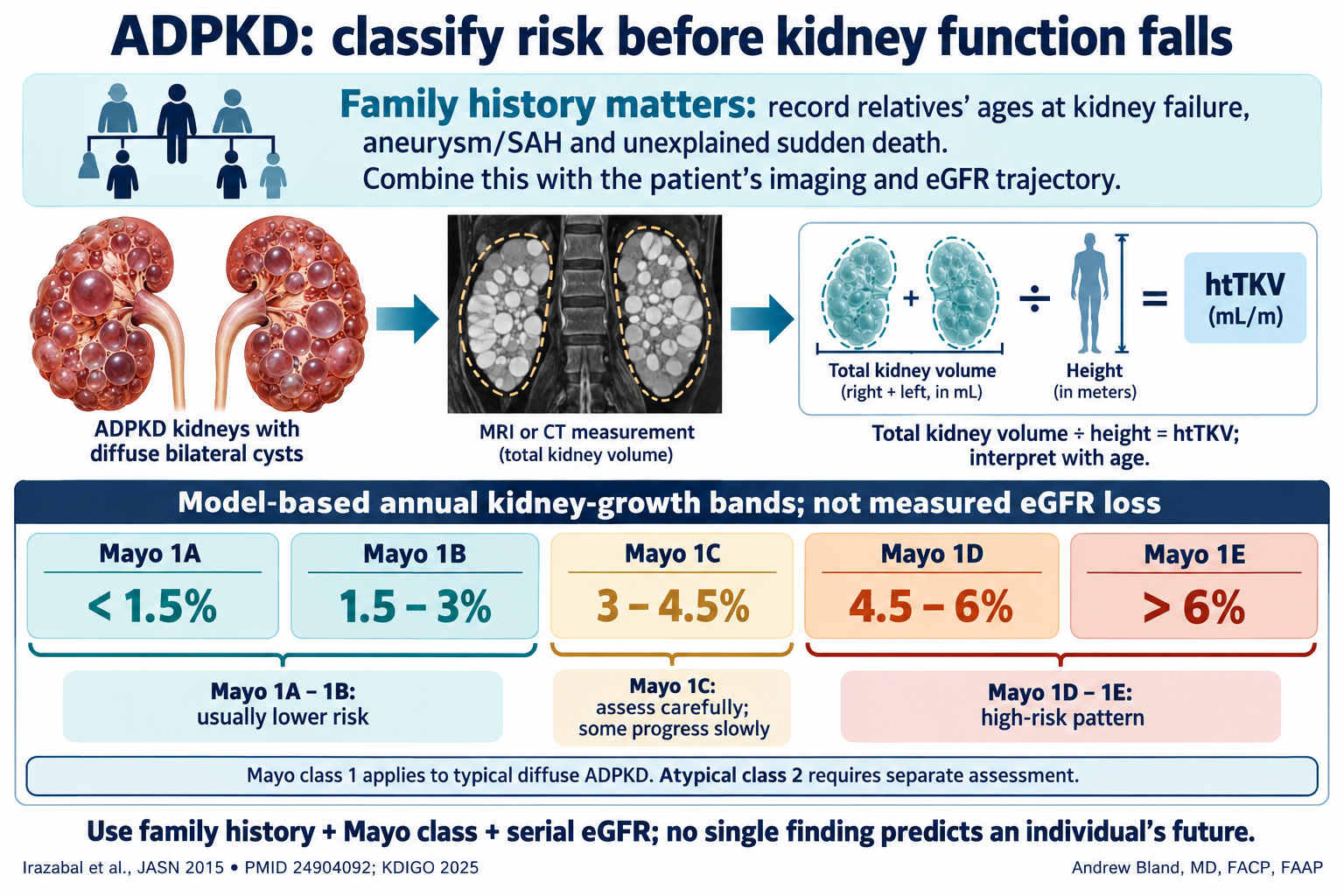
Mayo classification, Irazabal et al. — PubMed · KDIGO 2025 ADPKD, corrected April 2026
Read diagram text and evidence
Record relatives’ ages at kidney failure, including early KRT, and family aneurysm, subarachnoid hemorrhage or unexplained sudden death. Family history is important but does not determine an individual outcome. In typical diffuse ADPKD, MRI/CT total kidney volume divided by height gives htTKV, interpreted with age. Mayo classes 1A–1E correspond to model-based annual growth bands: <1.5%, 1.5–3%, 3–4.5%, 4.5–6%, and >6%. These are not measured eGFR-loss percentages. Class 1C includes some slower progressors; use additional evidence. Atypical class 2 requires separate assessment. The pictured scan is an illustration, not the patient’s MRI or a diagnostic example. No Mayo class can be assigned from kidney length alone.
Andrew Bland, MD, FACP, FAAP