FENa diagnostic review, 2022 — PubMed · Varghese et al., muddy brown casts with low FENa — PubMed · Perazella et al., urine microscopy — PubMed · Corwin et al., pigment AKI with low FENa — PubMed · Zarich et al., FENa exceptions — PubMed · Cox et al., loop diuretics alter FEUrea — PubMed
Read diagram text and evidence
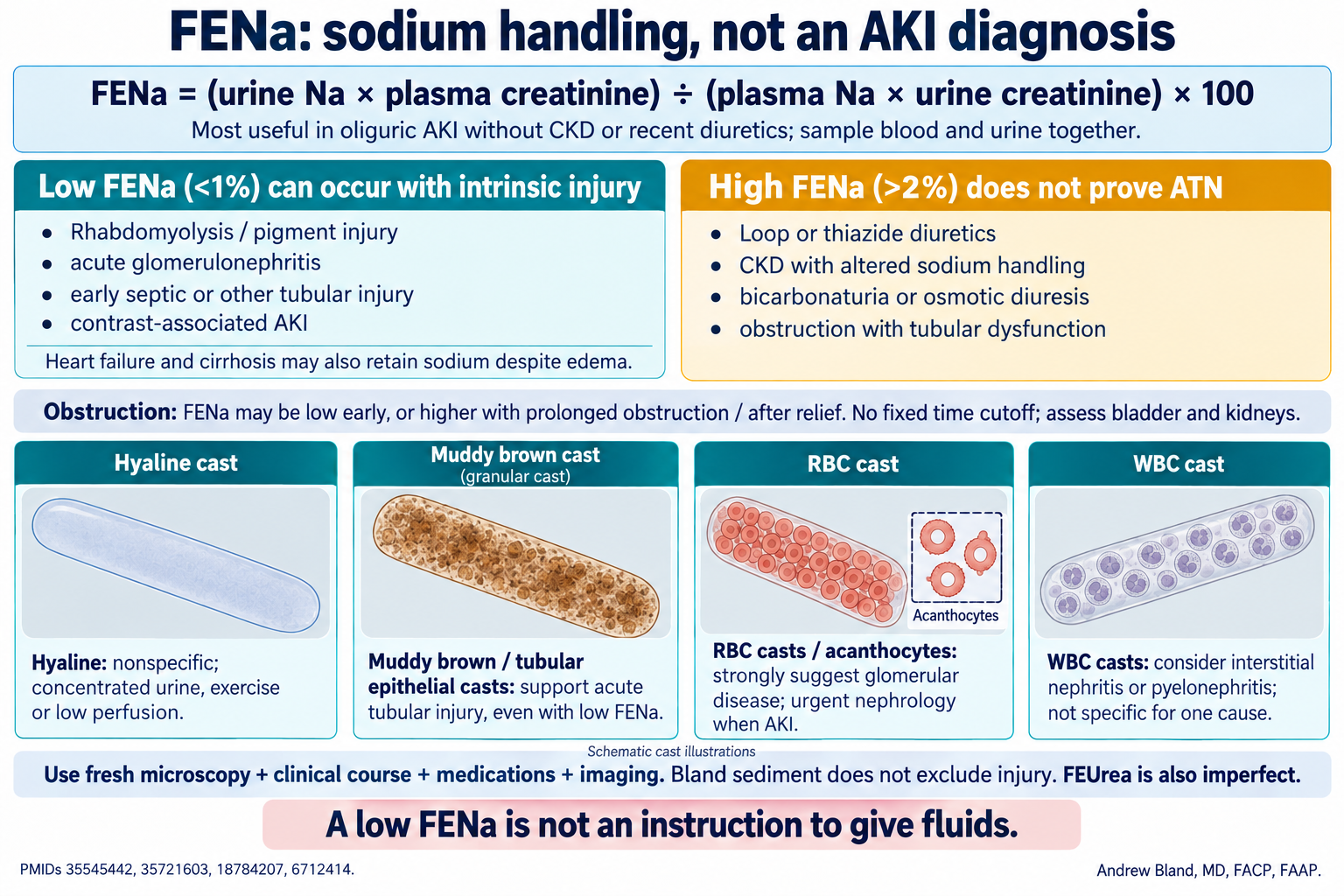
FENa = (urine sodium × plasma creatinine) / (plasma sodium × urine creatinine) × 100, using contemporaneous specimens and matching units. It describes sodium handling. Conventional low (<1%) and high (>2%) bands are clues with overlap, not diagnostic boundaries. Performance is best in oliguric AKI without CKD or recent diuretics.
Low FENa can occur in rhabdomyolysis/pigment injury, acute GN, septic or other tubular injury and contrast-associated AKI. Heart failure and cirrhosis can retain sodium despite edema. High FENa may reflect loop/thiazide diuretics, CKD adaptation, bicarbonaturia or osmotic diuresis rather than ATN. Obstruction can produce low FENa early and higher values with tubular dysfunction or after relief; duration is one influence, not a reliable clock. Assess bladder and kidneys regardless of FENa.
Fresh microscopy adds structural clues. Hyaline casts are nonspecific. Muddy brown granular casts and renal tubular epithelial cells/casts support tubular injury even with a low FENa. RBC casts or acanthocytes strongly suggest glomerular disease; AKI with active nephritis needs urgent nephrology assessment. WBC casts raise interstitial nephritis or pyelonephritis but do not distinguish them alone. Casts are schematics, not diagnostic photomicrographs. Bland sediment does not exclude injury, and operator/sample quality matters. FEUrea can also change with diuretics and is not a definitive rescue test. A low FENa is not an instruction to give fluids.
Andrew Bland, MD, FACP, FAAP