Visual reference
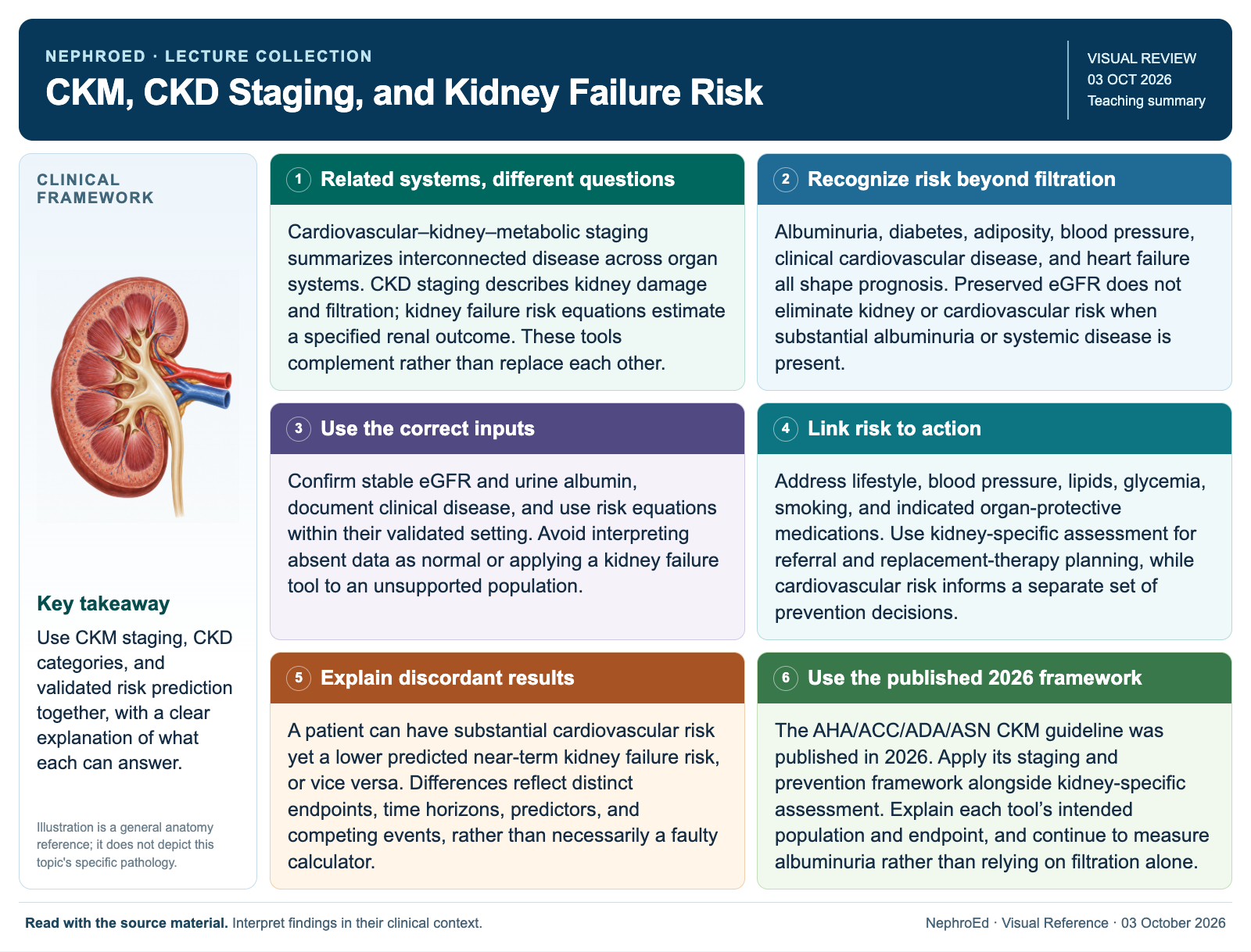
Browse the visual reference library · Download lesson Markdown
⚖️ Different questions
| CKM grid (KDIGO heat map) | KFRE | |
|---|---|---|
| Endpoint | Cardiovascular events; CKD enters as a risk equivalent | Kidney failure (kidney replacement therapy) at 2 and 5 years |
| Inputs | eGFR, UACR | eGFR, UACR, age, sex (4-variable); plus calcium, phosphate, bicarbonate, albumin (8-variable) |
| Output | Four ordinal categories | Continuous absolute risk |
| Validated range | All eGFR | G3–G5 only; not validated above eGFR 60 |
KDIGO action thresholds for KFRE
| Risk | Action |
|---|---|
| 5-year risk 3–5% | Nephrology referral |
| 2-year risk above 10% | Multidisciplinary care |
| 2-year risk above 40% | Modality education, access planning, transplant preparation |
🔄 Three ways they disagree
CKM overcalls — G4 A1
eGFR 25 with a UACR of 12 is CKM stage 3 regardless of patient characteristics. An 80-year-old woman in that cell often carries a 5-year KFRE in the low single digits. She will die with her kidneys, not from them. The grid is correct about her cardiovascular risk and actively misleading if read as progression risk.
KFRE overcalls — G3a/G3b A3, younger man
Identical stage 3 label, but a 2-year KFRE that can exceed 40% — access-planning territory. Same stage, opposite management.
Shared blind spot — G1/G2 A3
eGFR 95 with a UACR of 1,200 mg/g is CKM stage 2, sitting alongside uncomplicated hypertension. KFRE will not run at all above eGFR 60. Neither tool captures the steepest slope in the clinic — only the UACR value itself does.
🧩 Why the divergence is structural
🎯 Practical reconciliation — run all three
| Instrument | Answers | Drives |
|---|---|---|
| CKM stage | How much cardiovascular risk does this patient carry, and from which axis? | Treatment intensity and agent class |
| KFRE | How likely is this kidney to fail, and by when? | Referral, multidisciplinary care, access placement, transplant workup |
| PREVENT | What is the absolute 10- and 30-year cardiovascular risk? | The pharmacotherapy thresholds (7.5%, 20%, HF 5%) |
🔗 Where to go next
🔍 Source and verification
Primary source: the 2026 AHA/ACC/ADA/ASN guideline for the prevention, detection, evaluation, and management of cardiovascular-kidney-metabolic syndrome (Circulation. 2026;154(4):e50–e158, PMID 42263157), published Free Access and read in full for these pages. Glycemic triggers are from the ADA Standards of Care in Diabetes — 2026, Section 9 (PMID 41358900), read in full via PubMed Central. Kidney staging and glycemic targets in CKD are from KDIGO 2024 and KDIGO 2022 (PMID 36272764), the latter verified against its peer-reviewed synopsis (PMID 36623286).
Every numeric threshold on this page was checked against the source text. Figures that could not be confirmed in a primary source were removed rather than published with a caveat — including a set of pre-HF biomarker cut points that circulate in secondary summaries but appear nowhere in the guideline.