Visual reference
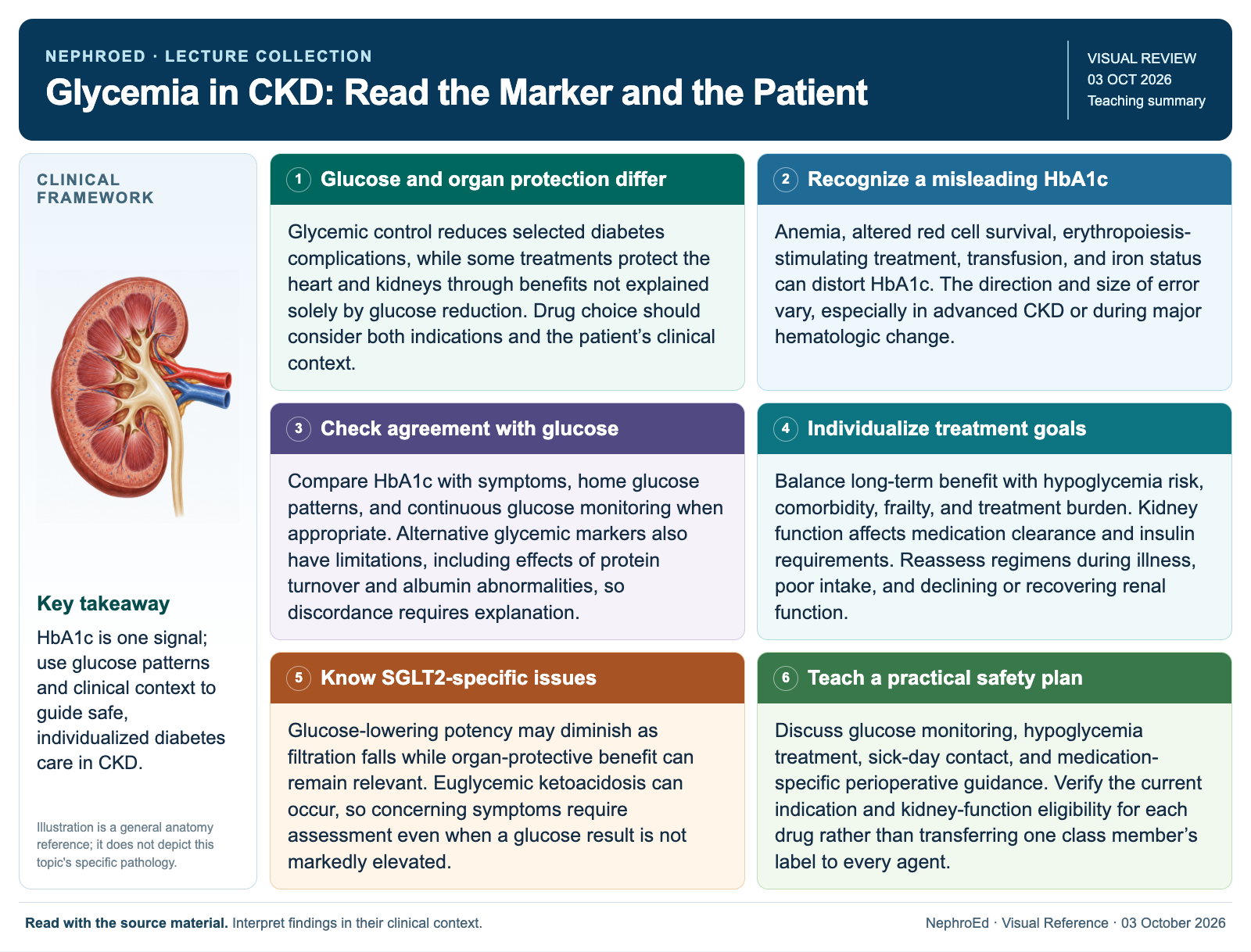
Browse the visual reference library · Download lesson Markdown
🔢 Problem 1 — HbA1c is a switch, not a dial
CKM staging treats diabetes as binary. An HbA1c of 6.5% assigns stage 2. An HbA1c of 13% also assigns stage 2. Severity never escalates the stage.
Severity re-enters in two places, both outside the stage:
- Agent selection. "Severe hyperglycemia" is named among the comorbidities steering the choice of cardioprotective antihyperglycemic, and uncontrolled diabetes favors a GLP-1 RA over finerenone in the albuminuria add-on decision.
- PREVENT. The guideline states that the PREVENT equations have "add-on models incorporating UACR, HbA1c, and the social deprivation index" — so HbA1c is carried as a continuous input there. If you stage without running an add-on PREVENT model, that risk simply disappears from the assessment.
Where glycemic severity does change management
Not through the CKM stage, but through the ADA Standards of Care. These are the verified triggers:
| Trigger | Action |
|---|---|
| A1C at or above 1.5% above the individualized goal | Many individuals will require dual-combination therapy or a more potent glucose-lowering agent to reach and hold goal |
| A1C above 10% (above 86 mmol/mol), or blood glucose at or above 300 mg/dL (16.7 mmol/L), or symptoms of hyperglycemia | Consider initiating insulin regardless of background glucose-lowering therapy or disease duration (Recommendation 9.20, grade E) |
| Severe hyperglycemia with catabolic features — weight loss, hypertriglyceridemia, ketosis | Insulin should be considered as part of any combination plan |
| No severe hyperglycemia or hyperglycemic crisis | GLP-1-based therapy is preferred to insulin for initial or add-on therapy (Recommendation 9.21, grade A) |
| If insulin is used | Combination with a GLP-1 RA, including a dual GIP and GLP-1 RA, is recommended (Recommendation 9.22) |
🧪 Problem 2 — the assay degrades as CKD advances
| G stage | Reliability | Target |
|---|---|---|
| G1–G2 | Reliable | Individualized, below 6.5% to below 8.0% |
| G3a–G3b | Generally reliable | Same range — the guideline sets one target for all non-dialysis CKD and does not tighten it by G stage |
| G4–G5, not on dialysis | Accuracy and precision decline | Same range, interpreted with caution; in practice most patients sit at the loose end |
| G5D (dialysis) | Low reliability | KDIGO sets no HbA1c target here |
🧬 Why HbA1c misreads in CKD — the mechanisms
Pushes it falsely LOW
- Shortened erythrocyte survival — less time to glycate
- ESA-driven reticulocytosis — a young red cell population
- Transfusion
- Hemolysis
These dominate in advanced CKD.
Pushes it falsely HIGH
- Iron deficiency — an aged red cell population
- Metabolic acidosis
- Carbamylation interference in uremia (assay-dependent)
Partially offsetting, and unpredictably so in the individual patient.
Why not just use a different marker?
KDIGO retains HbA1c as the biomarker of choice even in advanced CKD (Recommendation 2.1.1, 1C). Glycated albumin and fructosamine carry their own assay biases in the setting of hypoalbuminemia — common with proteinuria, malnutrition and peritoneal dialysis. When HbA1c is discordant with measured glucose or with clinical symptoms, the guideline directs you to the CGM-derived glucose management indicator (GMI) rather than to an alternative glycated protein.
⚠️ Nephrology-specific glycemic traps
Euglycemic DKA
Relative insulinopenia plus an SGLT2 inhibitor is the classic setup. At HbA1c above 10% with catabolic features, establish insulin before or alongside the SGLT2i.
AKI in the uncontrolled band
Sustained hyperglycemia drives osmotic diuresis and glomerular hyperfiltration — volume depletion, AKI and an accelerated eGFR slope, independent of the assigned stage.
Glycemic efficacy falls with eGFR
SGLT2i retains cardiorenal benefit down to eGFR 20 but is not a glucose-lowering agent at G4. Do not let the cardiorenal indication substitute for glycemic control.
Dosing floors
Metformin contraindicated below eGFR 30. SGLT2i initiable to eGFR 20. Finerenone requires potassium surveillance. GLP-1 RA dosing is not eGFR-adjusted.
🔗 Where to go next
🔍 Source and verification
Primary source: the 2026 AHA/ACC/ADA/ASN guideline for the prevention, detection, evaluation, and management of cardiovascular-kidney-metabolic syndrome (Circulation. 2026;154(4):e50–e158, PMID 42263157), published Free Access and read in full for these pages. Glycemic triggers are from the ADA Standards of Care in Diabetes — 2026, Section 9 (PMID 41358900), read in full via PubMed Central. Kidney staging and glycemic targets in CKD are from KDIGO 2024 and KDIGO 2022 (PMID 36272764), the latter verified against its peer-reviewed synopsis (PMID 36623286).
Every numeric threshold on this page was checked against the source text. Figures that could not be confirmed in a primary source were removed rather than published with a caveat — including a set of pre-HF biomarker cut points that circulate in secondary summaries but appear nowhere in the guideline.