Visual reference
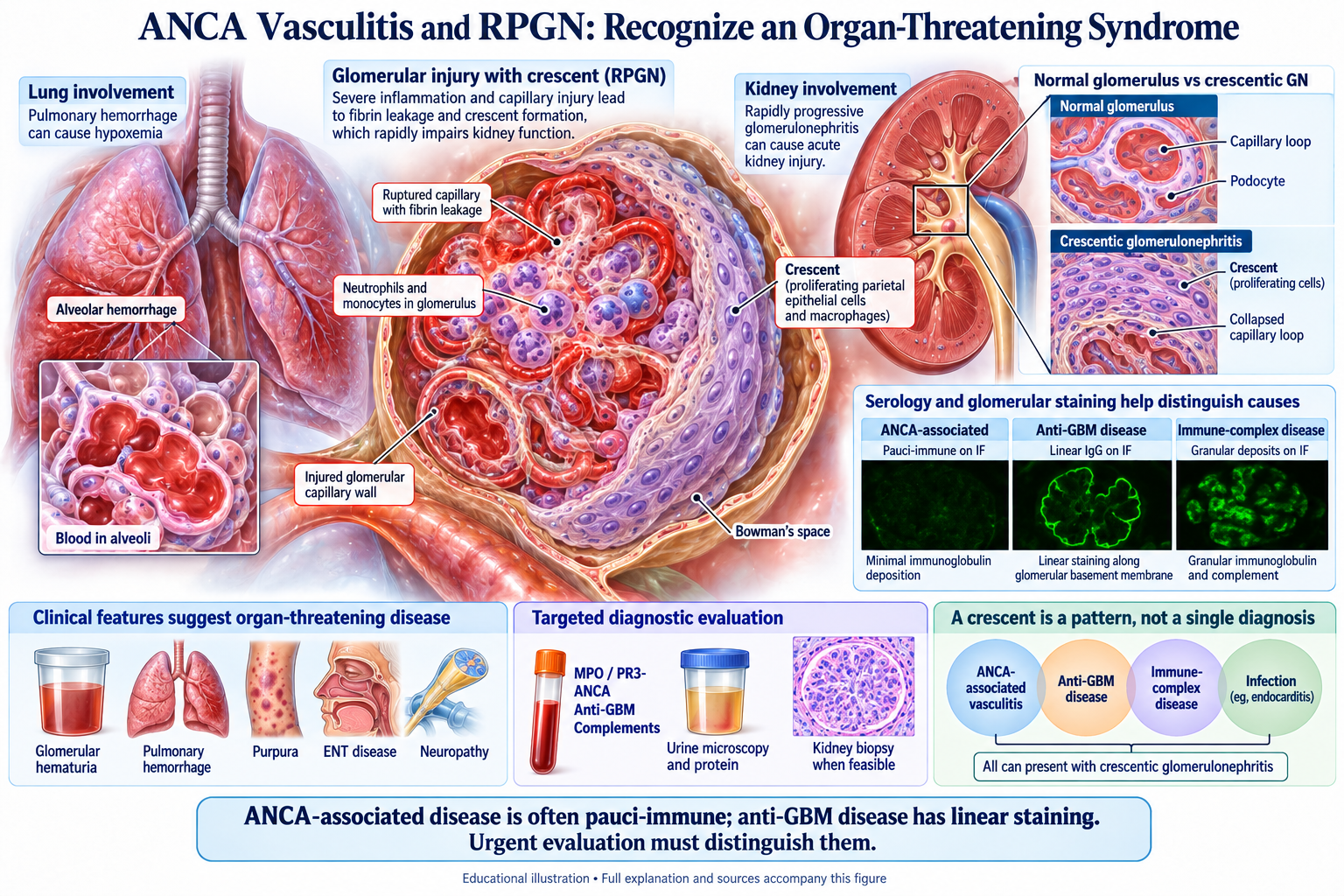
Browse the visual reference library · Download lesson Markdown
📚 Overview: RPGN & ANCA-Associated Vasculitis
Rapidly Progressive Glomerulonephritis (RPGN) is a clinical syndrome of rapid kidney-function decline over days to weeks, usually with an active urine sediment such as acanthocytes, red-cell casts, and proteinuria. Suspected RPGN requires immediate nephrology assessment; do not wait for a fixed percentage GFR loss or for casts to appear. The hallmark histopathologic finding is crescent formation in Bowman's space.
ANCA-associated vasculitis (AAV) is the most common cause of RPGN in adults and represents the "pauci-immune" category (Type III). These are systemic small-vessel vasculitides characterized by necrotizing inflammation with few or no immune deposits on immunofluorescence.
⚠️ Clinical Emergency
RPGN is a nephrology emergency. Untreated, patients can progress to dialysis-dependent kidney failure within days to weeks. Prompt recognition, urgent serologic workup, and early biopsy are essential. Treatment should not be delayed while awaiting biopsy results if clinical suspicion is high.
🏥 RPGN Classification: The Three Types
RPGN is classified by immunofluorescence pattern on kidney biopsy into three categories. Each has a distinct pathophysiology, serologic profile, and treatment approach.
Type I: Anti-GBM Disease
Pattern: Linear IgG staining along GBM
Mechanism: Antibodies directed against the alpha-3 chain of type IV collagen (NC1 domain) in the glomerular basement membrane
- Goodpasture syndrome: renal + pulmonary hemorrhage
- ~5% of all RPGN cases
- Bimodal age distribution (20s and 60-70s)
- Smoking and hydrocarbon exposure are risk factors for pulmonary involvement
- Serologic marker: anti-GBM antibody
- Complements are normal
Type II: Immune Complex
Pattern: Granular immune complex deposits
Mechanism: Immune complex deposition with complement activation
- Lupus nephritis (Class III/IV with crescents)
- IgA nephropathy with crescentic transformation
- Post-infectious GN with crescents
- Membranoproliferative GN
- ~25% of all RPGN cases
- Complements often low (C3 ± C4)
Type III: Pauci-Immune (ANCA)
Pattern: Few or no immune deposits ("pauci-immune")
Mechanism: ANCA activation of neutrophils → endothelial damage → necrotizing vasculitis
- GPA (Granulomatosis with Polyangiitis)
- MPA (Microscopic Polyangiitis)
- EGPA (Eosinophilic GPA)
- Renal-limited vasculitis
- ~65% of all RPGN cases (most common)
- Complements are normal
- ~10% are ANCA-negative
💡 The RPGN Workup
When you suspect RPGN, order these labs simultaneously — do not wait for results sequentially:
c-ANCA (PR3)
p-ANCA (MPO)
Rules out Type I
Low = immune complex
Rules out lupus
Gold standard
🔬 ANCA: c-ANCA (PR3) vs p-ANCA (MPO)
Anti-neutrophil cytoplasmic antibodies (ANCAs) are autoantibodies directed against proteins in neutrophil granules. They are detected by two complementary methods: immunofluorescence (IIF) for the staining pattern and ELISA/immunoassay for the specific antigen target.
| Feature | c-ANCA / PR3 | p-ANCA / MPO |
|---|---|---|
| IF Pattern | Cytoplasmic (diffuse granular) | Perinuclear |
| Target Antigen | Proteinase 3 (PR3) | Myeloperoxidase (MPO) |
| Primary Association | GPA (~80-90%) | MPA (~60-70%) EGPA (~40%) |
| Sensitivity for GPA | ~90% in active generalized disease | ~10% of GPA |
| Relapse Risk | Higher (~50% at 5 years) | Lower (~30% at 5 years) |
| ANCA Titer & Disease Activity | Correlates more closely with activity; rising titers may predict relapse | Less reliable predictor of relapse |
| Renal-Limited Disease | Less common | More common |
| Geographic Variation | More common in Northern Europe | More common in Southern Europe, Asia |
⚠️ Important Caveats
- ANCA-negative vasculitis: ~10% of biopsy-proven pauci-immune crescentic GN is ANCA-negative. A negative ANCA does NOT exclude the diagnosis.
- False-positive p-ANCA: ANA can cause a perinuclear staining artifact. Always confirm p-ANCA with anti-MPO ELISA.
- 2017 Revised Consensus: Guidelines now recommend antigen-specific immunoassays (PR3/MPO) as the primary screening method rather than IIF.
- Do not treat ANCA titers alone: Rising titers may prompt closer surveillance, but treatment decisions should be based on clinical disease activity, not serology alone.
🩸 GPA (Granulomatosis with Polyangiitis)
Formerly known as Wegener's granulomatosis, GPA is a systemic necrotizing granulomatous vasculitis affecting small and medium vessels. It classically involves the upper airways, lungs, and kidneys (the clinical triad).
📋 The Classic Triad of GPA
1. Upper Airway Disease
- Chronic sinusitis (refractory to antibiotics)
- Nasal crusting, epistaxis
- Saddle nose deformity (cartilage destruction)
- Subglottic stenosis (~15%)
- Serous otitis media, hearing loss
- Oral ulcers, "strawberry gingiva"
2. Pulmonary Involvement
- Pulmonary nodules (often cavitary)
- Diffuse alveolar hemorrhage (DAH)
- Hemoptysis, dyspnea, cough
- Chest CT: bilateral nodules ± cavitation
- BAL: progressively bloody returns
- Hemosiderin-laden macrophages
3. Glomerulonephritis
- Pauci-immune crescentic GN
- Hematuria, proteinuria, RBC casts
- Rapidly rising creatinine
- Focal segmental necrotizing GN
- Cellular crescents in Bowman's space
- Absent or scant IF staining
🔬 Histopathology of GPA
The characteristic biopsy triad in GPA:
- Necrotizing granulomatous inflammation — granulomas with central necrosis (geographic necrosis), multinucleated giant cells, palisading histiocytes
- Necrotizing vasculitis — fibrinoid necrosis of small and medium vessel walls with inflammatory infiltrates
- Crescentic glomerulonephritis — pauci-immune pattern; fibrinoid necrosis of glomerular tufts with epithelial cell proliferation in Bowman's space
📋 Other Organ Involvement in GPA
- Eyes: Scleritis, episcleritis, orbital pseudotumor (proptosis), nasolacrimal duct obstruction
- Nervous system: Mononeuritis multiplex (vasculitis of vasa nervorum), cranial nerve palsies, pachymeningitis
- Skin: Palpable purpura (leukocytoclastic vasculitis), ulcers, nodules
- Joints: Arthralgias, non-deforming arthritis
- Constitutional: Fever, weight loss, malaise, fatigue
🔬 MPA (Microscopic Polyangiitis)
MPA is a systemic necrotizing small-vessel vasculitis without granulomatous inflammation. It is the most common cause of pulmonary-renal syndrome and the most common cause of pauci-immune crescentic GN.
📋 Key Features of MPA
Renal Involvement (~90%)
- Most prominent organ involvement
- Pauci-immune necrotizing and crescentic GN
- Indistinguishable from GPA on renal biopsy
- Renal-limited vasculitis is a subset of MPA
- MPO-ANCA in ~60-70%
- PR3-ANCA in ~20-30%
Pulmonary Involvement (~30%)
- Diffuse alveolar hemorrhage
- Pulmonary capillaritis
- No cavitary nodules (unlike GPA)
- Interstitial lung disease (especially with MPO)
- UIP pattern on CT may precede vasculitis diagnosis
Other Features
- Palpable purpura, skin ulcers
- Mononeuritis multiplex
- Arthralgias, myalgias
- Constitutional symptoms
- No ENT disease (unlike GPA)
- No granulomas (unlike GPA)
💡 GPA vs MPA: How to Distinguish
| Feature | GPA | MPA |
|---|---|---|
| ENT involvement | Yes (sinusitis, saddle nose) | No |
| Granulomas | Yes | No |
| Cavitary lung nodules | Yes | No |
| Alveolar hemorrhage | Yes | Yes |
| Predominant ANCA | PR3 (c-ANCA) | MPO (p-ANCA) |
| Relapse rate | Higher | Lower |
| Renal-limited forms | Rare | Common |
💚 EGPA (Eosinophilic Granulomatosis with Polyangiitis)
Formerly known as Churg-Strauss syndrome, EGPA is a small-vessel vasculitis distinguished by asthma, peripheral eosinophilia, and tissue eosinophilic infiltration. It is the least common of the three AAV subtypes.
📋 Three Phases of EGPA
1. Prodromal (Allergic) Phase
- Late-onset asthma (often severe)
- Allergic rhinitis, nasal polyposis
- May precede vasculitis by years
2. Eosinophilic Phase
- Peripheral eosinophilia (>10% or >1500/microL)
- Eosinophilic pneumonia
- Eosinophilic gastroenteritis
3. Vasculitic Phase
- Systemic necrotizing vasculitis
- Mononeuritis multiplex (~70%)
- Palpable purpura
- Cardiac involvement (leading cause of death)
❤️ Cardiac Involvement in EGPA
Cardiac disease is the leading cause of mortality in EGPA and occurs in 30-50% of patients:
- Eosinophilic myocarditis → cardiomyopathy
- Pericarditis, pericardial effusion
- Endocardial fibrosis (Loeffler endocarditis)
- Coronary arteritis
- Cardiac involvement is more common in ANCA-negative EGPA
🔬 EGPA: Two Phenotypes
| Feature | ANCA-Positive (~40%) | ANCA-Negative (~60%) |
|---|---|---|
| ANCA type | MPO-ANCA (p-ANCA) | Negative |
| Renal involvement | More common (crescentic GN) | Less common |
| Cardiac involvement | Less common | More common (eosinophilic myocarditis) |
| Neuropathy | Common | Common |
| Vasculitis phenotype | Similar to MPA | Eosinophilic tissue infiltration |
🔬 Kidney Biopsy Findings in ANCA Vasculitis
Renal biopsy is essential for confirming the diagnosis, assessing severity, and determining prognosis. The hallmark is pauci-immune necrotizing and crescentic glomerulonephritis.
🔬 Light Microscopy
- Crescents: Proliferation of parietal epithelial cells and infiltrating macrophages in Bowman's space
- Cellular crescents: Early, active lesion — composed of proliferating cells; potentially reversible with treatment
- Fibrocellular crescents: Mixed cellular and fibrotic elements; partially reversible
- Fibrous crescents: Late, scarred lesion — irreversible; indicates chronic injury
- Focal segmental necrotizing GN: Fibrinoid necrosis of glomerular capillary loops
- Periglomerular inflammation: May extend into the interstitium
💡 Immunofluorescence
- "Pauci-immune": Absent or minimal immunoglobulin and complement deposition (≤1+ staining)
- This is the defining feature that distinguishes ANCA-associated GN from anti-GBM (linear) and immune complex (granular) disease
- Fibrin staining may be present in crescents and areas of necrosis
📋 Berden Histopathologic Classification (2010)
The Berden classification categorizes ANCA GN into four classes based on light microscopy, with prognostic significance for renal outcomes:
| Class | Definition | Renal Prognosis |
|---|---|---|
| Focal | ≥50% normal glomeruli | Best prognosis (1-yr renal survival ~93%) |
| Crescentic | ≥50% glomeruli with cellular crescents | Good with treatment (1-yr ~84%) |
| Mixed | <50% normal, <50% crescentic, <50% sclerotic | Intermediate (1-yr ~69%) |
| Sclerotic | ≥50% globally sclerotic glomeruli | Worst prognosis (1-yr ~50%) |
⚠️ Prognostic Significance of Crescents
- The percentage of glomeruli with crescents correlates with severity and is a key prognostic factor
- >50% crescents = severe disease; risk of dialysis-dependent renal failure if untreated
- Cellular crescents are potentially reversible with aggressive immunosuppression
- Fibrous crescents represent irreversible scarring and predict poor renal recovery
- The ratio of cellular to fibrous crescents helps guide treatment intensity
- Tubular atrophy and interstitial fibrosis (>25%) predict poor recovery regardless of crescent type
💊 Induction Therapy
The goal of induction therapy is to rapidly control disease activity and prevent organ damage. Treatment intensity is guided by disease severity.
💉 Pulse Corticosteroids
- Methylprednisolone 500-1000 mg IV daily x 3 days for severe/life-threatening disease (RPGN, DAH)
- Followed by oral prednisone 1 mg/kg/day (max 80 mg), tapered over 3-6 months
- PEXIVAS trial (2020): Demonstrated that a reduced-dose glucocorticoid regimen is non-inferior to standard-dose, with fewer infections
- Current trend: faster steroid taper; target prednisone ≤5 mg by 5-6 months
💊 Cyclophosphamide
Traditional induction agent, now largely replaced by rituximab for many patients.
| Route | Dosing | Key Points |
|---|---|---|
| IV Pulse (preferred) | 15 mg/kg (max 1200 mg) every 2-3 weeks x 3-6 months | Lower cumulative dose, fewer infections; Euro-Lupus-inspired dosing gaining favor |
| Oral Daily | 2 mg/kg/day (max 200 mg) x 3-6 months | Higher cumulative dose; higher risk of bladder toxicity and malignancy |
- Dose adjustment: Reduce for age >60, renal impairment, leukopenia
- Monitor: CBC every 1-2 weeks; target WBC >3500, ANC >1500
- Adverse effects: Bone marrow suppression, hemorrhagic cystitis (use MESNA with IV), infections, infertility, bladder cancer (cumulative dose >36g)
- Fertility preservation: Discuss sperm/oocyte banking before starting; GnRH agonists for ovarian protection
💊 Rituximab
Anti-CD20 monoclonal antibody that depletes B cells. Now considered first-line induction, particularly for PR3-ANCA and relapsing disease.
- Dosing: 375 mg/m² IV weekly x 4 doses (lymphoma protocol) or 1000 mg IV x 2 doses (2 weeks apart)
- RAVE Trial (Stone et al., NEJM 2010):
- Rituximab non-inferior to cyclophosphamide for induction of remission in ANCA vasculitis
- Superior for relapsing disease
- Non-inferior for new-onset severe disease
- RITUXVAS (2010): Jones et al. compared a rituximab-based regimen that included two cyclophosphamide pulses with an intravenous cyclophosphamide regimen in severe renal ANCA-associated vasculitis. Remission and severe adverse-event rates were similar in this small trial; it did not demonstrate fewer early severe adverse events.
💡 Avacopan (Complement C5a Receptor Inhibitor)
Historical ADVOCATE trial (2021; retracted 2026): This study tested avacopan, a C5a receptor inhibitor, against a prednisone taper on background rituximab or cyclophosphamide. Its originally reported superiority and steroid-sparing conclusions are withdrawn as reliable support for this teaching point. See the retraction notice above; assess current avacopan treatment decisions using independent evidence and current guidance.
💊 Maintenance Therapy
After achieving remission with induction therapy, maintenance immunosuppression is essential to prevent relapse. Duration is typically 18-24 months minimum, with some patients requiring indefinite therapy.
💊 Rituximab vs Azathioprine for Maintenance
| Feature | Rituximab | Azathioprine |
|---|---|---|
| MAINRITSAN (2014) | After remission induction, rituximab 500 mg on days 0 and 14 and at months 6, 12, and 18 reduced major relapse compared with azathioprine (5% versus 29% at month 28). PubMed | |
| MAINRITSAN2 (2018) | Tailored rituximab dosing (based on CD19 count and ANCA) was non-inferior to fixed-schedule dosing, with fewer infusions needed. | |
| MAINRITSAN3 (2020) | Extended rituximab maintenance (additional 18 months beyond standard 18 months) reduced relapse at 46 months compared to stopping rituximab. Supports longer duration for high-risk patients. | |
| Dosing | 500 mg IV every 6 months | 2 mg/kg/day oral |
| Duration | 18-48 months (ongoing debate) | 18-24 months |
| Advantages | Superior relapse prevention; preferred for PR3+ | Oral, lower cost, long track record |
| Disadvantages | Infusion requirements, hypogammaglobulinemia, late-onset neutropenia | Higher relapse rate, GI intolerance, hepatotoxicity |
💡 Maintenance: Key Takeaways
- Rituximab is now preferred for maintenance in most patients based on MAINRITSAN data
- PR3-positive (GPA) patients have the highest relapse risk and benefit most from rituximab maintenance
- Azathioprine remains a reasonable alternative for MPO-ANCA patients with low relapse risk, or where cost/access limits rituximab use
- Mycophenolate mofetil is an alternative but inferior to azathioprine for maintenance (IMPROVE trial showed higher relapse with MMF)
- Monitor immunoglobulin levels: Check IgG levels before each rituximab dose; hold if IgG <300-400 mg/dL with recurrent infections
🏹 Plasma Exchange (Plasmapheresis)
Plasma exchange (PLEX) rapidly removes circulating pathogenic antibodies and has a defined role in select situations.
📋 Indications and Evidence
| Condition | Recommendation | Evidence |
|---|---|---|
| Anti-GBM disease | Strongly recommended | Standard of care; removes pathogenic anti-GBM antibodies rapidly. Typically 14 exchanges over 14-21 days. Continue until antibody levels undetectable. |
| Diffuse alveolar hemorrhage (DAH) | Recommended | Life-threatening; PLEX may improve outcomes though RCT data limited. Often used in practice for severe pulmonary hemorrhage. |
| Severe ANCA-associated vasculitis | Individualized specialist decision | PEXIVAS (2020) did not show an overall reduction in death or ESKD with plasma exchange. Subgroup results do not prove absence of benefit for every high-risk patient. Current guidance considers selected patients with rapidly progressive kidney failure or hypoxemic alveolar hemorrhage; concomitant anti-GBM disease is a separate indication. |
| Double-positive (ANCA + anti-GBM) | Recommended | Treat as anti-GBM disease with PLEX + immunosuppression. |
⚠️ PEXIVAS: A Practice-Changing Trial
The PEXIVAS trial (2020) was the largest RCT in ANCA vasculitis (N=704). Key findings:
- PLEX did not reduce the composite endpoint of death or ESRD
- Reduced-dose glucocorticoids were non-inferior to standard-dose
- Result: PLEX is no longer routinely used for ANCA vasculitis; reserved for anti-GBM disease and possibly DAH
🏥 Anti-GBM Disease: Specific Management Pearls
💊 Treatment Protocol for Anti-GBM Disease
- Plasma exchange: 4L exchanges daily or every other day for 14 sessions (or until anti-GBM antibodies undetectable)
- Corticosteroids: Pulse methylprednisolone 500-1000 mg IV x 3 days, then oral prednisone
- Cyclophosphamide: 2 mg/kg/day oral x 2-3 months (rituximab data limited in anti-GBM)
- Duration of immunosuppression: Shorter than ANCA vasculitis (~3 months) because anti-GBM disease rarely relapses (<5%)
⚠️ Prognosis in Anti-GBM Disease
- Dialysis-dependent at presentation: Renal recovery is unlikely (<10%). Transplant can be considered after anti-GBM antibodies are negative for 6-12 months.
- Creatinine <5.7 mg/dL at presentation with <100% crescents: Better chance of renal recovery (~70-80%)
- 100% crescents on biopsy: Immunosuppression may not improve renal outcome; consider risk-benefit of aggressive treatment
- Anti-GBM rarely relapses (unlike ANCA vasculitis) — long-term maintenance immunosuppression is not needed unless patient is ANCA-positive
📉 Renal Recovery & Prognostic Factors in ANCA Vasculitis
📋 Factors Predicting Renal Outcome
| Factor | Better Prognosis | Worse Prognosis |
|---|---|---|
| Serum creatinine at presentation | <3 mg/dL | >5.7 mg/dL (especially if dialysis-dependent) |
| Biopsy class (Berden) | Focal class (≥50% normal glomeruli) | Sclerotic class (≥50% globally sclerotic) |
| Crescent type | Cellular crescents (active, treatable) | Fibrous crescents (scarred, irreversible) |
| Tubulointerstitial fibrosis | <25% | >25% (indicates chronicity) |
| Dialysis at presentation | Not dialysis-dependent | Dialysis-dependent (50-75% remain on dialysis) |
| ANCA type | MPO (fewer relapses) | PR3 (more relapses, higher cumulative damage) |
💡 When Is It Too Late to Treat?
Even dialysis-dependent patients deserve consideration for immunosuppression:
- If the biopsy shows predominantly cellular crescents with minimal chronicity → treat aggressively; ~25-30% may recover off dialysis
- If the biopsy shows >50% fibrous crescents or ≥50% globally sclerosed glomeruli with extensive interstitial fibrosis → aggressive immunosuppression is unlikely to restore renal function; treat extrarenal disease but plan for chronic dialysis/transplant
- Immunosuppression may still be warranted for extrarenal disease (DAH, neuropathy, etc.) even if renal recovery is unlikely
📉 Monitoring & Relapse
📋 Surveillance in Remission
- ANCA titers: Check every 3-6 months during maintenance
- Rising PR3-ANCA may predict relapse (sensitivity ~50-70%, specificity ~70-80%)
- MPO-ANCA titers are less predictive
- Do NOT treat ANCA titers alone — treat clinical relapse, not serologic relapse
- Urinalysis: Regular monitoring for return of hematuria (especially dysmorphic RBCs or RBC casts)
- Creatinine: Rising creatinine with active sediment = relapse until proven otherwise
- CBC: Monitor for cytopenias (drug-related), eosinophilia (EGPA relapse)
- Immunoglobulin levels: Before each rituximab infusion; hypogammaglobulinemia increases infection risk
- Infection prophylaxis: TMP-SMX for PJP during high-dose immunosuppression; vaccinations (avoid live vaccines)
📋 Relapse Rates by ANCA Type
| Feature | PR3-ANCA / GPA | MPO-ANCA / MPA |
|---|---|---|
| 5-year relapse rate | ~50% | ~30% |
| Relapse pattern | More frequent, often renal + extrarenal | Less frequent, often renal-limited |
| ANCA titer correlation | Better predictor (rising titers may precede relapse) | Poor predictor |
| Preferred maintenance | Rituximab (stronger recommendation) | Rituximab or azathioprine |
| Duration of maintenance | Longer (24-48+ months) | 18-24 months may suffice for first episode |
💡 Managing Relapse
- Minor relapse (e.g., sinusitis without renal involvement in GPA): May respond to increased corticosteroids ± adjustment of maintenance therapy
- Major relapse (renal involvement, DAH, organ-threatening): Re-induce with rituximab (preferred for relapsing disease, per RAVE data) + pulse corticosteroids
- If relapse occurred on azathioprine maintenance → switch to rituximab
- If relapse occurred on rituximab maintenance → re-induce with rituximab at higher intensity or consider cyclophosphamide
🎯 Key Learning Points
- RPGN is classified into three types by immunofluorescence: Type I (linear/anti-GBM), Type II (granular/immune complex), Type III (pauci-immune/ANCA) — the most common.
- PR3 (c-ANCA) is associated with GPA; MPO (p-ANCA) with MPA and EGPA.
- GPA involves the classic triad: upper airway, lungs, and kidneys with necrotizing granulomatous vasculitis.
- MPA causes pauci-immune crescentic GN without granulomas or ENT disease.
- EGPA features asthma, eosinophilia, and cardiac involvement as the leading cause of death.
- Kidney biopsy in ANCA vasculitis shows pauci-immune crescentic GN; the Berden classification predicts renal outcome.
- Rituximab is now first-line for both induction (RAVE, RITUXVAS) and maintenance (MAINRITSAN).
- PEXIVAS showed no benefit of plasma exchange in ANCA vasculitis; PLEX remains critical for anti-GBM disease.
- ADVOCATE was retracted in 2026. Do not use its reported avacopan benefits as established evidence; separate historical trial reporting from current treatment recommendations.
- PR3-ANCA patients relapse more often than MPO-ANCA and need longer/more intensive maintenance.
- Renal prognosis depends on creatinine at presentation, biopsy chronicity, and crescent type.
- Monitor with ANCA titers, urinalysis, creatinine, and immunoglobulin levels during maintenance.
📚 References
- Stone JH, Merkel PA, Spiera R, et al. Rituximab versus cyclophosphamide for ANCA-associated vasculitis (RAVE). N Engl J Med. 2010;363(3):221-232. PubMed: 20647199
- Jones RB, Tervaert JW, Hauser T, et al. Rituximab versus cyclophosphamide in ANCA-associated renal vasculitis (RITUXVAS). N Engl J Med. 2010;363(3):211-220. PubMed: 20647198
- Guillevin L, Pagnoux C, Karras A, et al. Rituximab versus azathioprine for maintenance in ANCA-associated vasculitis (MAINRITSAN). N Engl J Med. 2014;371(19):1771-1780. PubMed: 25372085
- Charles P, Terrier B, Perrodeau E, et al. Rituximab maintenance for ANCA-associated vasculitis (MAINRITSAN2). Ann Rheum Dis. 2018;77(8):1150-1156. PubMed: 29695500
- Charles P, Perrodeau E, Samson M, et al. Long-term rituximab use in ANCA-associated vasculitis (MAINRITSAN3). Ann Intern Med. 2020;173(3):179-187. PubMed: 32479166
- Walsh M, Merkel PA, Peh CA, et al. Plasma exchange and glucocorticoids in severe ANCA-associated vasculitis (PEXIVAS). N Engl J Med. 2020;382(7):622-631. PubMed: 32053298
- [RETRACTED — historical citation] Jayne DRW, Merkel PA, Schall TJ, Bekker P; ADVOCATE Study Group. Avacopan for the Treatment of ANCA-Associated Vasculitis. N Engl J Med. 2021;384:599–609. PMID 33596356. Retracted 29 June 2026: Rubin EJ, retraction notice; PMID 42377355.
- Berden AE, Ferrario F, Hagen EC, et al. Histopathologic classification of ANCA-associated glomerulonephritis. J Am Soc Nephrol. 2010;21(10):1628-1636. PubMed: 20616173
- Jennette JC, Nachman PH. ANCA glomerulonephritis and vasculitis. Clin J Am Soc Nephrol. 2017;12(10):1680-1691. PubMed: 28842398
- KDIGO 2021 Clinical Practice Guideline for the Management of Glomerular Diseases. Kidney Int. 2021;100(4S):S1-S276. PubMed: 34556256
- Levy JB, Turner AN, Rees AJ, Pusey CD. Long-term outcome of anti-glomerular basement membrane antibody disease treated with plasma exchange and immunosuppression. Ann Intern Med. 2001;134(11):1033-1042. PubMed: 11388816
- Specks U, Merkel PA, Seo P, et al. Efficacy of remission-induction regimens for ANCA-associated vasculitis. N Engl J Med. 2013;369(5):417-427. PubMed: 23902481