This learning hub connects kidney emergencies with bedside physiology. Start with the immediate threat, then identify the mechanism, select support, and reassess. The linked lessons expand the framework for AKI, electrolyte disturbances, replacement therapy, and heart–kidney interactions.
Learning goal: Connect assessment, evidence, and a clear next clinical decision. Educational use; individual care requires the treating team’s assessment and applicable protocols.
Visual reference
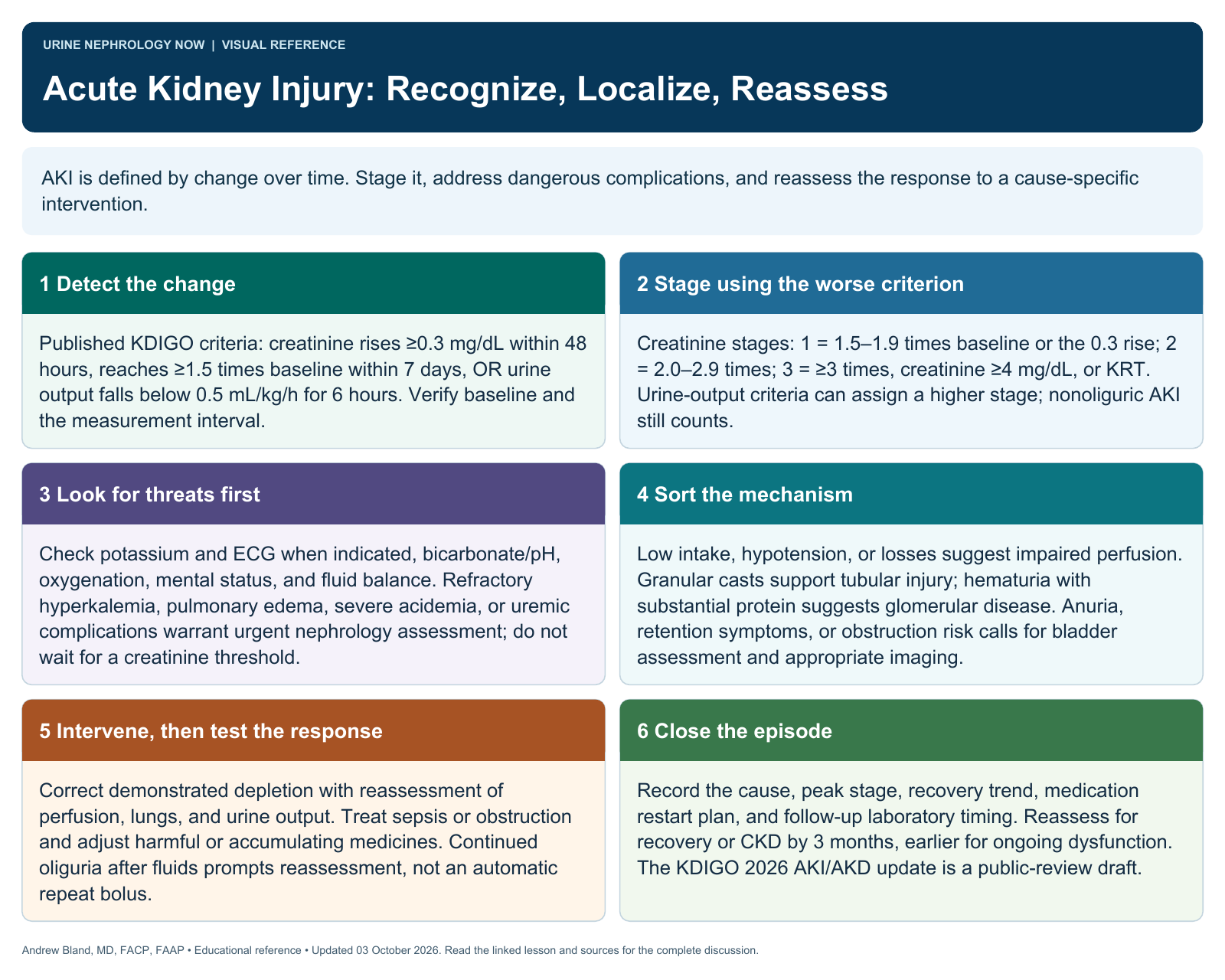
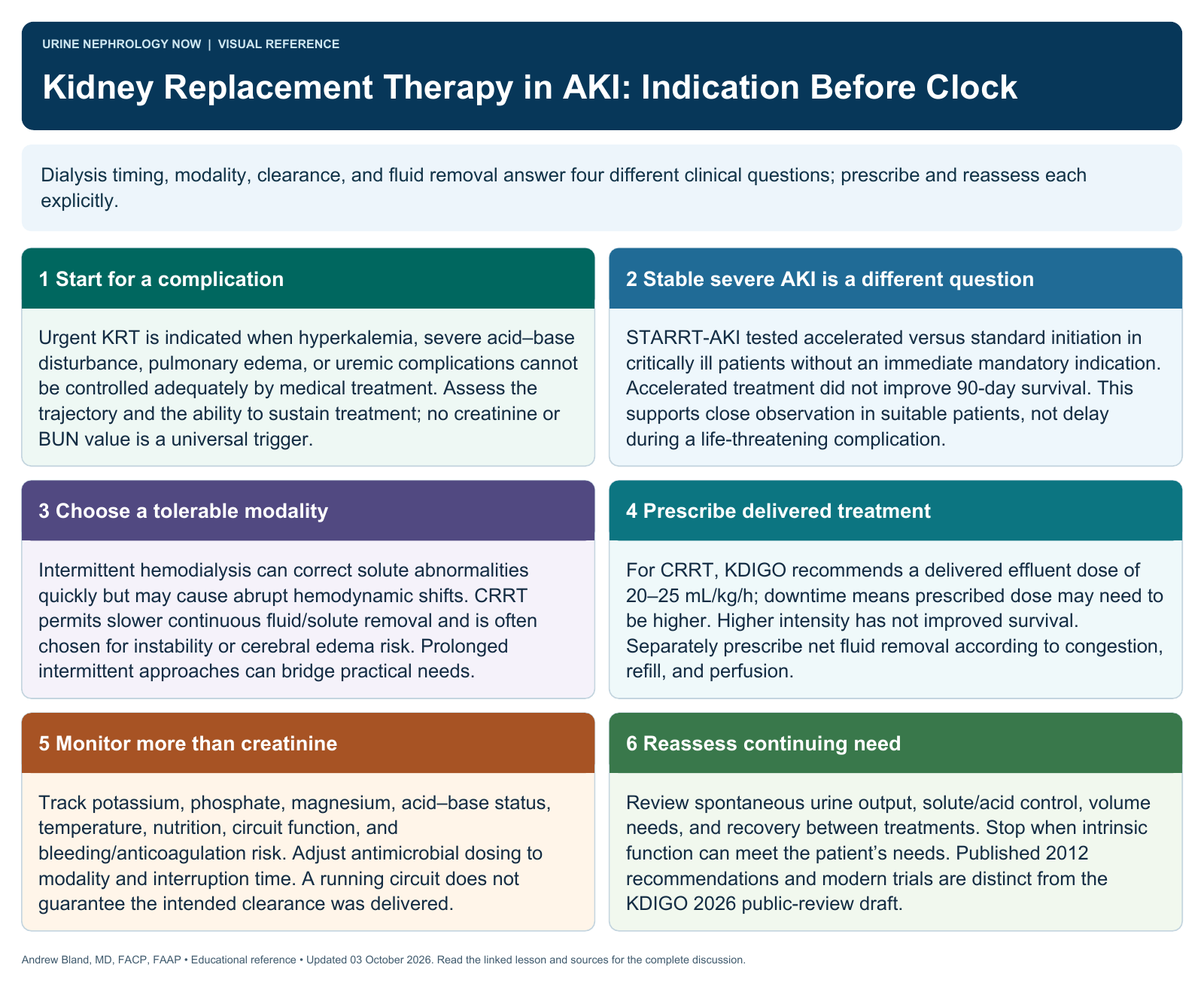
Browse the visual reference library · Download lesson Markdown
Stabilize before classifying
Rapidly assess oxygenation, ventilation, circulation, perfusion, mental status, and rhythm. A deteriorating patient needs the emergency pathway while investigations proceed. A reassuring creatinine value does not exclude a rapidly evolving potassium, acid–base, or volume emergency.
Follow trajectories
Use prior kidney function, urine output, chemistry, medications, and the timing of shock or exposures. Repeat observations after interventions. Single values cannot show the speed of change, and a fluid balance total does not by itself establish intravascular volume or tissue perfusion.
Distinguish congestion and depletion
Kidney dysfunction can arise from low perfusion, venous congestion, intrinsic injury, or obstruction, often together. Assess the patient rather than assigning a fluid strategy from oliguria alone. Fluids, vasopressors, diuretics, and mechanical support address different physiologic problems and require monitored reassessment.
Treat dangerous complications
Severe hyperkalemia, pulmonary edema, refractory acidosis, uremic complications, or selected intoxications may require urgent replacement therapy. Temporizing measures do not replace definitive removal when needed. Coordinate the modality and prescription with hemodynamic status, neurologic concerns, and the need for controlled correction.
Use the connected lessons
Study severe AKI for the initial framework, potassium disorders for arrhythmia risk, and the replacement-therapy lesson for timing and modality. The advanced heart-failure cases contrast ongoing congestion, hypoperfusion, and diagnostic uncertainty. Each link below leads to an actual teaching destination.
Hand off a reassessment plan
Communicate the working diagnosis, uncertainty, current support, medicines adjusted, next laboratories, urine output, and thresholds for escalation. After stabilization, plan kidney follow-up and reconcile which medicines should be restarted. Recovery is a trajectory that can continue after critical care discharge.
Apply the framework
Why is oliguria alone an incomplete fluid prescription?
Show the reasoning
It is a finding shared by depletion, congestion, obstruction, and intrinsic injury. The safe response depends on perfusion, volume assessment, cause, and response to treatment.
References and evidence
These sources support the teaching framework. Trial populations, endpoints, and limitations should be checked before applying a result to an individual patient.
- STARRT-AKI Investigators, Canadian Critical Care Trials Group, Australian and New Zealand Intensive Care Society Clinical Trials Group et al.. Timing of Initiation of Renal-Replacement Therapy in Acute Kidney Injury. N Engl J Med. 2020;383(3):240-251. PubMed 32668114
- Saha M, Allon M. Diagnosis, Treatment, and Prevention of Hemodialysis Emergencies. Clin J Am Soc Nephrol. 2017;12(2):357-369. PubMed 27831511