Visual reference
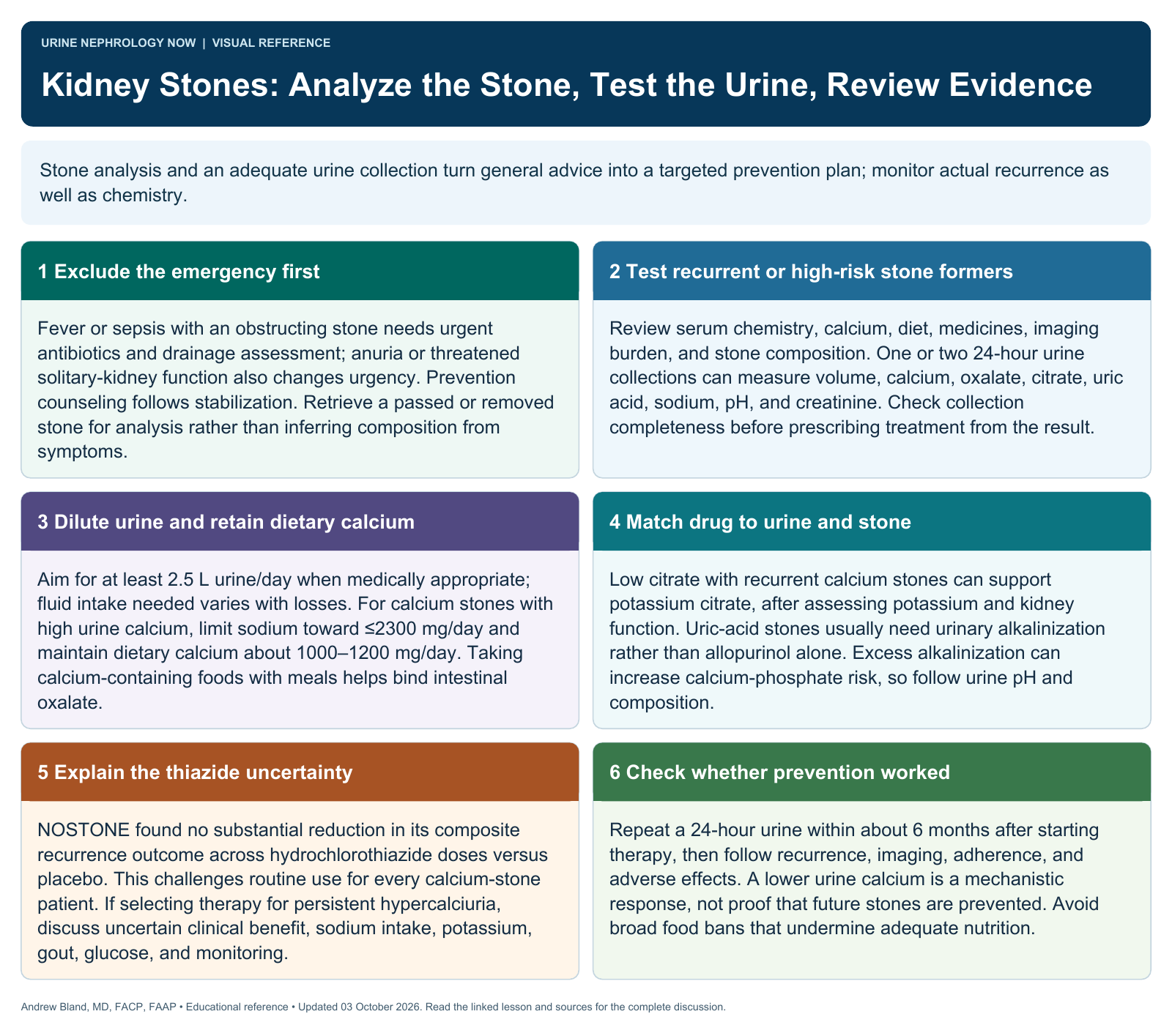
Browse the visual reference library · Download lesson Markdown
🎯 The Big Picture: Plausible Physiology, Thin Trials
Stone prevention rests on an elegant, almost certainly correct physical-chemistry premise: a stone forms when urine is supersaturated with a crystalline salt, and lowering that supersaturation should reduce crystallization.
The catch: the randomized evidence that these maneuvers reduce actual stone events is far weaker than guidelines imply. The two largest modern trials — NOSTONE (thiazide) and PUSH (hydration) — both came back null.
🧪 The Model (Sound)
Every intervention maps onto supersaturation: dilute the urine, lower the cation or anion, raise an inhibitor (citrate), or shift pH out of the salt's crystallization window.
📉 The Evidence (Thin)
Dominated by small, single-center trials from the 1980s–2000s, many comparing on-treatment recurrence to a pre-treatment rate — a design biased toward apparent benefit.
💧 Water & Hydration: Does "Pushing Fluids" Actually Work?
Fluid is the one intervention offered to every stone former — it dilutes the urine and lowers the supersaturation of every salt at once. It is also the most instructive story in stone prevention, because the observational data and the modern randomized data disagree.
✅ The Positive Signal
- Curhan (Nurses' Health Study): 81,093 women — the highest fluid-intake quintile had a 38% lower stone risk (RR 0.62).
- Borghi 1996 (the one positive RCT): in first-time formers, high fluid cut 5-year recurrence to 12% vs 27%.
⚖️ The Modern Null — PUSH 2026
- 1,658 stone formers; a behavioral program to raise fluid intake vs guideline care.
- Urine volume did rise in the intervention arm — yet symptomatic recurrence was 19% vs 20% (HR 0.96). No difference in new stones or growth.
🔑 How to Read PUSH — It Didn't Test Water
PUSH tested a behavioral adherence program — a fluid prescription plus daily financial incentives, health coaching, and smart water bottles — not water itself. Here's the catch: even with all that, median urine volume only rose from about 1.3 to 1.8 L/day — it never reached the 2.5 L target the program was built to hit. So PUSH couldn't cleanly test whether high urine volume prevents stones; it showed that getting patients to drink that much is itself the hard part.
A secondary analysis found patients whose volume rose the most had somewhat fewer stones — but that's the healthy-adherer trap: people who succeed at drinking more also tend to take their meds, watch their diet, and show up for follow-up, so you can't credit the water alone. The honest reading: fluid stays a sound, cheap, low-harm first-line measure — but pushing patients to drink more did not reliably prevent stones. Don't over-promise.
💡 Practical Target
Aim for a urine output >2–2.5 L/day (usually 2.5–3 L of intake) — urine pale yellow all day, fluid spaced across the day. Coffee, tea, and lemonade count (citrate helps); grapefruit juice is the one to skip. For the full "pushing water" discussion — including the high-risk populations where you should not push fluids — see the Water & Hydration handout.
🧪 The Same Story for Thiazides — NOSTONE
The other therapy patients hear is "the key" is thiazide for hypercalciuria. NOSTONE (416 recurrent stone formers) tested hydrochlorothiazide at 12.5, 25, and 50 mg/day against placebo — and found no reduction in recurrence at any dose, with no dose-response, even though thiazide reliably lowered urinary calcium. It's the cleanest lesson in stone prevention: a drug can move the lab number and still not move the outcome. So the two therapies everyone calls "first-line" — water and thiazide — both failed their best modern RCT. Use them as reasonable, low-harm options; don't sell them as guaranteed.
🔬 The Metabolic Workup: Who, What, When
Stone analysis is the single highest-yield test — obtain it whenever a stone is passed or retrieved. It reorganizes the differential and frequently overrides the urine chemistry.
🩺 Basic Evaluation (Any Stone Former)
- Serum calcium, electrolytes/bicarbonate, creatinine
- Urinalysis with pH
- Stone composition + imaging
🧪 Comprehensive (Recurrent / High-Risk)
- Two non-consecutive 24-hour urine collections on the habitual diet
- Defer several weeks after an acute episode or procedure
- Screen for hyperparathyroidism, distal RTA, CKD
💡 Clinical Pearl
Stone composition trumps urine chemistry. Hypercalciuria means something different if the stone is calcium oxalate (treat the calcium) versus calcium phosphate at pH 6.8 (now you worry about distal RTA and are wary of alkali). Always anchor on the stone first.
📊 Reading the 24-Hour Urine (Litholink-Style)
Read in three passes: (1) check collection adequacy, (2) read the supersaturations to find the threat salt, (3) read the analytes to explain why supersaturation is high and what is modifiable.
⚠️ Check Adequacy First
Confirm completeness with 24-hour creatinine indexed to body weight (approximately 15–20 mg/kg/day men, 10–15 women). An implausibly low creatinine means under-collection that spuriously lowers every analyte — misreading it as "normal calcium" is a common error.
💡 Clinical Pearl
Use supersaturation as the dashboard. Analytes tell you which knobs to turn; the SS for the offending salt tells you whether you turned them enough. (Remember: SS reduction is itself a surrogate — see the evidence section.)
🪨 Stone Types & Directed Therapy
💠 Calcium Oxalate (70–80%)
The workhorse stone — where nearly all trial evidence lives. Fluid for all; thiazide for hypercalciuria; K-citrate for hypocitraturia; lower sodium/animal protein with normal calcium intake; allopurinol only if hyperuricosuric.
🧊 Calcium Phosphate (rising, esp. women)
Higher urine pH, hypercalciuria, hypocitraturia. Evaluate for hyperparathyroidism and distal RTA. Citrate is double-edged here — see below.
🟡 Uric Acid (8–10%)
Driver is persistently low urine pH (insulin resistance/obesity). Cornerstone is alkalinization to pH ≈ 6.5–7.0 (K-citrate) — can both prevent and dissolve stones. Allopurinol is a reserve.
🦠 Struvite (infection)
A microbiologic problem — urease-producing organisms (Proteus, Klebsiella). Complete surgical clearance is primary; residual fragments re-seed. AHA is the only agent with RCT support but is toxic/adjunctive.
🧬 Cystine (rare, genetic)
High-volume fluid (often 3–4 L/day), aggressive alkalinization (pH >7–7.5), sodium restriction, thiol-binding agents for refractory disease.
🎯 Lowering Oxalate
Diet + normal calcium (gut calcium binds oxalate — don't restrict it). Oral calcium with meals as a binder in enteric hyperoxaluria. RNAi (lumasiran) only for primary hyperoxaluria.
💊 Does It Actually Work? What the Trials Show
⚠️ The Stone-Clinic Effect (Regression to the Mean)
Patients enroll after a cluster of stones — a statistical peak that regresses on its own. Hosking showed 58% of idiopathic calcium formers became metabolically inactive on fluid and diet advice alone. Trials using pre-treatment or historical controls credit this spontaneous regression to the drug. There is an inverse relationship between trial quality and apparent effect.
⚖️ Three Commonly Confused Therapies
💊 Allopurinol
Its randomized evidence is for calcium-oxalate stones with hyperuricosuria — NOT for uric-acid stones (where alkalinization is the cornerstone). It's a CaOx therapy that happens to act on urate.
🧲 Magnesium
Widely sold as a "stone" supplement, but the one randomized test (as the hydroxide) did not beat placebo. The "positive magnesium trial" was really a citrate trial (K-Mg citrate). Not an evidence-based monotherapy.
🧪 Citrate in CaP Disease
Double-edged: it corrects hypocitraturia but the alkali load raises urine pH, which increases calcium-phosphate supersaturation. Extrapolated from CaOx trials; monitor pH and CaP SS rather than assuming benefit transfers.
🔑 Key Takeaways
- Get stone composition and two 24-hour collections in recurrent formers; read supersaturations as the dashboard and verify adequacy by creatinine.
- Lead with fluid and diet (normal calcium, lower sodium/protein, oxalate moderation) — low harm, plausible, and give them a real trial before drugs (stone-clinic effect).
- Reserve drugs for genuinely recurrent disease: K-citrate for hypocitraturia/UA stones, allopurinol only with documented hyperuricosuria, thiazide for hypercalciuria — while candid that NOSTONE weakens the thiazide case.
- Don't reach for magnesium, and be cautious with citrate in calcium-phosphate disease.
- The largest modern trials (NOSTONE, PUSH) were null — treat these as reasonable, low-harm, mechanism-based measures, not precisely-quantified therapies.