Water, Hydration, and the "Pushing Water" Question — PT Edition
Level: DPT Student · Duration: 20–30 minutes · Version: 2026-04-18
What this handout gets you
- Why "drink more water" is wrong for a large chunk of your patient panel.
- A two-axis framework (tonicity vs volume) for sorting hydration decisions.
- Clear population guidance: athletes, older adults, CHF, CKD, dialysis.
- The counter-intuitive story PTs working with runners must know: exercise-associated hyponatremia — overdrinking can kill.
- Red flags and teach-backs you can use today.
Visual reference
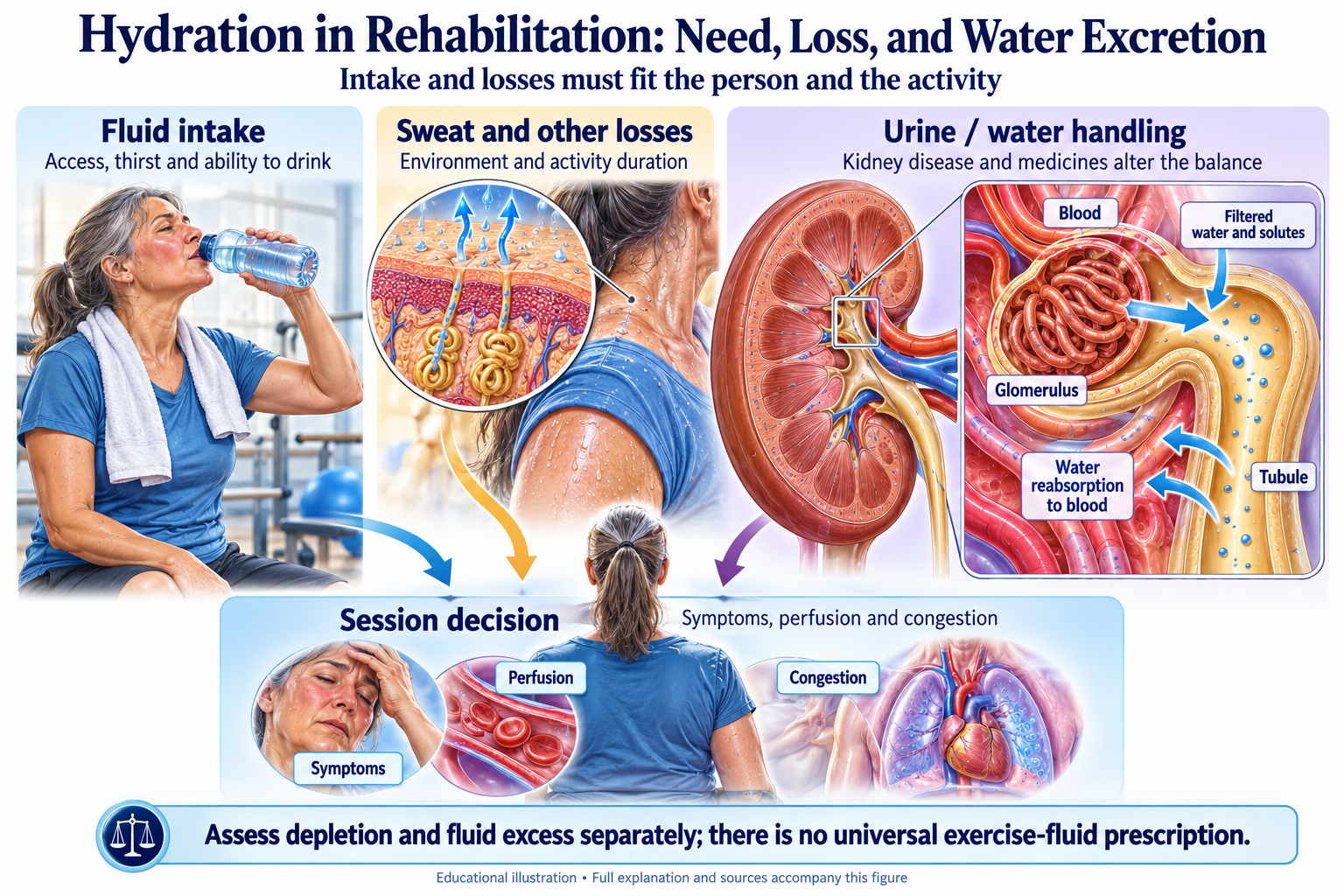
Browse the visual reference library · Download lesson Markdown
1. Why This Matters to You as a PT
"Drink more water" is the most reflexive advice in clinical medicine. It's also wrong for millions of Americans. The patient with heart failure who gains four pounds overnight got worse, not better, because she drank what her cardiac rehab group leader suggested. The endurance athlete who collapsed at mile 23 wasn't dehydrated — she had drunk herself to death. The dialysis patient on a 1.2-liter daily fluid restriction is being given bottled water by well-meaning family at every visit. These are PT patients. You're often the person who sees them weekly.
The job is not memorizing a single number. The job is recognizing which axis the patient is on — tonicity or volume — and knowing which populations flip the "more is better" rule. Once you have that, the rest is pattern recognition.
The PT's three jobs on hydration
- Recognize the populations where "drink more" is unsafe — CHF, SIADH, advanced CKD, dialysis, and endurance athletes drinking by schedule rather than thirst.
- Teach the right drinking strategy for the patient in front of you — drink-to-thirst for athletes, weight-based restriction for CHF/CKD, sick-day rules for everyone.
- Escalate the red flags — rapid weight gain, new edema, confusion, nausea-plus-headache in a runner — before they become hospitalizations.
2. What Hydration Actually Is (Minimal)
Total Body Water, in One Paragraph
About 60% of an adult man and 50% of an adult woman is water. Roughly two-thirds of that water sits inside cells (intracellular fluid); one-third sits outside (extracellular fluid), split between the plasma and the interstitium. The membranes between these compartments are freely permeable to water but not to solutes. That single fact is why tonicity matters — it determines which direction water moves.
The Two Axes PTs Conflate — Tonicity vs Volume
PTs (and many physicians) use "dehydration" to mean both "low volume" and "high sodium." They're not the same.
| Axis | What it measures | What it tells you | What treats it |
|---|---|---|---|
| Tonicity | Serum sodium concentration (solute / water ratio) | Whether cells are shrinking (hypernatremia), normal (isotonic), or swelling (hyponatremia) | Free water (if hypernatremic); free water restriction or hypertonic saline (if hyponatremic) |
| Volume | Total extracellular fluid (ECF) | Whether the patient is volume-depleted, euvolemic, or volume-overloaded | Isotonic saline (if depleted); diuretics + fluid restriction (if overloaded) |
The canonical four-box
Patients live somewhere in a 2×2 of tonicity (normal/high Na vs low Na) and volume (low/normal vs high). A patient can be volume-overloaded AND hyponatremic at the same time — that's classic CHF. Giving them more water makes both worse. Giving them salty Gatorade is also wrong (worsens volume without fixing tonicity).
Thirst: the Body's Built-in Regulator
Healthy kidneys, a healthy thirst mechanism, and access to water keep a person's sodium between 135 and 145 mmol/L nearly all the time. This is not a system that needs a rigid daily fluid target. When something goes wrong, it's almost always one of three things: the kidney can't regulate (CKD, heart failure, SIADH), the thirst mechanism is impaired (older adults, hospitalized patients, endurance athletes listening to a stopwatch instead of their body), or the fluid choice is wrong (plain water when sweat losses are big, free water when the body needs sodium).
3. What You Will See in Clinic
When "More Water" IS Right
- Ambulatory, otherwise healthy patients in hot weather, during exercise, with acute gastroenteritis — the common case. Drink to thirst plus a little is fine.
- Nephrolithiasis (kidney stones). In the Nurses' Health Study (81,093 women followed over 8 years, 719 stone events), women in the highest fluid-intake quintile had a 38% lower stone risk than women in the lowest (relative risk 0.62, 95% CI 0.48 to 0.80)[4]. Fluid is the single most cost-effective stone-prevention intervention.
- Heat stress and heavy sweat losses. The ACSM position stand recommends customized fluid replacement by individual sweat rate, targeting less than 2% body-weight loss during exercise[5].
- Recurrent UTI in women — additional water (about 1.5 L/day above baseline) reduces UTI recurrence in small trials. Reasonable to recommend.
When "More Water" Is WRONG — High-Risk Populations
🚩 Do NOT push fluids in any of these
| Population | Why extra water hurts | What PT should do |
|---|---|---|
| Congestive heart failure (any EF) | Failing heart cannot offload a volume challenge. Extra free water worsens pulmonary and peripheral edema. | Follow their cardiologist's fluid target (commonly 1.5–2 L/day). Reinforce daily weights. |
| SIADH | Body retains free water inappropriately → hyponatremia. Extra intake deepens it. | Reinforce prescribed fluid restriction (often 800–1000 mL/day). Do not add water on hot days without medical guidance[3]. |
| Advanced CKD (stage 4–5) not on dialysis | Kidneys cannot excrete free water or sodium load normally. | Defer to nephrology's individualized prescription — usually 1.5–2 L/day. |
| Dialysis (HD and PD) | Oliguric or anuric patients cannot offload fluid between sessions. Gains drive blood-pressure swings, pulmonary edema, cramping. | Reinforce the prescribed fluid and sodium limits (commonly 1–1.5 L/day). Weigh every visit. |
| Endurance athletes drinking by schedule | Slow runners who drink at every station for hours develop exercise-associated hyponatremia (see below). | Teach drink-to-thirst. Warn against "stay ahead of thirst" dogma[1]. |
| Cirrhosis with ascites or hyponatremia | Total body water is already expanded; free water worsens dilutional hyponatremia. | Reinforce fluid and sodium restriction from hepatology. |
| Psychogenic polydipsia | Massive intake overwhelms renal free-water excretion capacity. | Behavioral — coordinate with psychiatry or primary care. |
The Counter-Intuitive Story: Exercise-Associated Hyponatremia (EAH)
This is the story every PT working with runners, triathletes, or long-course endurance athletes needs to own. Overdrinking during endurance exercise kills people. Since the mid-1980s there have been well-documented fatalities, most famously Cynthia Lucero at the 2002 Boston Marathon, whose death prompted the definitive cohort study.
Almond et al. studied 488 runners with finish-line blood samples at the 2002 Boston Marathon and found 13% had hyponatremia (serum sodium ≤135 mmol/L) and 0.6% had critical hyponatremia (≤120 mmol/L)[2]. In their multivariate analysis, the two dominant risk factors were weight gain during the race (odds ratio 4.2, 95% CI 2.2 to 8.2) and racing time over 4 hours (odds ratio 7.4, 95% CI 2.9 to 23.1). These are the slower, longer-duration runners who have time to overdrink.
The 3rd International Exercise-Associated Hyponatremia Consensus (Hew-Butler et al. 2015) replaced "stay ahead of thirst" with "drink to thirst" as the guiding rule[1]. In a 2021 survey of 210 marathon runners, less than 5% could name "drink to thirst" as a prevention strategy and only 32% could list a symptom of EAH, despite 84% claiming awareness of the condition[6]. PTs working with runners are in the education gap.
🚩 EAH red flags in a runner
- Nausea + headache, often with vomiting.
- Confusion or unusual behavior.
- Puffy hands or face; tight rings; weight gain during the event.
- Late-race or post-race seizure — neuro-emergent, transport.
Do NOT give plain water. If the runner is alert and can swallow, salty broth or a hypertonic snack. Any altered mental status, vomiting, or seizure → EMS. Hyponatremia severe enough to cause seizure is treated with hypertonic saline in the hospital, not with "fluids."
Red Flags for Volume Overload (CHF / CKD / Dialysis Patients)
| Finding | What it may signal |
|---|---|
| Weight up >2 lb overnight or >5 lb in a week | Fluid retention — call the prescribing clinician |
| New or worsening lower-extremity edema | Volume overload |
| New orthopnea, PND, dyspnea on minimal exertion | Decompensating HF |
| JVP elevated (if you check it) | Volume overload |
| Poor interdialytic weight control (HD patients) | Dietary counseling needed; escalate |
4. What to Do — The PT Decision Algorithm
Decision Algorithm
Patient presents (or asks) about hydration
        ↓
Is the patient in a high-risk-for-overload group?
(CHF, SIADH, advanced CKD, dialysis, cirrhosis with ascites)
        ├── YES → Defer to their clinician's prescribed fluid target.
        │         Do NOT recommend "drink more water" on your own.
        │         Reinforce daily weights + sodium/fluid education.
        │
        └── NO  → Continue below.
        ↓
Is this an endurance athlete or prolonged heat exposure?
        ├── YES → Teach drink-to-thirst. Discourage by-the-clock drinking.
        │         Emphasize salty snacks/electrolyte fluids over plain water
        │         for events >2 hours. Warn about EAH red flags.
        │
        └── NO  → Generic guidance: drink to thirst plus a small margin.
                  Extra fluid for stone prevention if recurrent
                  nephrolithiasis.
        ↓
Is there a red flag right now?
        ├── YES → Stop session. Contact prescribing clinician or route
        │         to urgent care / ED per severity.
        │
        └── NO  → Proceed with session, reinforce teaching, document.
Population-Specific Fluid Guidance
| Population | Typical guidance | PT emphasis |
|---|---|---|
| Healthy ambulatory adult | Drink to thirst; urine color pale yellow is a practical marker. | No rigid daily target needed. |
| Older adult (blunted thirst) | Scheduled small sips through the day; 1.5–2 L total from beverages is reasonable if no cardiac/renal restriction. | Fall risk if over-restricted; edema risk if over-pushed. Balance. |
| Endurance athlete >2-hour events | Drink to thirst; include sodium (sports drinks or salty food); target <2% body-weight loss but do not chase pre-event weight[5]. | Discourage fixed-volume-per-mile plans. Weigh pre/post if possible. |
| Hot-weather exerciser | Prehydrate in the hours before; drink to thirst during; replace sodium after. Avoid free-water loading. | Acclimatize. Watch for heat illness + EAH — the symptoms overlap. |
| CHF | Follow cardiology — commonly 1.5–2 L/day, with sodium restriction. Daily weights. | Do not add "extra" water on hot days without clinician guidance. |
| Advanced CKD (stage 4–5), pre-dialysis | Individualized by nephrology; often 1.5–2 L/day. | Sodium restriction matters as much as water. |
| Dialysis (HD) | Commonly 1–1.5 L/day + 500 mL residual urine if any. <5% interdialytic weight gain. | Reinforce. Weigh every visit. Flag large gains. |
| Dialysis (PD) | Similar; ultrafiltration more continuous so restriction often slightly more liberal. | Weight + UF volume are the key data points. |
| Recurrent kidney stones | Target urine output >2 L/day — typically requires 2.5–3 L intake[4]. | Only when kidney and heart function allow. |
| SIADH | Free-water restriction (often 800–1000 mL/day)[3]. | Do NOT encourage extra fluids, even on hot days. |
Electrolyte Drinks vs Plain Water — When It Matters
- Short exercise (<60–90 min): plain water is fine for most adults.
- Long exercise (>90 min), heat, heavy sweat, or multi-hour events: include sodium. Sports drinks, electrolyte tablets, or salty food work. Plain-water-only is the classic EAH setup.
- Acute diarrheal illness: oral rehydration solution (ORS) or commercial equivalents (Pedialyte, Liquid IV) — plain water is not enough.
- Dialysis / CKD patients: be careful with sports drinks — many are high in potassium or phosphorus. Coordinate with nephrology.
- CHF patients: high-sodium beverages undo their sodium restriction. Avoid.
The Tonicity-Decoupling Framework — for most PT patients, skip the sports drink
A sports drink locks tonicity at a fixed (hypotonic) ratio of water to sodium. For exertion in a Na-normal patient, fine. For almost every other PT scenario — thiazide patient, SSRI patient, POTS, post-op older adult, cardiac-rehab heat day — a better approach is to pick sodium and water separately: broth + water, pretzels + water, pickle juice + water, salt tab + water. This is how the ICU actually replaces volume. It gives the clinician and patient control over tonicity instead of giving it away in a pre-mixed bottle.
The full master table (broth, WHO-ORS, Pedialyte, LMNT, pickle juice, salt tabs, canned soup) and the decision framework live in the companion handout:
→ High-Salt Foods & the Tonicity-Decoupling Framework (PT Edition)
The limit case for this framework — even plain water can kill at rates exceeding the kidney's free-water-excretion ceiling — is taught in depth in forthcoming Case 2f (Sports Drinks + Jennifer Strange / "Hold Your Wee for a Wii"). Architecture: principle (this handout) → application (High-Salt Foods handout) → limit case (Case 2f).
Sick-Day Rules — For Most Patients
For the otherwise-healthy adult with vomiting, diarrhea, or fever: small frequent sips of ORS or water-plus-salt. Watch for signs of dehydration (dry mouth, reduced urine, orthostatic lightheadedness). For CHF / CKD / dialysis patients, sick-day rules are opposite: they may need to hold diuretics, SGLT2 inhibitors, and ACEi/ARBs to prevent hypotensive AKI, and call their clinician early — see the NSAIDs PT handout for the overlapping sick-day logic.
5. What to Teach the Patient
Scripts You Can Use Today
The "drink to thirst" script for endurance athletes
"Your body has a built-in fluid gauge. It's called thirst. For events under 90 minutes, plain water when you're thirsty is almost always enough. For longer events, keep drinking to thirst — but include some sodium, either in a sports drink or a salty snack. Do not try to stay ahead of thirst by drinking at every aid station on schedule. Slow runners who do that end up in the medical tent with low sodium, not saved from dehydration."
The "daily weight" script for CHF / CKD / dialysis patients
"Weigh yourself every morning, same time, same scale, right after you empty your bladder and before you eat. Write it down. Call your doctor if you go up more than two pounds overnight or more than five pounds in a week. That's fluid, not fat, and your heart and kidneys notice it long before you feel it."
The "fluid restriction is not a punishment" script
"Fluid restriction feels harsh, especially in hot weather. The reason we do it is that your heart (or kidneys) can't move the water out the way a healthy body does, so extra water fills your lungs and legs instead. Sipping slowly, using ice chips, and sucking on hard candy for dry mouth all help. Write down every drink for a day so you can see how fast it adds up."
The "kidney stone prevention" script
"For kidney stones, the single most effective thing you can do is drink enough water that your urine stays pale yellow all day. Most people need two-and-a-half to three liters of total fluid — water, coffee, and tea all count. Lemonade counts too because citrate helps. Grapefruit juice is the one to skip. Space it through the day, not all at once."
The "urine color check" script
"An easy check: look at your urine after you've been up a few hours. Pale yellow like lemonade means you're in a good range. Dark yellow like apple juice means drink more. Clear as water all day long actually means you might be drinking too much. Middle of the road is the target."
When to Call — Give the Patient the List
For CHF / CKD / dialysis patients, laminate or text this list:
- Weight up >2 lb overnight or >5 lb in a week.
- New or worsening leg, foot, or hand swelling.
- New shortness of breath, especially lying flat.
- Much less urine than usual.
- New nausea, confusion, or dizziness.
- Cramping (HD patients post-session).
For endurance athletes:
- Headache + nausea during or after a long event.
- Puffy hands or face; rings suddenly tight.
- Weight gain during the event.
- Confusion, altered behavior, seizure — EMS immediately.
6. Quick-Reference Card (One Page, Printable)
Hydration & PT — At a Glance
THE TWO AXES: tonicity (serum Na) and volume (ECF). A patient can be volume-overloaded AND hyponatremic at the same time (classic CHF).
WHO GETS MORE WATER:
- Healthy ambulatory adults — drink to thirst
- Recurrent kidney stones — target urine output >2 L/day [Curhan 1998]
- Hot-weather exercise — prehydrate, drink to thirst during, replace sodium after [ACSM 2007]
- Acute diarrheal illness in otherwise healthy adults — ORS
WHO GETS LESS WATER (or prescribed restriction):
- CHF — commonly 1.5–2 L/day per cardiology
- SIADH — commonly 800–1000 mL/day [Verbalis 2013]
- Advanced CKD (stage 4–5) — individualized
- Dialysis (HD/PD) — commonly 1–1.5 L/day + residual urine
- Cirrhosis with ascites / hyponatremia
ENDURANCE ATHLETES: "drink to thirst," not by the clock [Hew-Butler 2015]. Slow runners + long races + schedule drinking = EAH. Almond 2002 Boston Marathon: 13% hyponatremic, 0.6% critical; odds ratio 4.2 for weight gain, 7.4 for race >4 hours [Almond 2005].
RED FLAGS — VOLUME OVERLOAD: weight up >2 lb overnight or >5 lb/wk; new edema; new dyspnea / orthopnea / PND.
RED FLAGS — EAH IN ATHLETES: nausea + headache, confusion, puffy hands, weight gain during event, late-race seizure → EMS; do NOT give plain water.
SICK-DAY RULE: healthy adult → ORS + sips. CHF/CKD/dialysis → hold diuretics/SGLT2i/ACEi-ARB per clinician instruction and call early; see NSAIDs PT handout.
References
- Hew-Butler T, Rosner MH, Fowkes-Godek S, Dugas JP, Hoffman MD, Lewis DP, Maughan RJ, Miller KC, Montain SJ, Rehrer NJ, Roberts WO, Rogers IR, Siegel AJ, Stuempfle KJ, Winger JM, Verbalis JG. Statement of the 3rd International Exercise-Associated Hyponatremia Consensus Development Conference, Carlsbad, California, 2015. Br J Sports Med 2015;49(22):1432–46. PMID: 26227507. PubMed
- Almond CSD, Shin AY, Fortescue EB, Mannix RC, Wypij D, Binstadt BA, Duncan CN, Olson DP, Salerno AE, Newburger JW, Greenes DS. Hyponatremia among runners in the Boston Marathon. N Engl J Med 2005;352(15):1550–6. PMID: 15829535. PubMed
- Verbalis JG, Goldsmith SR, Greenberg A, Korzelius C, Schrier RW, Sterns RH, Thompson CJ. Diagnosis, evaluation, and treatment of hyponatremia: expert panel recommendations. Am J Med 2013;126(10 Suppl 1):S1–42. PMID: 24074529. PubMed
- Curhan GC, Willett WC, Speizer FE, Stampfer MJ. Beverage use and risk for kidney stones in women. Ann Intern Med 1998;128(7):534–40. PMID: 9518397. PubMed
- Sawka MN, Burke LM, Eichner ER, Maughan RJ, Montain SJ, Stachenfeld NS. American College of Sports Medicine position stand. Exercise and fluid replacement. Med Sci Sports Exerc 2007;39(2):377–90. PMID: 17277604. PubMed
- Namineni N, Potok OA, Ix JH, Ginsberg C, Negoianu D, Rifkin DE, Garimella PS. Marathon Runners' Knowledge and Strategies for Hydration. Clin J Sport Med 2022;32(5):517–522. PMID: 34723866. PubMed