NSAIDs and Pain Management — PT Edition
Level: DPT Student · Duration: 20–30 minutes · Version: 2026-04-18
What this handout gets you
- A defensible answer when your patient asks "Should I just take some ibuprofen before therapy?"
- The three-tool PT-actionable bundle: Voltaren gel + lidocaine patch + percussion massage.
- Red flags that mean stop the session and call the prescribing clinician.
- Patient-teaching language you can use today.
Visual reference
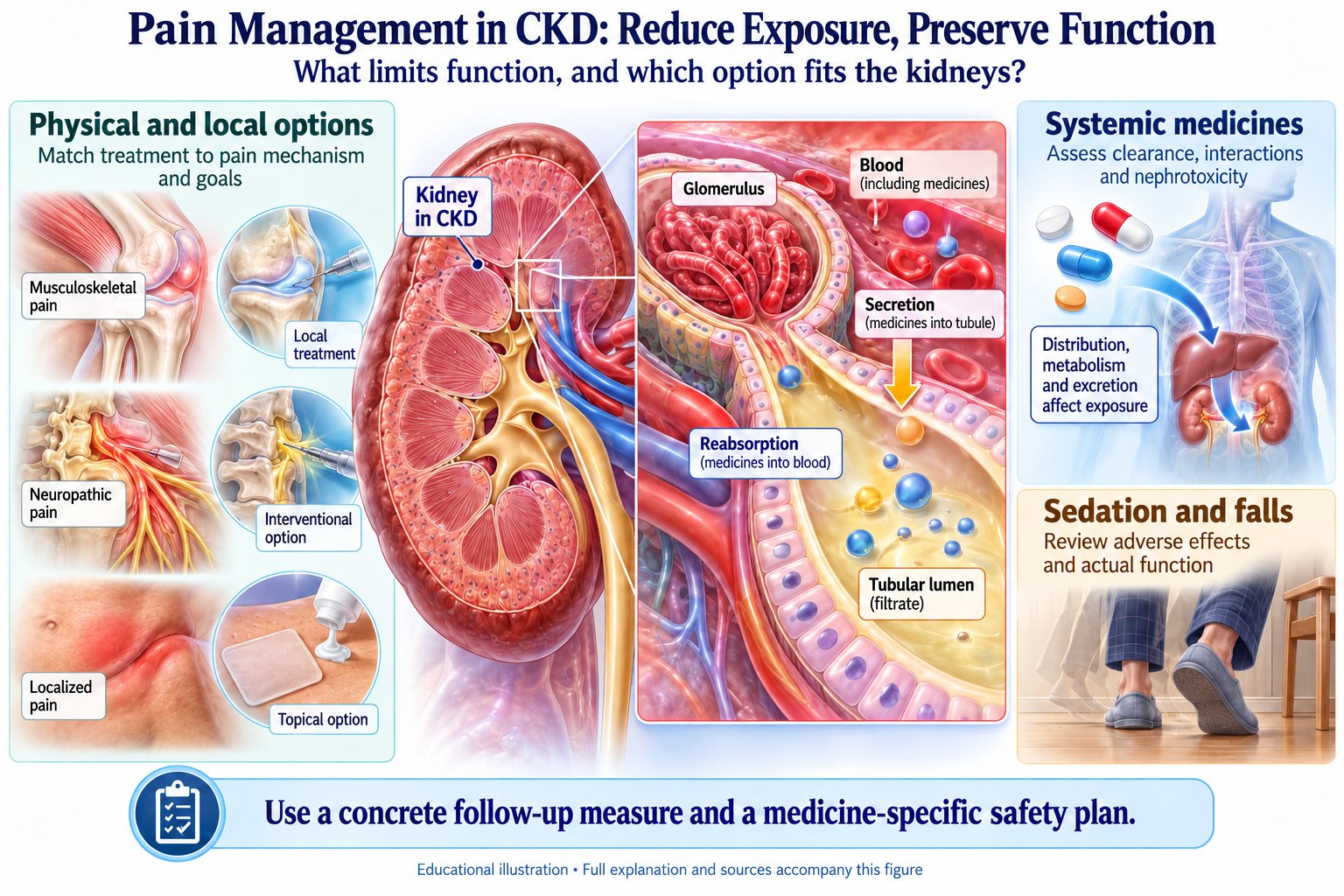
Browse the visual reference library · Download lesson Markdown
1. Why This Matters to You as a PT
Your patients use NSAIDs. A lot of them. The patient limping into outpatient ortho with knee osteoarthritis, the cardiac rehab participant whose cardiologist just added a second diuretic, the fall-risk older adult on eight medications — most of them take an NSAID at some point. You don't prescribe these drugs. You decide what to do with patients who are on them.
Here's the paradox. NSAIDs help musculoskeletal pain. That is the population you see every day. But the same drugs cause acute kidney injury, worsen heart failure, raise blood pressure, trigger ulcers, and interact with the cardiovascular medications your patients are most likely to be taking. The risk is not spread evenly: the higher the risk (CKD, CHF, elderly, on ACEi/ARB, on diuretics), the more your patient's exposure matters — and PT is one of the few places where someone is watching.
The PT's three jobs on NSAIDs
- Recognize who is at high risk for NSAID harm.
- Recommend the PT-owned alternatives — topical NSAIDs, lidocaine patches, percussion massage, graded exercise, heat/ice, TENS.
- Escalate when red flags appear — you are often the first person to see them.
This is where topical Voltaren, lidocaine patches, and a percussion massage gun become PT-owned tools — not prescriptions, but counseling. You can demonstrate a percussion device in clinic. You can teach a patient how to apply a lidocaine patch. You can explain why a 73-year-old with CHF on a loop diuretic and an ACE inhibitor should not reach for oral ibuprofen after a gardening injury.
2. What NSAIDs Actually Do (Mechanism, Minimal)
The COX Pathway in One Paragraph
NSAIDs block cyclooxygenase (COX-1 and COX-2) enzymes, which reduces prostaglandin production. Prostaglandins do two things you need to know: they inflame (COX-2 output at injury sites) and they protect (COX-1 output in the kidney, stomach, and platelets). Block the inflammation — good. Block the protection — bad. Every NSAID does both to some degree.
The Three Renal Harms PTs Need to Recognize
| Injury | Mechanism | Onset | What you might see in PT |
|---|---|---|---|
| Hemodynamic AKI | Prostaglandins normally dilate the afferent arteriole in stress states (volume depletion, CHF, cirrhosis, CKD). NSAID blocks that reflex → GFR drops fast. | Hours to days | Sudden fatigue, reduced urine output, rising BUN/creatinine on the next lab draw, orthostasis. |
| Acute interstitial nephritis (AIN) | Hypersensitivity reaction in tubulointerstitium — not dose-related. | Days to weeks | Low-grade fever, rash (sometimes absent), arthralgia, new fatigue, eosinophilia on labs. |
| Chronic CKD progression | Sustained high-dose use accelerates GFR decline in susceptible patients. | Months to years | No acute signal — shows up on labs at the next PCP visit. |
A meta-analysis of observational data found regular-dose NSAID use in moderate-to-severe CKD was not associated with accelerated progression (pooled OR 0.96, 95% CI 0.86–1.07), whereas high-dose NSAID use was (pooled OR 1.26, 95% CI 1.06–1.50) [2]. Translation: dose and duration matter more than the drug class itself.
The "Triple Whammy" — Memorize This
⚠️ Triple whammy = NSAID + ACEi/ARB + diuretic
Lapi et al. (2013) studied 487,372 patients on antihypertensive drugs in the UK. The combination of a diuretic PLUS an ACE inhibitor or ARB PLUS an NSAID raised acute kidney injury risk by 31% (rate ratio 1.31, 95% CI 1.12–1.53). The risk was highest in the first 30 days of the combination (rate ratio 1.82, 95% CI 1.35–2.46) [3].
PT implication: every cardiac rehab, HF, and older hypertensive patient in your clinic is a potential triple-whammy setup. If they add an oral NSAID for a new shoulder ache, you need to know.
Topical vs Oral — The Reason Voltaren Gel Is in This Handout
Systemic exposure after topical diclofenac is a fraction of oral dosing. In the original Voltaren Emulgel percutaneous absorption study, approximately 6% of the applied dose was systemically absorbed over 12 hours of non-occluded skin application; steady-state plasma levels on daily topical application ran at 20–40 nmol/L [4]. More recent pharmacokinetic work confirms that topical diclofenac delivers meaningful tissue concentrations at the application site while keeping plasma levels well below therapeutic oral ranges [5]. The Cochrane overview of topical analgesics puts the safety story plainly: "Systemic or local adverse event rates with topical NSAIDs (4.3%) were no greater than with topical placebo (4.6%)" in acute pain, and GI adverse events with topical NSAIDs did not differ from placebo [6].
That is the sentence worth memorizing. Topical is not "weaker oral." Topical is a different risk profile — enough local drug to help, too little systemic drug to harm.
3. What You Will See in Clinic
The High-Risk Patient Profile
The patients where NSAID harm is most likely to bite are exactly the ones filling your schedule. Memorize this profile:
- Age >65 — reduced GFR, more medications, more comorbidity.
- CKD (known eGFR <60, or history of diabetes / long-standing hypertension).
- Heart failure (any EF) — prostaglandin-dependent renal perfusion.
- On an ACEi, ARB, or ARNI (sacubitril/valsartan) — efferent dilation already present.
- On a diuretic — volume-depleted baseline.
- On an SGLT2 inhibitor (empagliflozin, dapagliflozin) — expected mild volume contraction.
- On lithium — NSAIDs raise lithium levels, can trigger toxicity.
- Dehydration / recent GI illness / hot-weather exertion — acute volume issues amplify NSAID effect.
Red Flags — What to Watch For During PT
🚩 If any of these appear during or between sessions, stop and escalate
| Finding | What it may signal |
|---|---|
| New lower-extremity edema, rapid weight gain (>2 lb/day) | Sodium retention, worsening HF, or NSAID-related fluid overload |
| New or worsening dyspnea, orthopnea, PND | Decompensated HF |
| New/rising blood pressure out of baseline range | NSAID-driven BP rise or volume overload |
| Orthostatic drop >20 mmHg SBP with symptoms | Volume depletion — possible hemodynamic AKI setup |
| Reduced urine output (patient reports going less often, darker urine) | AKI |
| New fatigue, nausea, metallic taste, confusion | Uremic symptoms from AKI |
| Low-grade fever + new rash + joint pain | AIN — classic triad |
| Black or maroon stool, new epigastric pain, coffee-ground emesis | GI bleeding |
| Lithium patient with new tremor, confusion, ataxia | Lithium toxicity from NSAID interaction |
Three Check-Questions for Every PT Session
- "Any new over-the-counter medications since I saw you last?" — catches the Advil-for-a-tweak.
- "How much are you drinking — water, not coffee or soda — on exercise days?" — catches volume depletion.
- "Any new swelling in your ankles or weight gain since last visit?" — catches volume overload.
These take 20 seconds. They catch the vast majority of NSAID-related decompensations before they land in the ED.
4. What to Do — The PT Decision Algorithm
Decision Algorithm
Patient reports using or considering an NSAID for MSK pain
        ↓
Is the patient in any high-risk bucket above?
        ├── NO  →  Topical first. Short-course oral NSAID is reasonable if
        │         topical inadequate and no absolute contraindication.
        │         Document the counseling.
        │
        └── YES →  Do NOT recommend oral NSAIDs on your own.
                   Pivot to the PT-actionable bundle (Section 4b).
                   Document your counseling and escalate any decision
                   about oral NSAIDs back to the prescribing clinician.
        ↓
Is there a red flag right now?
        ├── NO  →  Proceed with session, apply non-pharm tools,
        │         reinforce teaching, note in chart.
        │
        └── YES →  Stop the session. Contact the prescribing clinician
                   or route to urgent care / ED per severity.
4b. The PT-Actionable Bundle — Voltaren Gel + Lidocaine Patch + Percussion Massage
These are the three tools you can reach for today. They are not prescriptions. They are counseling — what you demonstrate, recommend, and explain.
Tool 1 — Voltaren (Diclofenac) Gel 1% (OTC in the US since 2020)
- Best for: localized osteoarthritis pain of knee, hand, ankle, elbow — superficial joints. Less useful for hip, shoulder, spine (too much tissue between skin and target).
- Evidence: Cochrane 2016 — topical diclofenac NNT for clinical success (approximately 50% pain relief) in knee osteoarthritis over 6–12 weeks = 9.8 (95% CI 7.1–16, moderate-quality evidence). The few head-to-head trials of topical vs oral NSAIDs showed similar efficacy overall, though evidence quality was low and data were almost entirely from knee OA [7].
- Dose (per patient's prescribing clinician or OTC label): 2 g or 4 g per application (knee vs hand), four times daily. Use the dosing card from the tube.
- PT counseling: rub in until dry, do not occlude with a bandage immediately after, do not apply heat over the area for approximately 1 hour, wash hands after application (unless treating the hands).
- Cautions: pregnancy (especially third trimester), open skin, severe aspirin-sensitive asthma, active GI bleeding. Patients on anticoagulants should still notify their prescribing clinician even though systemic absorption is low.
Tool 2 — Lidocaine Patch 5% (Rx) or 4% (OTC)
- Best for: well-localized neuropathic pain (classic indication: postherpetic neuralgia), localized myofascial pain where a defined trigger area can be covered. Lidocaine patch is a guideline-level first-line option for PHN [8]. Evidence in chronic musculoskeletal pain is more limited than for PHN — position it as an adjunct, not a primary.
- Dose: up to three patches at a time for up to 12 hours on, 12 hours off (per label).
- PT counseling: apply to intact skin only; cut patches to shape before removing the backing; avoid heating pads over the patch (increases absorption); remove before bathing.
- Cautions: severe hepatic disease, known lidocaine allergy, use with caution in patients on Class I antiarrhythmics. Symptomatic bradyarrhythmia, metallic taste, lightheadedness → remove and escalate.
Tool 3 — Percussion Massage (Percussive Massage Therapy)
- Best for: delayed-onset muscle soreness (DOMS), trigger-point release, warm-up and recovery in physically active patients. A 2025 randomized trial in active young men found that 40-minute sessions of percussive massage therapy produced greater reductions in VAS pain scores and greater recovery of knee range of motion and jump performance at 48 hours post-exercise than static stretching, with longer sessions outperforming shorter (25-minute) sessions [9].
- PT counseling: demonstrate proper head selection, pressure (not pain), and time on muscle belly (typically 1–2 minutes per area). Avoid bony prominences, the anterior neck, the kidney area, and directly over joints.
- Contraindications and cautions:
- Anticoagulation (warfarin, DOACs) — higher bruising / hematoma risk; avoid or use very low intensity.
- Known or suspected DVT — do NOT use over the affected limb.
- Open wounds, fragile skin, active infection, acute fracture, recent surgery on the area.
- Severe osteoporosis, uncontrolled hypertension, pregnancy over areas of concern.
- Peripheral neuropathy with reduced sensation — patient cannot report pain accurately.
How the bundle works together
A knee-OA patient in cardiac rehab on furosemide and lisinopril asks whether they can take ibuprofen for a flare. The safe answer is almost never yes — that combination is the triple whammy. The defensible answer is the bundle: Voltaren gel to the knee four times daily, a lidocaine patch at night if the pain disrupts sleep, percussion massage to the quadriceps and hamstrings before exercise. Reinforce graded exercise and ice. Escalate to the prescribing clinician if pain control is still inadequate after one to two weeks — they can make the oral-NSAID risk/benefit call, not you.
4c. Other Non-Pharm and Adjunctive Tools
| Tool | Best for | PT role |
|---|---|---|
| Acetaminophen | Baseline analgesia in CKD/CHF/elderly | Remind patient of daily max (3 g in vulnerable populations, 4 g otherwise); no alcohol; does not replace NSAID anti-inflammatory effect but is renal-safe and cardiac-safe in standard doses. |
| Duloxetine (Cymbalta) | Chronic knee OA, chronic low back pain — a prescribing clinician's decision | Recognize it is in the pain toolkit; modest effect size — a 2020 systematic review and meta-analysis of nine RCTs found duloxetine produced a weighted mean difference of −0.67 on a 10-point pain scale vs placebo in OA/chronic low back pain [10]. Watch for orthostasis, fall risk, sedation. |
| Topical capsaicin | Chronic localized pain, PHN, OA | Counsel on the initial burning sensation, regular application needed for effect, avoid eyes / mucous membranes. |
| TENS | Chronic low back, knee OA, muscle pain | Electrode placement, intensity titration, skin inspection. |
| Heat / ice | Acute injuries (ice early), chronic stiffness (heat) | Timing, skin protection, not over topical NSAID or lidocaine patch application sites. |
| Graded therapeutic exercise | Almost everything you see | The primary intervention. Every other tool is adjunct. |
4d. Drug Interactions Every PT Should Know
| If patient takes... | Adding an NSAID risks... | PT action |
|---|---|---|
| ACEi / ARB / ARNI | AKI via blocked efferent dilation + blocked afferent dilation | Steer to topical / non-pharm; escalate if oral NSAID being considered |
| Loop or thiazide diuretic | Volume-depletion AKI; diuretic resistance | Same — pivot to bundle |
| SGLT2 inhibitor | Mild additional volume contraction; small added AKI signal | Same — pivot to bundle |
| MRA (spironolactone, eplerenone) | Hyperkalemia; AKI in combination with ACEi/ARB | Escalate |
| Anticoagulants (warfarin, DOACs, heparin) | GI bleeding; intracranial bleeding | Avoid oral NSAID counseling; prefer topical + non-pharm; report bruising |
| Antiplatelets (aspirin, clopidogrel) | GI bleeding; if ASA primary-prevention, NSAID may blunt its antiplatelet effect | Same |
| Lithium | Reduced lithium clearance → toxicity (tremor, confusion, ataxia) | Escalate; never recommend oral NSAID on your own |
| Corticosteroids | Synergistic GI ulceration | Avoid oral NSAID counseling |
5. What to Teach the Patient
Teaching happens in plain language. The sentences below are tested — they work in actual clinic conversations.
Scripts You Can Use Today
The "why we're starting with topical" script
"The ibuprofen and naproxen pills work well for pain, but they can hurt your kidneys, raise your blood pressure, and make your heart medicines less effective. The gel and patch give you most of the pain relief without those risks — so that's where we're starting. If we can't get you comfortable with these tools plus exercise and heat/ice, I'll help you talk to your doctor about whether an oral pill is worth the tradeoff."
The "hold the NSAID on sick days" script
"Any day you are throwing up, have diarrhea, or can't keep fluids down — skip the gel too, not just the pill. Your kidneys need water to work, and these medicines make them more sensitive to being dry. Same rule for a bad flu or any hospitalization — hold NSAIDs until you are drinking normally again."
The "watch your weight" script for CHF and CKD patients
"Weigh yourself every morning, same time, same scale, right after you empty your bladder. Call your doctor if you gain more than two pounds in a day or five pounds in a week — that's fluid, not fat, and it matters for your heart and your kidneys."
The "percussion gun safety" script
"Think of this as pressure, not pain — if it hurts, ease off. Stay on muscle, not bone and not joints. Not over the front of the neck, not over the kidneys on your back, and not over any area that's bruised, numb, or healing. If you're on a blood thinner, let me show you a much lighter setting, or we'll use a different tool."
When to Call — Give the Patient the List
Print or text the patient a short version of this list. Laminate it for CHF/CKD high-risk patients.
- Weight up >2 lb overnight or >5 lb in a week.
- New or worse swelling in legs or feet.
- New shortness of breath, especially lying flat.
- Less urine than usual, or dark urine.
- New nausea or vomiting lasting more than a day.
- Black, tarry, or bloody stool; vomit that looks like coffee grounds.
- Confusion, dizziness, lightheadedness standing up.
6. Quick-Reference Card (One Page, Printable)
NSAID & PT Pain Management — At a Glance
HIGH-RISK (don't recommend oral NSAIDs on your own): age >65 · CKD · CHF · on ACEi/ARB/ARNI · on diuretic · on SGLT2i · on lithium · volume-depleted.
THE TRIPLE WHAMMY: NSAID + ACEi/ARB + diuretic = +31% AKI risk, highest in first 30 days [Lapi 2013].
THE PT BUNDLE:
- Voltaren gel 1% — 2 or 4 g four times daily; used for knee, hand, ankle, and elbow OA in practice; NNT 9.8 at 6–12 wk for knee OA [Derry 2016].
- Lidocaine patch — up to 3 patches, 12 hr on / 12 hr off; localized pain; first-line for PHN [Tang 2023].
- Percussion massage — muscle bellies only, 1–2 min per area, avoid anticoag/DVT/fractures/sensation loss [Li 2025].
RED FLAGS — STOP SESSION, ESCALATE: new edema · rapid weight gain · new dyspnea/orthopnea · orthostatic drop · reduced urine output · new fever+rash+joint pain · GI bleeding signs · lithium-toxicity symptoms.
THREE CHECK-QUESTIONS EVERY SESSION:
- Any new over-the-counter meds since last time?
- How much water on exercise days?
- Any new swelling or weight gain?
SICK-DAY RULE: vomiting, diarrhea, dehydration, hospitalization → hold ALL NSAIDs (oral AND topical) until eating/drinking normally.
References
- Derry S, Moore RA, Rabbie R. Topical NSAIDs for chronic musculoskeletal pain in adults. Cochrane Database Syst Rev 2012;9:CD007400. PMID: 22972108. PubMed (superseded by 2016 update; included for historical completeness)
- Nderitu P, Doos L, Jones PW, Davies SJ, Kadam UT. Non-steroidal anti-inflammatory drugs and chronic kidney disease progression: a systematic review. Fam Pract 2013;30(3):247–55. PMID: 23302818. PubMed
- Lapi F, Azoulay L, Yin H, Nessim SJ, Suissa S. Concurrent use of diuretics, angiotensin converting enzyme inhibitors, and angiotensin receptor blockers with non-steroidal anti-inflammatory drugs and risk of acute kidney injury: nested case-control study. BMJ 2013;346:e8525. PMID: 23299844. PubMed
- Riess W, Schmid K, Botta L, et al. The percutaneous absorption of diclofenac. Arzneimittelforschung 1986;36(7):1092–6. PMID: 3768079. PubMed
- Brunner M, Davies D, Martin W, Leuratti C, Lackner E, Müller M. A new topical formulation enhances relative diclofenac bioavailability in healthy male subjects. Br J Clin Pharmacol 2011;71(6):852–9. PMID: 21241352. PubMed
- Derry S, Wiffen PJ, Kalso EA, Bell RF, Aldington D, Phillips T, Gaskell H, Moore RA. Topical analgesics for acute and chronic pain in adults — an overview of Cochrane Reviews. Cochrane Database Syst Rev 2017;5:CD008609. PMID: 28497473. PubMed
- Derry S, Conaghan P, Da Silva JAP, Wiffen PJ, Moore RA. Topical NSAIDs for chronic musculoskeletal pain in adults. Cochrane Database Syst Rev 2016;4:CD007400. PMID: 27103611. PubMed
- Tang J, Zhang Y, Liu C, Zeng A, Song L. Therapeutic Strategies for Postherpetic Neuralgia: Mechanisms, Treatments, and Perspectives. Curr Pain Headache Rep 2023;27(9):307–319. PMID: 37493871. PubMed
- Li H, Luo L, Zhang J, Cheng P, Wu Q, Wen X. The effect of percussion massage therapy on the recovery of delayed onset muscle soreness in physically active young men — a randomized controlled trial. Front Public Health 2025;13:1561970. PMID: 40206177. PubMed
- Weng C, Xu J, Wang Q, Lu W, Liu Z. Efficacy and safety of duloxetine in osteoarthritis or chronic low back pain: a systematic review and meta-analysis. Osteoarthritis Cartilage 2020;28(6):721–734. PMID: 32169731. PubMed