Visual summary
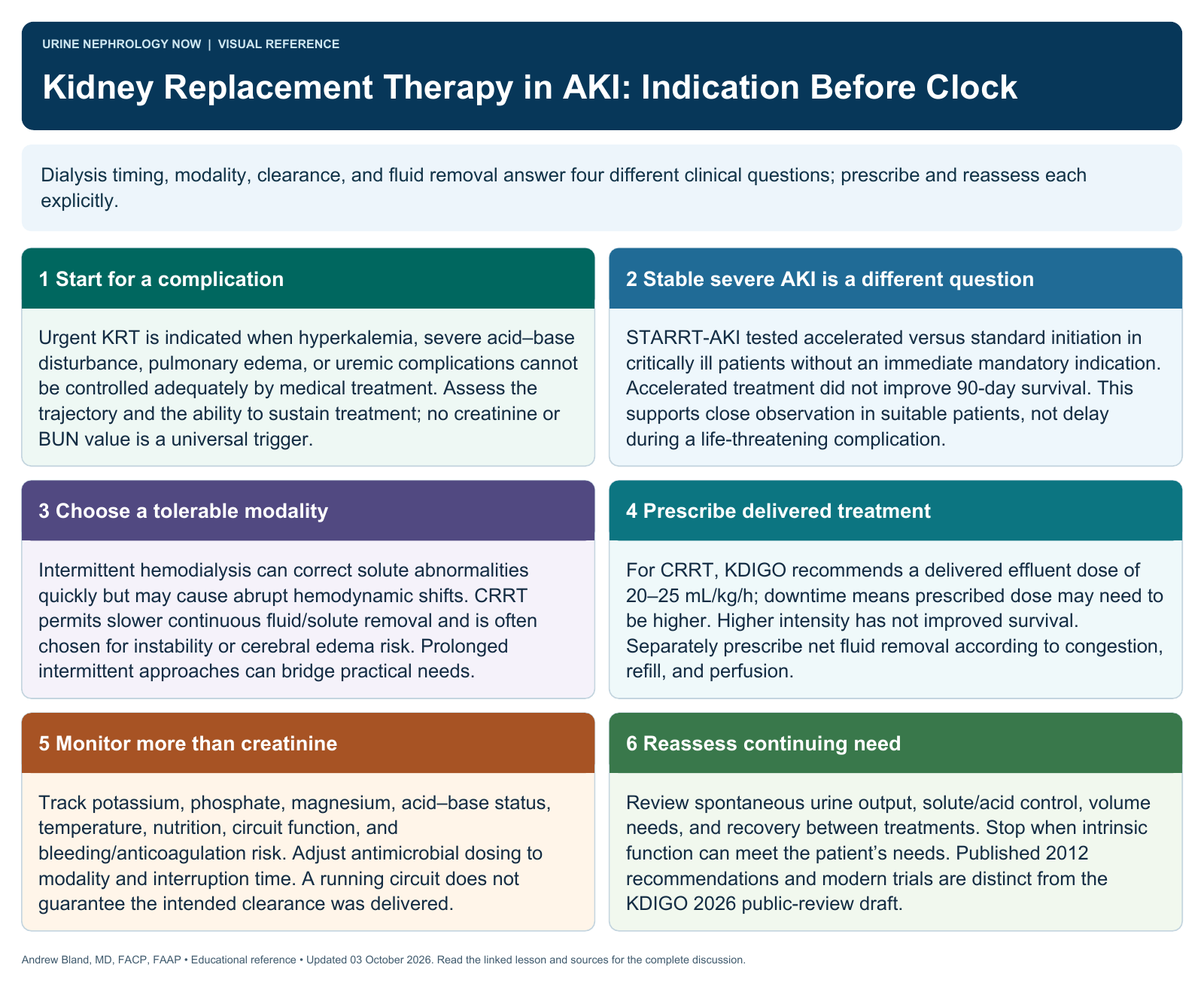
Dialysis timing, modality, clearance, and fluid removal answer four different clinical questions; prescribe and reassess each explicitly.
Text version
Start for a complication
Urgent KRT is indicated when hyperkalemia, severe acid–base disturbance, pulmonary edema, or uremic complications cannot be controlled adequately by medical treatment. Assess the trajectory and the ability to sustain treatment; no creatinine or BUN value is a universal trigger.
Stable severe AKI is a different question
STARRT-AKI tested accelerated versus standard initiation in critically ill patients without an immediate mandatory indication. Accelerated treatment did not improve 90-day survival. This supports close observation in suitable patients, not delay during a life-threatening complication.
Choose a tolerable modality
Intermittent hemodialysis can correct solute abnormalities quickly but may cause abrupt hemodynamic shifts. CRRT permits slower continuous fluid/solute removal and is often chosen for instability or cerebral edema risk. Prolonged intermittent approaches can bridge practical needs.
Prescribe delivered treatment
For CRRT, KDIGO recommends a delivered effluent dose of 20–25 mL/kg/h; downtime means prescribed dose may need to be higher. Higher intensity has not improved survival. Separately prescribe net fluid removal according to congestion, refill, and perfusion.
Monitor more than creatinine
Track potassium, phosphate, magnesium, acid–base status, temperature, nutrition, circuit function, and bleeding/anticoagulation risk. Adjust antimicrobial dosing to modality and interruption time. A running circuit does not guarantee the intended clearance was delivered.
Reassess continuing need
Review spontaneous urine output, solute/acid control, volume needs, and recovery between treatments. Stop when intrinsic function can meet the patient’s needs. Published 2012 recommendations and modern trials are distinct from the KDIGO 2026 public-review draft.