Visual summary
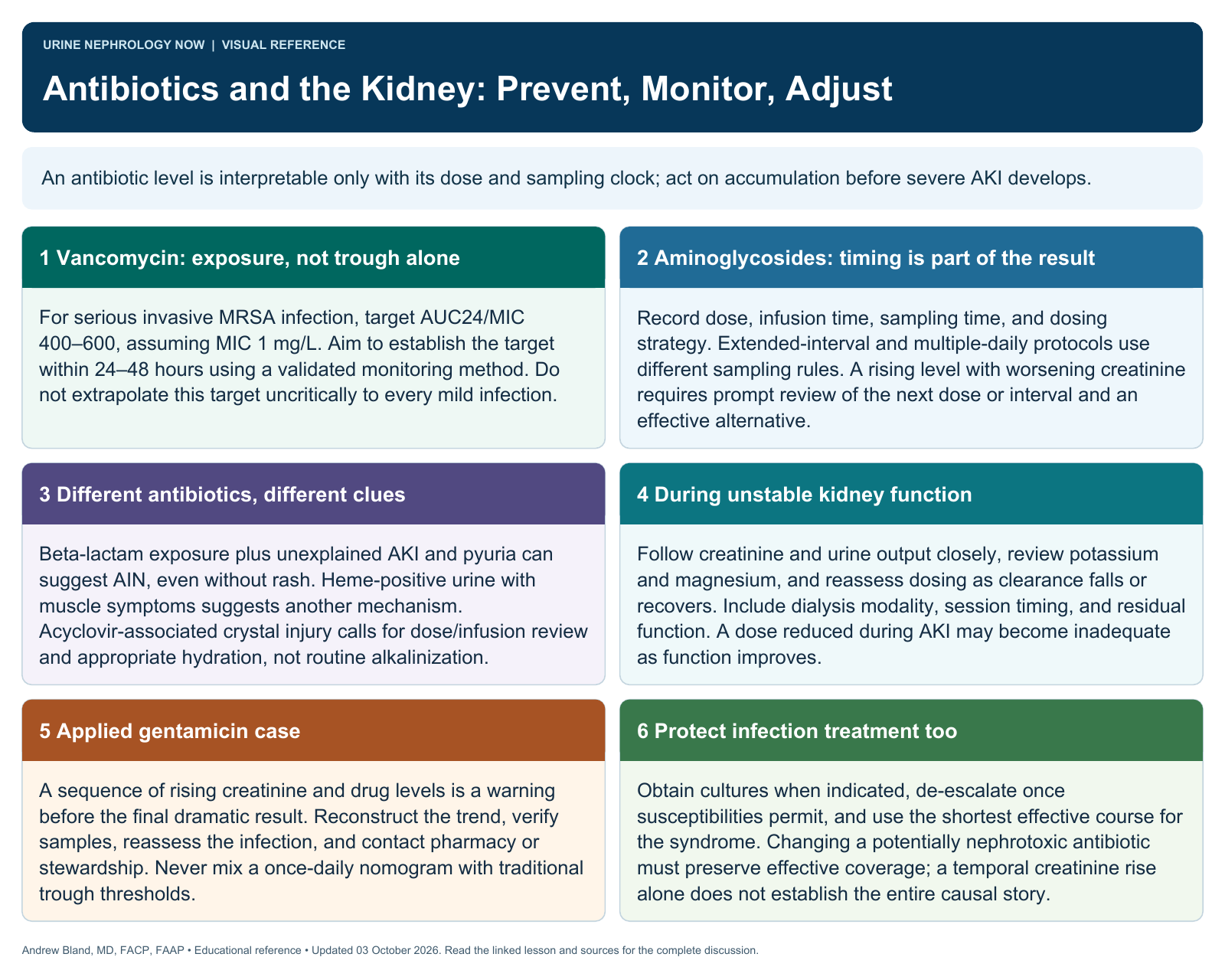
An antibiotic level is interpretable only with its dose and sampling clock; act on accumulation before severe AKI develops.
Text version
Vancomycin: exposure, not trough alone
For serious invasive MRSA infection, target AUC24/MIC 400–600, assuming MIC 1 mg/L. Aim to establish the target within 24–48 hours using a validated monitoring method. Do not extrapolate this target uncritically to every mild infection.
Aminoglycosides: timing is part of the result
Record dose, infusion time, sampling time, and dosing strategy. Extended-interval and multiple-daily protocols use different sampling rules. A rising level with worsening creatinine requires prompt review of the next dose or interval and an effective alternative.
Different antibiotics, different clues
Beta-lactam exposure plus unexplained AKI and pyuria can suggest AIN, even without rash. Heme-positive urine with muscle symptoms suggests another mechanism. Acyclovir-associated crystal injury calls for dose/infusion review and appropriate hydration, not routine alkalinization.
During unstable kidney function
Follow creatinine and urine output closely, review potassium and magnesium, and reassess dosing as clearance falls or recovers. Include dialysis modality, session timing, and residual function. A dose reduced during AKI may become inadequate as function improves.
Applied gentamicin case
A sequence of rising creatinine and drug levels is a warning before the final dramatic result. Reconstruct the trend, verify samples, reassess the infection, and contact pharmacy or stewardship. Never mix a once-daily nomogram with traditional trough thresholds.
Protect infection treatment too
Obtain cultures when indicated, de-escalate once susceptibilities permit, and use the shortest effective course for the syndrome. Changing a potentially nephrotoxic antibiotic must preserve effective coverage; a temporal creatinine rise alone does not establish the entire causal story.