Pre-Case Assessment: Test Your Baseline Knowledge
Answer these questions before reviewing the case to assess your starting knowledge
Which aminoglycoside has the highest nephrotoxicity risk based on its molecular structure?
Learning Point: Gentamicin has +5 positive charges and 5 amino groups, creating the highest nephrotoxicity among commonly used aminoglycosides. Higher positive charge → stronger binding to negatively charged tubular cells → greater toxicity.
📚 Reference: Aminoglycoside Structure-Toxicity Relationship
Which urinalysis finding most strongly supports acute tubular injury (often called ATN) in this case?
Learning Point: Muddy brown granular casts strongly support acute tubular injury. They contain uromodulin and cellular debris; interpret them alongside tubular cells, exposures, hemodynamics, and the kidney-function trend.
📚 Reference: Complete Cast Interpretation Guide
What is the typical timeline for aminoglycoside-induced nephrotoxicity to become clinically apparent?
Learning Point: Aminoglycoside nephrotoxicity has a characteristic delayed onset (7-10 days) because damage accumulates in lysosomes before affecting tubular function. This delayed pattern helps differentiate from prerenal AKI.
📚 Reference: Antibiotic Nephrotoxicity Timelines
Case Presentation
Patient: 65-year-old man
Chief Complaint: Decreased urine output and rising creatinine on day 8 of gentamicin therapy
History: Admitted 8 days ago with severe pneumonia and sepsis. Started on gentamicin 320mg IV q24h (5mg/kg) plus ceftriaxone. Clinical improvement noted but routine lab monitoring shows rising creatinine.
Past Medical History: Type 2 diabetes, hypertension, stage 2 CKD (baseline Cr 1.4 mg/dL)
Medications: Gentamicin 320mg q24h (day 8), ceftriaxone 2g daily, metoprolol, metformin (held), insulin sliding scale
🤔 Initial Clinical Reasoning Questions
Based on this presentation, what are the key risk factors for drug-induced AKI in this patient?
Clinical Reasoning: This patient has the "triple threat" for aminoglycoside toxicity: advanced age (>65), pre-existing CKD (baseline 1.4 mg/dL), and prolonged therapy (8 days). Each factor independently increases risk.
📚 Learn More: Antibiotic Nephrotoxicity Risk Factors
What was the rationale for using extended-interval dosing (320mg q24h) in this patient?
Learning Point: Extended-interval dosing leverages aminoglycosides' concentration-dependent killing and post-antibiotic effect while allowing time for drug clearance from proximal tubules, reducing nephrotoxicity by 30-50%.
📚 Reference: Full article: 💉 Antibiotic-Induced Nephrotoxicity
Interactive Clinical Timeline Analysis
Click through each time point to analyze the progression of nephrotoxicity
📅 Days 1-2: Initial Treatment & First Trough
Creatinine 1.5 mg/dL, first gentamicin trough 0.8 mg/L. Was the initial dosing appropriate?
Initial Dosing Analysis:
- Dose calculation: 5 mg/kg × 64 kg = 320mg q24h ✓ Appropriate
- Trough level: 0.8 mg/L (target <2.0 mg/L) ✓ Acceptable
- Clinical status: Septic, requiring treatment ✓ Indicated
- Creatinine: 1.5 mg/dL (stable from baseline) ✓ No concerns yet
Decision: Continue current dosing, monitor trough levels every 2-3 days.
📅 Days 3-5: Rising Levels & Clinical Improvement
Creatinine slowly rising (1.5→1.7 mg/dL), trough levels increasing (1.2→1.6 mg/L). Patient improving clinically. Continue or modify therapy?
Mid-Treatment Decision Point:
- Trough trend: 0.8 → 1.2 → 1.6 mg/L (concerning upward trend)
- Creatinine trend: 1.5 → 1.6 → 1.7 mg/dL (gradual increase)
- Clinical status: Significant improvement, off vasopressors
- Risk assessment: Accumulating drug despite normal GFR-based dosing
⚠️ Critical Teaching Point: This is the decision point where intervention could prevent toxicity. Consider extending interval to q36h or stopping gentamicin with monotherapy.
📅 Days 6-8: Overt Nephrotoxicity
Creatinine jumps to 2.8 mg/dL, urine output drops to 30 mL/hr, trough 2.4 mg/L. What went wrong?
Nephrotoxicity Analysis:
- KDIGO Staging: 2.8 ÷ 1.5 = 1.87× increase = Stage 2 AKI
- Trough level: 2.4 mg/L is grossly elevated for once-daily (Hartford-style) gentamicin dosing — Hartford-style targets a trough <1 mg/L (often undetectable) at 24 hours, NOT the <2 mg/L threshold used for traditional multiple-daily-dosing (MDD) protocols. Day 5 trough of 1.6 mg/L should already have triggered a hold/extension.
- Mechanism: Lysosomal accumulation → mitochondrial dysfunction → tubular cell death
- Clinical signs: Oliguria + rising creatinine = Established ATN
🚨 Key Learning: The traditional MDD trough cutoff (<2.0 mg/L) does NOT apply to Hartford-style q24h dosing — the goal there is undetectable trough at 24 h. Applying MDD targets to once-daily dosing missed the accumulation.
📅 Day 8: Urinalysis Results Available
Fresh urinalysis shows muddy brown granular casts, RTECs, and FENa 3.6%. How do these findings refine the working diagnosis?
Urinalysis Supporting Acute Tubular Injury:
- Muddy brown casts: Strong evidence for tubular injury; correlate with the clinical course
- Renal tubular epithelial cells: Direct evidence of tubular damage
- FENa 3.6%: Consistent with impaired sodium reabsorption, but not diagnostic of ATN or gentamicin toxicity; diuretics and CKD can also raise FENa
- Isosthenuria: Specific gravity 1.012 = loss of concentrating ability
Working Diagnosis: Acute tubular injury, with gentamicin exposure a likely contributor after reviewing competing causes
📚 Reference: Complete Urinalysis Interpretation
Laboratory Evolution Analysis
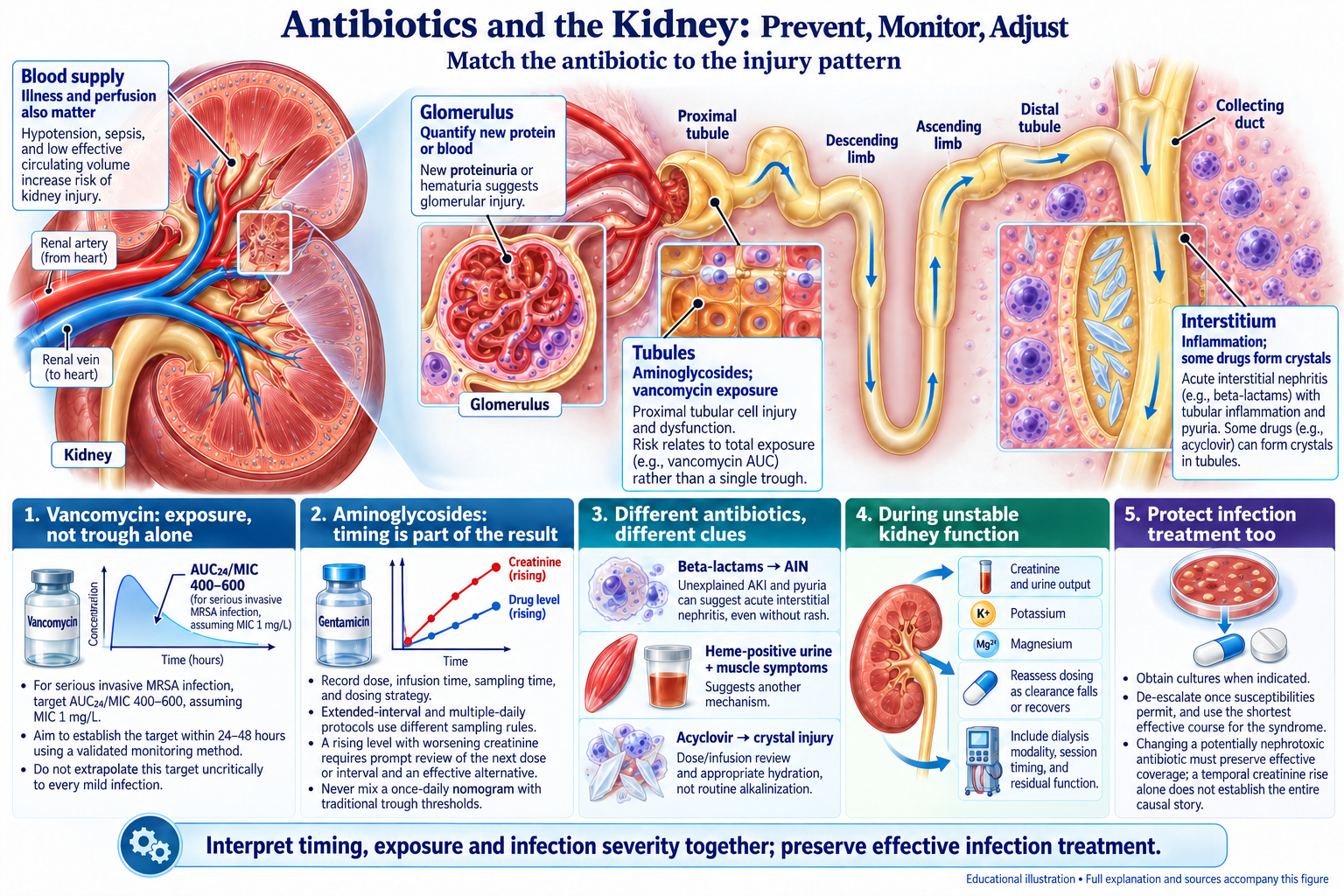
Therapeutic Drug Monitoring Failure Analysis (Hartford-style q24h gentamicin)
Extended-interval and conventional multiple-daily aminoglycoside regimens require different sampling schedules and targets. Follow the specific dosing and monitoring protocol, reassess kidney function, and investigate accumulating concentrations.
| Day | Dose | Creatinine | Trough Level (24h) | Hartford q24h Target | Action Taken | Optimal Action |
|---|---|---|---|---|---|---|
| 1 | 320mg | 1.5 mg/dL | 0.8 mg/L | <1 mg/L (ideally undetectable) | Continue | ⚠️ Borderline — recheck |
| 3 | 320mg | 1.6 mg/dL | 1.2 mg/L | <1 mg/L | Continue | ⚠️ Above Hartford target — extend interval to q36h |
| 5 | 320mg | 1.7 mg/dL | 1.6 mg/L | <1 mg/L | Continue | ❌ Hold and reassess — accumulation evident |
| 7 | 320mg | 2.1 mg/dL | 2.4 mg/L | <1 mg/L | Continue | ❌ Should have stopped by day 3 once trough rose above 1 mg/L |
📊 Therapeutic Drug Monitoring Analysis
At what point should gentamicin therapy have been discontinued based on TDM data?
Clinical Teaching: The rising trough trend (0.8→1.2→1.6 mg/L) on days 1-5 indicated drug accumulation despite stable creatinine. This is the window for prevention before overt toxicity develops.
📚 Learn More: Therapeutic Drug Monitoring Protocols
Calculate the KDIGO AKI stage for this patient on Day 8:
Day 1 creatinine: 1.5 mg/dL, Day 8 creatinine: 2.8 mg/dL (true pre-illness baseline 1.4 mg/dL)
Calculation: Using the true pre-illness baseline of 1.4 mg/dL: 2.8 ÷ 1.4 = 2.0× baseline increase, meeting KDIGO Stage 2 criteria (2.0-2.9× baseline). Note: Stage 2 also includes urine output <0.5 mL/kg/hr for ≥12 hours.
📚 Reference: Interactive KDIGO Calculator
Why is the BUN:Creatinine ratio remaining around 20:1 rather than the >30:1 seen in prerenal AKI?
Learning Point: In intrinsic AKI (ATN), damaged tubules cannot enhance urea reabsorption like functioning tubules do in prerenal states. The BUN:Cr ratio typically remains 10-20:1 in ATN vs >20:1 in prerenal AKI.
📚 Learn More: AKI Classification: Prerenal vs Intrinsic
Aminoglycoside Nephrotoxicity: Molecular Mechanisms
🧬 Gentamicin: High-Risk Structure-Function Profile
Molecular Structure
- Positive Charges: +5 (highest among common agents)
- Amino Groups: 5 groups
- Nephrotoxicity Rank: 4/5 (very high)
- Clinical Efficiency: Broad spectrum, cost-effective
Toxicity Pathway
- Step 1: Megalin/cubilin receptor binding
- Step 2: Proximal tubule endocytosis
- Step 3: Lysosomal accumulation (phospholipidosis)
- Step 4: Mitochondrial dysfunction → cell death
🔬 Molecular Mechanism Analysis
Which step in aminoglycoside nephrotoxicity explains the delayed onset (7-10 days)?
Mechanism: Aminoglycosides accumulate in proximal tubular lysosomes over several days before reaching the threshold for phospholipidosis and mitochondrial dysfunction. This explains why creatinine remains stable initially.
📚 Learn More: Aminoglycoside Nephrotoxicity Mechanisms
Why would amikacin (+4 charges) potentially be a safer alternative to gentamicin (+5 charges) in this patient?
Structure-Toxicity Relationship: Amikacin's +4 charges (vs gentamicin's +5) result in weaker binding to negatively charged phospholipids in tubular cells, leading to 30-40% lower nephrotoxicity risk.
📚 Reference: Complete Aminoglycoside Comparison
Management & Treatment Decisions
💊 Treatment Decision Analysis
What is the MOST important immediate intervention for this patient?
Rationale: With established ATN (muddy brown casts + Stage 2 AKI), continued gentamicin will only worsen damage. Immediate discontinuation is essential. Dose reduction or interval extension are insufficient.
📚 Learn More: Antibiotic-Induced AKI Management
What is the appropriate antibiotic strategy after discontinuing gentamicin?
Clinical Reasoning: Patient is clinically improving on dual therapy. Since gentamicin was primarily for gram-negative coverage, ceftriaxone monotherapy is appropriate if cultures support this approach and clinical improvement continues.
📚 Learn More: Antibiotic Alternatives After Nephrotoxicity
What is the expected recovery timeline for gentamicin-induced ATN?
Recovery Pattern: Aminoglycoside ATN typically shows delayed recovery onset (2-7 days) followed by gradual improvement over 2-3 weeks. Many patients have some permanent loss of function (~10-25% decrease in baseline).
📚 Learn More: AKI Recovery & Prognosis
📊 Recovery Monitoring Protocol
Immediate Phase (Days 8-10)
- Daily creatinine: Expect continued rise to peak
- Urine output monitoring: q8h measurement
- Electrolyte monitoring: Daily K+, Mg2+, PO4
- Volume status: Maintain euvolemia
Recovery Phase (Days 11-21)
- Creatinine trend: Slow decline after peak
- Polyuric phase: Watch for excessive losses
- Medication dosing: Adjust for AKI/recovery
- Nephrology consultation: If no improvement by day 14
Prevention Strategies & Future Management
🛡️ Prevention Strategy Analysis
What would be the optimal prevention strategy for future aminoglycoside use in this patient?
Strategy: While aminoglycosides should be avoided if possible, if absolutely necessary: (1) Use less nephrotoxic agent (amikacin), (2) Shortest possible duration, (3) Daily trough monitoring, (4) Stop at first sign of accumulation.
📚 Learn More: Aminoglycoside Selection & Monitoring
How should this episode affect future drug dosing decisions for this patient?
Long-term Management: Partial recovery to ~1.9 mg/dL represents his new baseline kidney function. He's now at higher risk for future AKI and should be considered for enhanced monitoring with any nephrotoxic medications.
📚 Learn More: Creatinine, GFR & New Baselines
🎯 Evidence-Based Prevention Strategies
Dosing Optimization
- Extended-interval dosing (30-50% ↓ toxicity)
- Hartford nomogram utilization
- Trough-guided therapy
- Shortest effective duration
Enhanced Monitoring
- Daily creatinine after day 3
- Trough levels every 2-3 days
- Stop if trough >2.0 mg/L
- Risk factor assessment
Alternative Strategies
- Beta-lactam monotherapy when possible
- Less nephrotoxic aminoglycosides
- Novel antibiotics (ceftolozane/tazobactam)
- Combination therapy duration minimization
Learning Objectives Assessment
Evaluate your mastery of the key learning objectives from this case
🎯 Learning Objective 1: Drug-Induced ATN Recognition
Objective: Recognize the clinical pattern, timeline, and urinalysis findings of aminoglycoside-induced ATN.
A 58-year-old woman receives gentamicin for endocarditis. On day 12, her creatinine rises from 1.0 to 2.4 mg/dL. Which urinalysis finding would MOST strongly support aminoglycoside nephrotoxicity?
Clinical Integration: The delayed rise in creatinine during gentamicin exposure and the tubular sediment pattern support aminoglycoside-associated tubular injury. Review drug levels, sampling times, perfusion, infection severity, and other nephrotoxins; the sediment does not identify one cause by itself.
📚 Master This: Complete Urinalysis Interpretation
🎯 Learning Objective 2: Therapeutic Drug Monitoring
Objective: Apply TDM principles to optimize aminoglycoside therapy and prevent nephrotoxicity.
A patient on extended-interval gentamicin has trough levels: Day 1: 0.9 mg/L, Day 3: 1.4 mg/L, Day 5: 1.8 mg/L. Creatinine stable at 1.2 mg/dL. What is the optimal management?
Key Principle: Rising trough levels indicate drug accumulation, which precedes creatinine elevation. Early intervention prevents overt nephrotoxicity. Don't wait for creatinine to rise!
📚 Master This: TDM Protocols & Prevention
🎯 Learning Objective 3: Structure-Function Relationships
Objective: Understand how aminoglycoside molecular structure determines nephrotoxicity risk.
Rank these aminoglycosides from HIGHEST to LOWEST nephrotoxicity risk based on their charge structure:
Structure-Function Principle: Higher positive charges → stronger binding to negatively charged tubular cell membranes → greater cellular uptake → higher nephrotoxicity. This relationship guides clinical selection.
📚 Master This: Complete Aminoglycoside Science
Case Reflection & Multi-Module Integration
🚨 AKI Module Integration
- KDIGO staging in drug-induced AKI
- Intrinsic AKI pattern recognition
- eGFR limitations during rising creatinine
- ATN recovery timeline and prognosis
- Monitoring and supportive care protocols
💊 Drug Nephrotoxicity Integration
- Aminoglycoside structure-toxicity relationships
- Delayed onset toxicity mechanisms
- Extended-interval dosing benefits
- TDM strategies and interpretation
- Prevention and risk mitigation
🔬 Urinalysis Integration
- Muddy brown casts as strong evidence of tubular injury
- Renal tubular epithelial cell identification
- FENa calculation and ATN confirmation
- Isosthenuria as concentrating defect marker
- Timeline of urinalysis changes in ATN
🧪 Clinical Pharmacology Integration
- Hartford nomogram application
- Concentration-dependent vs time-dependent killing
- Post-antibiotic effect optimization
- Risk factor-based dosing adjustments
- Alternative antibiotic selection strategies
🎯 Key Integration Concepts
This case demonstrates the complex interplay between drug pharmacokinetics, cellular toxicity mechanisms, and clinical monitoring strategies. Understanding aminoglycoside nephrotoxicity requires integrating molecular pharmacology (charge-toxicity relationships), clinical pharmacology (TDM and dosing optimization), nephrology (AKI recognition and management), and laboratory medicine (urinalysis interpretation). The case emphasizes that effective clinical practice requires synthesizing knowledge across multiple domains to optimize therapy while minimizing harm.
🧬 Molecular Understanding
How drug structure determines toxicity patterns and informs clinical decision-making
📊 Monitoring Integration
Combining TDM data, clinical assessment, and laboratory findings for optimal care
🛡️ Prevention Focus
How understanding mechanisms leads to effective prevention and harm reduction strategies
Recovery Timeline & Final Outcome
Days 8-10: Immediate Response
Intervention: Gentamicin discontinued, ceftriaxone continued
Creatinine: Continued rising to peak of 3.2 mg/dL (expected lag)
Urine output: Remained low ~30-40 mL/hr
Days 11-14: Recovery Onset
Improvement signs: Urine output increased to 80-100 mL/hr
Creatinine: Plateau at 3.2 mg/dL, then began slow decline
Urinalysis: Fewer muddy brown casts, improving microscopy
Days 15-21: Progressive Recovery
Creatinine trend: 3.2 → 2.8 → 2.3 → 1.9 mg/dL
Discharge status: Stable at 1.9 mg/dL (potenital baseline)
Long-term impact: Potential ~25% permanent reduction in kidney function. Not yet outside window for recovery
📈 Recovery Analysis
How does recovery after ATN typically progress, and when does the majority of recovery occur?
Teaching Point: After ATN, kidney function typically improves most during the first 4-6 weeks as tubular epithelium regenerates, but further recovery can occur over several months. Avoid labeling deficits as permanent too early—reassess over time.
📚 Learn More: AKI Recovery Timelines
What is the preferred outpatient monitoring plan after discharge for ATN recovery?
Teaching Point: ATN recovery can continue for months. Plan outpatient follow-up with serum creatinine every 4-8 weeks for 4-6 months, adjusting medications and counseling based on the trend. This avoids premature conclusions about “new baseline” kidney function.
📚 Learn More: AKI Follow-Up & Monitoring
🎯 Final Integration Question
COMPREHENSIVE CASE QUESTION: A 70-year-old man with diabetes and CKD (baseline Cr 1.6 mg/dL) needs antibiotic therapy for resistant Pseudomonas pneumonia. Based on this case's lessons, what is the optimal approach?
Integrated Approach: Multiple risk factors (age, diabetes, CKD) mandate extreme caution. First-line: avoid aminoglycosides with newer alternatives. If absolutely necessary: use less nephrotoxic agent (amikacin), minimize duration, and implement enhanced monitoring with early discontinuation at first sign of accumulation.
🎯 Key Learning: This case teaches us to integrate molecular understanding, clinical risk assessment, and monitoring strategies for optimal patient outcomes.
📚 Learn More: Antibiotic Nephrotoxicity Prevention
📝 Case Summary & Clinical Pearls
This case exemplifies aminoglycoside-induced ATN with its characteristic delayed onset, charge-dependent toxicity mechanism, and irreversible kidney damage. The systematic integration of molecular pharmacology, therapeutic drug monitoring, urinalysis interpretation, and clinical management provides a comprehensive understanding of drug nephrotoxicity. Key learning emphasizes early recognition of drug accumulation, the limitations of traditional monitoring approaches, and the importance of prevention over treatment.
🔑 Key Clinical Pearls from This Case:
- Charge-Toxicity Rule: Gentamicin +5 charges = highest nephrotoxicity risk among common aminoglycosides
- Rising Trough Trend: More predictive than absolute levels - intervene early when trending upward
- Delayed Onset Pattern: 7-10 days typical onset helps differentiate from prerenal causes
- Muddy Brown Casts: Strongly support tubular injury; their absence does not exclude it
- Prevention Focus: Extended-interval dosing reduces toxicity by 30-50% vs traditional dosing
- Irreversible Damage: 10-25% permanent function loss is common despite recovery