Visual summary
Choose the class from the comorbidity and safety profile, simplify delivery, and reassess the expected BP and laboratory effects after every change.
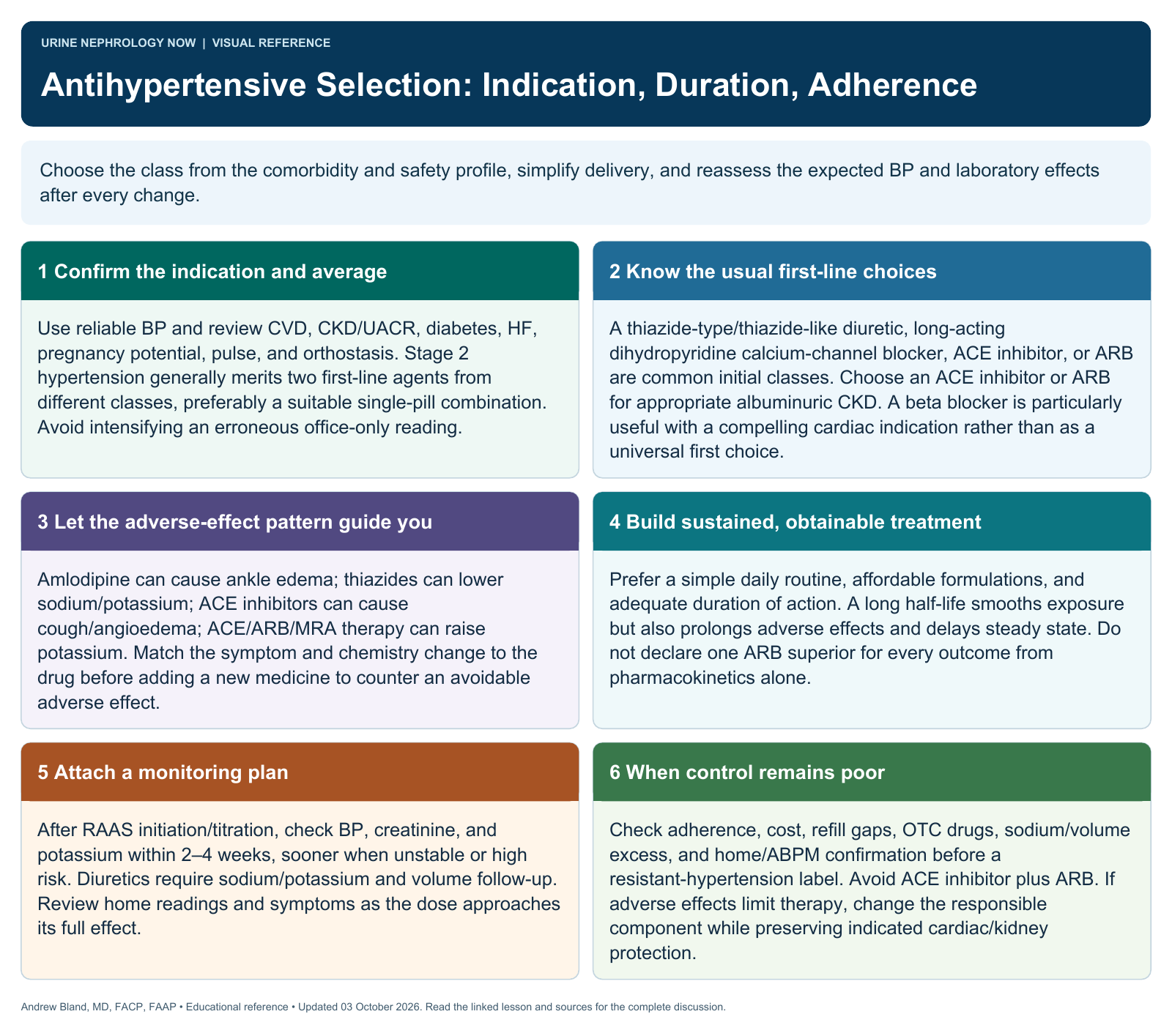
Text version
Confirm the indication and average
Use reliable BP and review CVD, CKD/UACR, diabetes, HF, pregnancy potential, pulse, and orthostasis. Stage 2 hypertension generally merits two first-line agents from different classes, preferably a suitable single-pill combination. Avoid intensifying an erroneous office-only reading.
Know the usual first-line choices
A thiazide-type/thiazide-like diuretic, long-acting dihydropyridine calcium-channel blocker, ACE inhibitor, or ARB are common initial classes. Choose an ACE inhibitor or ARB for appropriate albuminuric CKD. A beta blocker is particularly useful with a compelling cardiac indication rather than as a universal first choice.
Let the adverse-effect pattern guide you
Amlodipine can cause ankle edema; thiazides can lower sodium/potassium; ACE inhibitors can cause cough/angioedema; ACE/ARB/MRA therapy can raise potassium. Match the symptom and chemistry change to the drug before adding a new medicine to counter an avoidable adverse effect.
Build sustained, obtainable treatment
Prefer a simple daily routine, affordable formulations, and adequate duration of action. A long half-life smooths exposure but also prolongs adverse effects and delays steady state. Do not declare one ARB superior for every outcome from pharmacokinetics alone.
Attach a monitoring plan
After RAAS initiation/titration, check BP, creatinine, and potassium within 2–4 weeks, sooner when unstable or high risk. Diuretics require sodium/potassium and volume follow-up. Review home readings and symptoms as the dose approaches its full effect.
When control remains poor
Check adherence, cost, refill gaps, OTC drugs, sodium/volume excess, and home/ABPM confirmation before a resistant-hypertension label. Avoid ACE inhibitor plus ARB. If adverse effects limit therapy, change the responsible component while preserving indicated cardiac/kidney protection.