Visual summary
Treat the cardiac and renal phenotype together, preserving beneficial therapy whenever clinical tolerance and evidence support it.
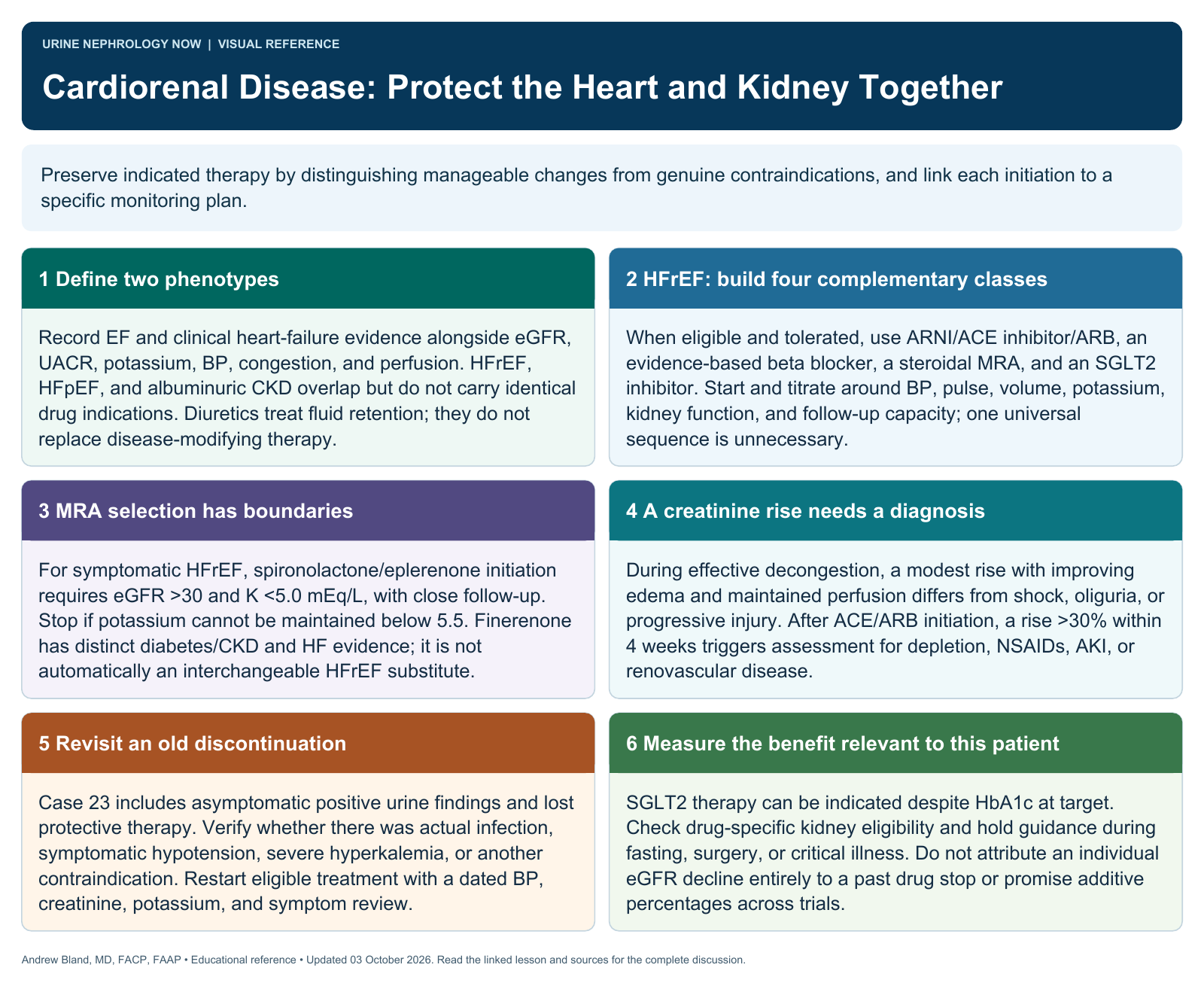
Text version
Bidirectional organ stress
Heart and kidney disease interact through venous congestion, perfusion changes, neurohormonal activation, inflammation, and shared metabolic risk. Either organ may initiate deterioration, and systemic illness can injure both simultaneously.
Define the phenotype
Assess heart failure symptoms and ejection fraction, blood pressure, rhythm, volume status, kidney function, albuminuria, and potassium. Treatment benefit and tolerability depend on the specific cardiac and renal conditions present.
Build a treatment foundation
Choose indicated RAAS-pathway therapy, SGLT2 inhibition, beta blockade, and mineralocorticoid receptor antagonism according to phenotype. The familiar four-pillar HFrEF framework should not be automatically applied unchanged to every CKD or HFpEF patient.
Manage congestion and monitoring
Relieve clinically significant congestion while following symptoms, urine output, blood pressure, creatinine, and electrolytes. An isolated creatinine rise needs interpretation alongside perfusion, decongestion, medication changes, and the overall clinical course.
Applied case: rebuild useful therapy
Case 23 explores medication discontinuation and GDMT reintroduction. Reassess the original reason for stopping therapy, distinguish true contraindication from a manageable adverse effect, and organize early monitoring after restarting.
Keep benefit claims specific
Use trial results for the populations and outcomes actually studied. Avoid promising a universal magnitude of benefit, treating asymptomatic bacteriuria as an automatic SGLT2 contraindication, or replacing individualized illness advice with blanket medication holds.
Continue learning
This graphic summarizes a topic. The full educational pages provide the broader discussion and references.