An evidence-based teaching synthesis of mechanisms, phenotype-directed treatment, and practical follow-up
Andrew Bland, MD, FACP, FAAP · Urine Nephrology Now · Corrected edition: October 3, 2026
This edition supersedes the July 24, 2025 teaching report. It preserves the educational scope while revising the interpretation of comparative treatment effects, FINEARTS-HF, biomarkers, and medication safety. Educational material; individual prescribing depends on the full clinical assessment, current product information, and applicable guidance.
Visual reference
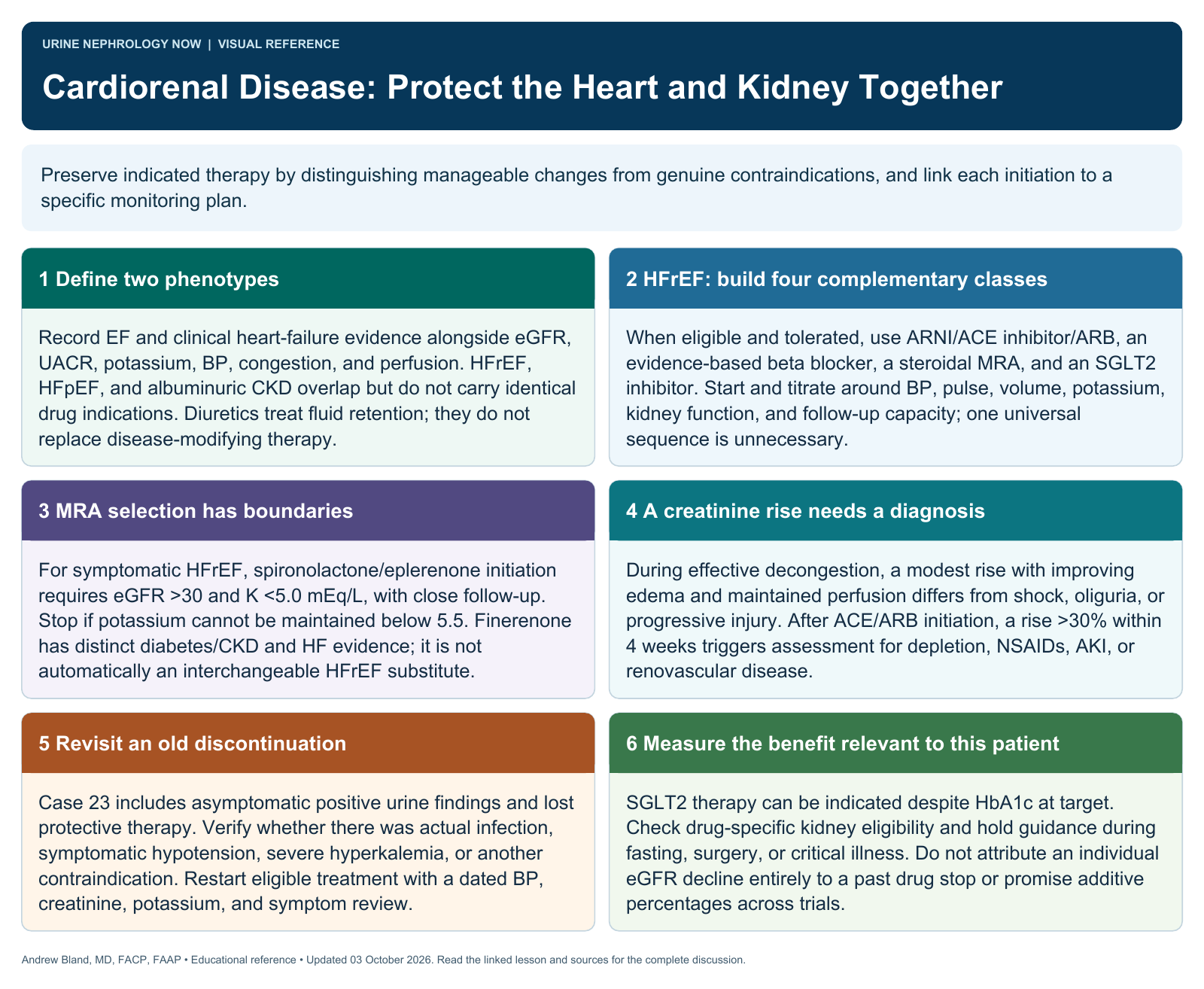
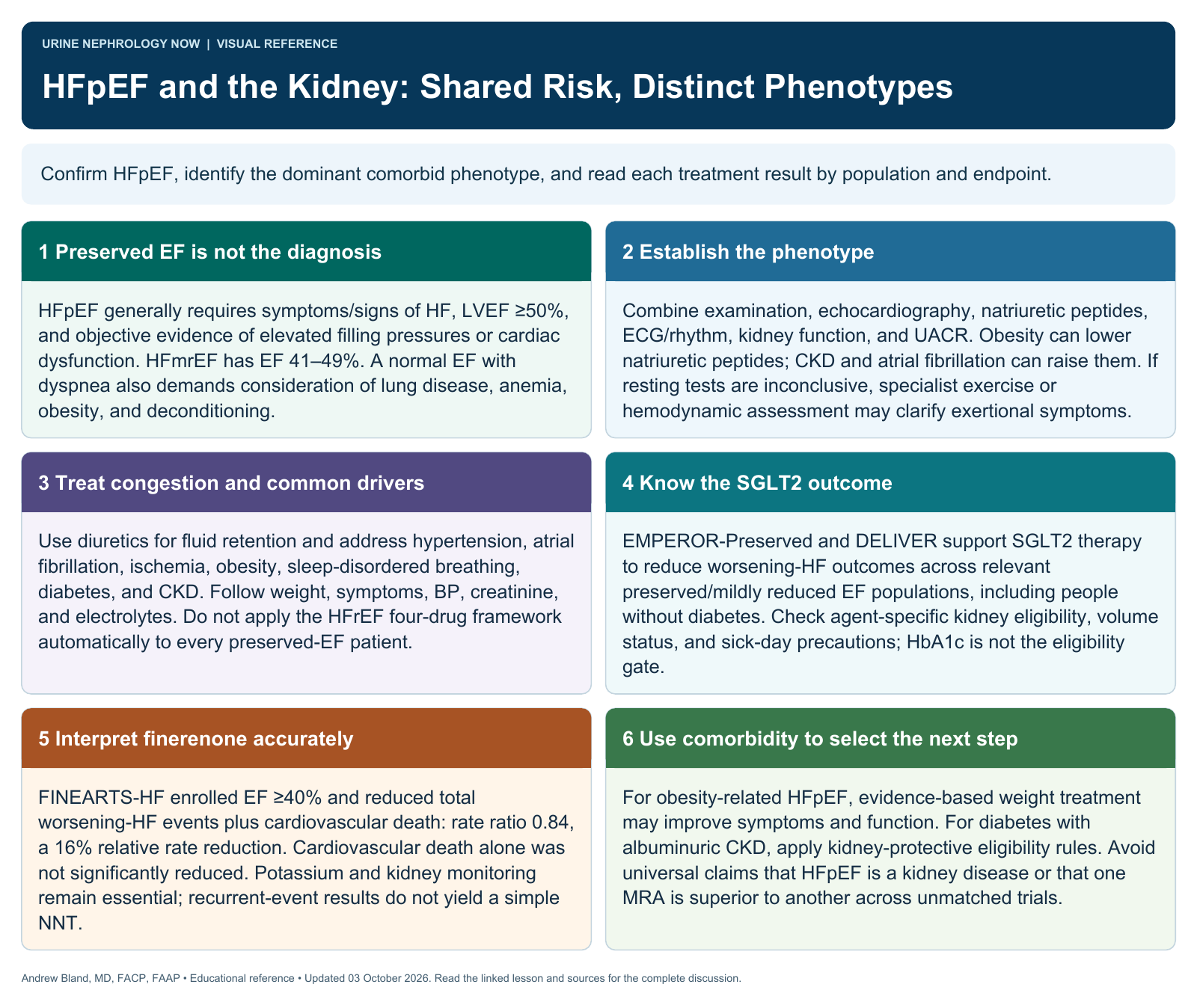
Browse the visual reference library · Download lesson Markdown
1. The clinical problem: two organs, several mechanisms
Cardiorenal disease describes interacting heart and kidney dysfunction. It is useful to identify the sequence—acute cardiac deterioration followed by AKI, chronic heart disease with CKD, acute kidney injury affecting the heart, chronic kidney disease affecting the heart, or systemic disease affecting both. These descriptive categories organize thinking but do not establish the mechanism in an individual patient. Several processes often coexist. AHA scientific statement.
Low cardiac output is only one pathway. Elevated venous pressure can impair kidney function even when forward flow is relatively preserved. Sodium retention, neurohormonal activation, endothelial dysfunction, inflammation, and fibrosis contribute over time. Diabetes, hypertension, atherosclerosis, obesity, anemia, and other comorbidities may accelerate both organ disorders. A creatinine rise therefore requires context: new shock, persistent congestion, an expected hemodynamic drug effect, obstruction, infection, or a separate kidney lesion lead to different decisions.
HFpEF is heterogeneous. Kidney sodium retention can contribute to its symptoms, but it is inaccurate to classify all HFpEF as primarily a renal disorder. Cardiac structure, filling pressures, rhythm, vascular function, obesity, lung disease, and physical deconditioning deserve assessment. Likewise, an evolutionary account of sodium conservation may be an interesting explanatory hypothesis; it does not demonstrate that modern medications work by recreating an ancestral environment.
Begin with a shared problem statement: the HF phenotype, eGFR and albuminuria category, congestion/perfusion findings, potassium, blood pressure, and the patient's symptoms and priorities. This turns a broad syndrome label into a tractable clinical plan.
2. Establish the phenotype before selecting the regimen
The HFrEF medication framework consists of a RAAS/neprilysin pathway agent, an evidence-based beta-blocker, an MRA, and an SGLT2 inhibitor, when appropriate and tolerated. Diuretics address fluid retention but are not interchangeable with disease-modifying therapy. The same four-class prescription is not an obligatory regimen for every person with HFpEF or isolated CKD. HF guideline.
| Clinical frame | Main question | Practical implication |
|---|---|---|
| HFrEF | Which foundational therapies are indicated and tolerated? | Plan comprehensive treatment and follow-up; avoid unnecessary delays between classes. |
| HFmrEF/HFpEF | Is HF established, and which trial population matches this patient? | Use phenotype-specific evidence, relieve congestion, and treat relevant comorbidities. |
| CKD with albuminuria | What is the kidney diagnosis, progression risk, and diabetes status? | Select kidney-protective treatment using eGFR, albuminuria, potassium, and indication. |
| Acute decompensation | Is the patient congested, hypoperfused, or both? | Stabilize and decongest while reviewing safe continuation or initiation of long-term therapy. |
| Advanced CKD or dialysis | How applicable is the trial evidence? | Recognize evidence gaps and individualize treatment with specialist input. |
An ejection fraction is one part of the phenotype. Clinical HF diagnosis also requires compatible symptoms/signs and objective support. A preserved EF alone does not diagnose HFpEF. Prior reduced EF, structural disease, rhythm, and changing clinical status affect interpretation and longitudinal treatment.
3. RAAS inhibition: compare the actual trial, not a universal hierarchy
ACE inhibitors, ARBs, and sacubitril/valsartan act at different points in related pathways. Mechanistic distinctions do not establish a universal ranking across hypertension, proteinuric CKD, HFrEF, and HFpEF. Historical placebo-controlled trials also differed in era, enrolled risk, background therapy, and endpoints. An apparent difference between separate trial estimates is not the same as a randomized head-to-head comparison.
PARADIGM-HF directly compared sacubitril/valsartan with enalapril in 8442 patients with reduced EF. The primary outcome, cardiovascular death or HF hospitalization, occurred in 21.8% versus 26.5% over median follow-up of 27 months, with hazard ratio 0.80. All-cause mortality was 17.0% versus 19.8%. This is strong evidence for the studied HFrEF comparison; it does not establish that every ACE inhibitor is superior to every ARB in every disease. Hypotension and nonserious angioedema were more frequent with sacubitril/valsartan. PARADIGM-HF.
In UK HARP-III, 414 participants with CKD and eGFR 20–60 received sacubitril/valsartan or irbesartan. Kidney function and albuminuria effects over 12 months were similar, despite differences in blood pressure and cardiac biomarkers. This trial illustrates why an HF result cannot simply be relabeled as superior kidney protection. UK HARP-III.
Transitions require explicit instructions. Allow at least 36 hours between an ACE inhibitor and sacubitril/valsartan in either direction. Do not combine them. Sacubitril/valsartan already contains an ARB, so the prior ARB is stopped when switching. Review angioedema history, pregnancy-related contraindications, blood pressure, potassium, kidney function, and interacting medicines. CKD does not create a routine five-to-seven-day washout. Prescribing information.
4. MRAs: phenotype and endpoint matter
Spironolactone in RALES and eplerenone in EMPHASIS-HF established benefits in selected HFrEF populations. TOPCAT, studying spironolactone with preserved EF, did not significantly reduce its overall primary composite outcome; interpretation is also complicated by regional differences. These are distinct findings, not proof that steroidal MRAs stop working at one EF or kidney-function boundary. RALES, EMPHASIS-HF, TOPCAT.
Finerenone has separate evidence in CKD with type 2 diabetes and in HF with LVEF at least 40%. Its nonsteroidal structure does not make potassium monitoring optional. Avoid inferring that one MRA is intrinsically safer or more effective than another solely from placebo comparisons in different populations.
| Study | Population and comparison | What the primary result establishes |
|---|---|---|
| FIDELIO-DKD | CKD and type 2 diabetes; finerenone versus placebo on background RAAS blockade | Benefit for the prespecified kidney composite in the studied population. |
| FIGARO-DKD | CKD and type 2 diabetes; finerenone versus placebo | Benefit for the cardiovascular composite; keep this distinct from individual components. |
| FINEARTS-HF | 6001 participants with symptomatic HF and LVEF ≥40%; finerenone versus placebo | Lower rate of total first/recurrent worsening-HF events plus cardiovascular death. |
| 2024 individual-patient meta-analysis | RALES, EMPHASIS-HF, TOPCAT, and FINEARTS-HF; 13,846 participants | MRA evidence across EF, with different treatment effects across the trial populations. |
FINEARTS-HF reported a primary rate ratio of 0.84, a 16% relative rate reduction, over median follow-up of 32 months. Cardiovascular death alone was not significantly reduced. Hyperkalemia was more frequent. A recurrent-event outcome is not a simple proportion of patients with a first event; an unsupported NNT of 17 should not be attached to this result. FINEARTS-HF.
The four-trial meta-analysis used time to first HF hospitalization or cardiovascular death as its primary endpoint. It found stronger mortality evidence in HFrEF than in the higher-EF trials. Because both the MRA and enrolled phenotype vary across trials, the analysis does not provide a randomized steroidal-versus-nonsteroidal comparison. 2024 analysis.
5. SGLT2 inhibitors and kidney protection
SGLT2 inhibitors have outcome evidence in several HF and CKD populations, including patients without diabetes in relevant trials. Their effects cannot be reduced to glucose lowering or to one proposed mechanism. Changes in renal hemodynamics, sodium handling, and other metabolic processes are plausible contributors, but a mechanistic account is not itself a treatment-effect estimate.
| Trial family | Clinical setting | Interpretation |
|---|---|---|
| DAPA-HF and EMPEROR-Reduced | HFrEF | Support disease-modifying therapy in the studied populations, not merely additional diuresis. |
| EMPEROR-Preserved and DELIVER | HF with higher EF | Support reduction of HF-related composite outcomes; distinguish hospitalization effects from mortality claims. |
| DAPA-CKD and EMPA-KIDNEY | CKD populations with specified entry criteria | Support kidney protection beyond a single diabetes phenotype; eligibility and composite definitions differ. |
DAPA-CKD's primary kidney-function decline component was a sustained decline in eGFR of at least 50%, not 40%. EMPA-KIDNEY used a different progression definition. Do not compare reported hazard ratios without comparing entry criteria and endpoints. DAPA-CKD, EMPA-KIDNEY.
Before starting therapy, assess indication, kidney-function eligibility under the relevant label, volume status, current diuretics, and ketoacidosis risk. Explain genital adverse effects, symptoms requiring assessment, and temporary interruption during selected illnesses, prolonged fasting, or procedures. A modest early eGFR change may be hemodynamic, but significant deterioration still warrants clinical review. Treatment on dialysis should not be assumed from predialysis trial evidence.
CONFIDENCE studied finerenone plus empagliflozin in CKD with type 2 diabetes, on background RAAS inhibition. Its primary endpoint was change in urine albumin-to-creatinine ratio at 180 days. Greater albuminuria reduction with combination treatment is relevant but does not, by itself, prove a corresponding reduction in dialysis, HF admissions, or mortality. CONFIDENCE.
6. Beta-blockers and phenotype-specific priorities
Evidence-based beta-blockers are foundational in HFrEF. Selection and titration depend on the particular drug and formulation, heart rate/rhythm, blood pressure, congestion, and clinical stability. Initiating or escalating a beta-blocker in shock is different from continuing established treatment during a stable admission. A low pulse or fatigue also warrants examination for other causes before abandoning a useful therapy.
In HFpEF, a beta-blocker may be indicated for another reason, such as rate control or ischemic disease, but HFrEF mortality benefits cannot automatically be transferred to every patient with preserved EF. Chronotropic limitation and symptomatic bradycardia may matter. Advanced CKD, frailty, and multimorbidity call for careful assessment rather than a blanket rule for or against the class.
The practical question is not which single class “wins.” It is which therapies have independent evidence for this patient's indications and how to deliver them safely together. The incremental benefit of each class in a particular patient cannot be calculated by simply adding historical relative risk reductions.
7. Congestion, creatinine, and diuretic response
Relieving clinically important congestion is a central goal. Monitor symptoms, oxygenation, examination, weight trajectory, input/output, renal function, and electrolytes. A creatinine rise during effective decongestion is not automatically structural tubular injury, but neither should every rise be dismissed as harmless. Look for persistent hypotension, poor perfusion, ongoing overload, new nephrotoxins, obstruction, and alternative disease.
DOSE compared loop-diuretic strategies in acute HF. It did not show a significant primary difference between bolus and continuous infusion; the higher-dose strategy produced more diuresis with transient worsening of kidney function in some patients. ADVOR found that adding acetazolamide improved successful early decongestion in its selected acute-HF population, without proving a mortality advantage. Neither trial supplies a universal standing order for every admission. DOSE, ADVOR.
When response is inadequate, reassess the diagnosis, oral absorption, dose delivery, sodium exposure, hemodynamics, and adherence. Combination diuresis may be useful but increases the need to monitor sodium, potassium, magnesium, acid-base status, and kidney function. Early spot urine sodium can inform response within a defined protocol; its timing and the surrounding clinical assessment matter.
PUSH-AHF randomized 310 patients and found greater natriuresis with a urine-sodium-guided strategy, without a significant improvement in the combined clinical endpoint of mortality or HF rehospitalization at 180 days. This supports physiological response assessment while limiting claims about outcomes. A single low urine sodium does not diagnose natriuretic-peptide receptor failure. PUSH-AHF.
Hypertonic saline combined with loop diuretics has been investigated in selected settings; it is not a routine substitute for standard decongestion. Sodium correction, fluid balance, and study limitations require specialist attention. Ultrafiltration is also not automatically superior when creatinine rises: CARRESS-HF favored a stepped pharmacologic approach over its tested ultrafiltration strategy for preservation of renal function, with similar weight loss and more adverse events in the ultrafiltration group. Refractory life-threatening complications still require individualized kidney replacement assessment. CARRESS-HF.
8. Biomarkers: useful signals, limited treatment rules
BNP and NT-proBNP can support diagnosis and risk assessment. Interpret them with age, atrial fibrillation, kidney function, body size, and the clinical presentation. Obesity may lower concentrations, while CKD and atrial fibrillation may raise them. A single cutoff does not diagnose HF in every setting or identify irreversible resistance to endogenous natriuretic peptides.
BNP and NT-proBNP are not interchangeable during neprilysin inhibition. Changes in BNP metabolism complicate interpretation, whereas NT-proBNP is not a neprilysin substrate. Even so, no biomarker trend should replace the bedside assessment or be the sole reason to escalate diuretics. GUIDE-IT did not show improved clinical outcomes from its NT-proBNP-targeted strategy compared with high-quality usual care in high-risk HFrEF. GUIDE-IT.
PIONEER-HF supports in-hospital sacubitril/valsartan initiation in appropriately stabilized HFrEF, with greater NT-proBNP reduction than enalapril. It does not validate a cGMP:BNP threshold, a NYHA-stage onset of peptide resistance, or a requirement to treat before a speculative irreversible stage. PIONEER-HF.
9. Intercurrent illness: an individualized pause and restart plan
The same symptom can point in different directions. Vomiting with poor intake and orthostasis suggests a different medication decision from worsening edema and breathlessness. A generic instruction to stop every RAAS inhibitor and diuretic while continuing the MRA can cause harm. Hyperkalemia, hypotension, AKI, persistent congestion, and ketoacidosis risk each affect the plan.
| Situation to assess | Information needed | Documented plan |
|---|---|---|
| Reduced intake or fluid loss | Duration, urine output, blood pressure, orthostasis, congestion | Which medicines need temporary adjustment; when and how to seek review. |
| Worsening breathlessness or edema | Weight, oxygenation, examination, missed treatment | Urgent assessment when severe; do not assume all diuretics should be held. |
| Possible AKI or hyperkalemia | Laboratory trajectory, drugs, volume/perfusion, obstruction risk | Address causes and specify repeat testing; avoid automatic permanent discontinuation. |
| SGLT2-related illness/procedure risk | Fasting, infection, ketone symptoms, operative plan | Product-appropriate hold instructions and criteria for safe restart. |
| Recovery after a temporary hold | Intake, symptoms, hemodynamics, kidney function, potassium | Named clinician responsible for restarting and retitrating indicated therapy. |
Patients need accessible written instructions, a contact route, and advice about urgent symptoms. A temporary interruption is not a complete plan until responsibility for reassessment and restart is assigned. Coordinate the message across cardiology, nephrology, primary care, pharmacy, and nursing so that conflicting instructions do not become a hidden treatment barrier.
11. Emerging and expanding evidence
GLP-1-based therapies now have relevant evidence beyond glucose lowering, but their trial outcomes remain distinct. FLOW demonstrated benefit for a major kidney-event composite with semaglutide in CKD and type 2 diabetes. STEP-HFpEF showed improved symptoms, function, and weight with semaglutide in obesity-related HFpEF. SUMMIT found a reduction in a composite of cardiovascular death or worsening HF with tirzepatide in obesity-related HFpEF, driven principally by worsening-HF events; it should not be described as proven mortality reduction. FLOW, STEP-HFpEF, SUMMIT.
These results add options for selected phenotypes; they do not make all drugs or doses interchangeable. Review gastrointestinal tolerability, nutrition, comorbidities, product indications, and other safety considerations. New mineralocorticoid, metabolic, anti-inflammatory, and monitoring strategies should be evaluated by design, population, and outcome rather than by mechanism alone.
Digital follow-up and multidisciplinary clinics can make care more coordinated, but a technology's physiological measurement or predictive accuracy is not equivalent to improved patient outcomes. The implementation question is whether the service produces timely, appropriate clinical action without adding disproportionate burden.
12. Applying the framework
Consider a synthetic teaching patient with HFrEF, CKD, recent diuretic escalation, and a rising creatinine. The next step is not automatically a fluid bolus, dialysis, or stopping every disease-modifying medicine. Determine whether congestion has improved, whether perfusion is adequate, what changed in the medication list, and whether infection, obstruction, or another kidney process is present. Reassess electrolytes and the trajectory, then match the treatment to the mechanism.
For a second synthetic patient with HFpEF, obesity, albuminuria, and type 2 diabetes, identify which HF and kidney trials match the phenotype. An SGLT2 inhibitor, finerenone, and a GLP-1-based therapy may each raise a different indication-specific question. The decision requires eligibility, safety, affordability, monitoring, and preference—not a universal ranking or a combined percentage guarantee.
The teaching task is to connect physiology to a testable clinical assessment, then connect each treatment choice to relevant evidence. Preserve the endpoint, comparator, time horizon, and uncertainty whenever a trial result is communicated.
Full references
1. Rangaswami J, Bhalla V, Blair JEA, et al. Cardiorenal Syndrome: Classification, Pathophysiology, Diagnosis, and Treatment Strategies: A Scientific Statement From the American Heart Association. Circulation. 2019;139(16):e840-e878. PubMed 30852913
2. Heidenreich PA, Bozkurt B, Aguilar D, et al. 2022 AHA/ACC/HFSA Guideline for the Management of Heart Failure: A Report of the American College of Cardiology/American Heart Association Joint Committee on Clinical Practice Guidelines. Circulation. 2022;145(18):e895-e1032. PubMed 35363499
3. McMurray JJ, Packer M, Desai AS, et al. Angiotensin-neprilysin inhibition versus enalapril in heart failure. N Engl J Med. 2014;371(11):993-1004. PubMed 25176015
4. Haynes R, Judge PK, Staplin N, et al. Effects of Sacubitril/Valsartan Versus Irbesartan in Patients With Chronic Kidney Disease. Circulation. 2018;138(15):1505-1514. PubMed 30002098
5. Pitt B, Zannad F, Remme WJ, et al. The effect of spironolactone on morbidity and mortality in patients with severe heart failure. Randomized Aldactone Evaluation Study Investigators. N Engl J Med. 1999;341(10):709-17. PubMed 10471456
6. Zannad F, McMurray JJ, Krum H, et al. Eplerenone in patients with systolic heart failure and mild symptoms. N Engl J Med. 2011;364(1):11-21. PubMed 21073363
7. Pitt B, Pfeffer MA, Assmann SF, et al. Spironolactone for heart failure with preserved ejection fraction. N Engl J Med. 2014;370(15):1383-92. PubMed 24716680
8. Solomon SD, McMurray JJV, Vaduganathan M, et al. Finerenone in Heart Failure with Mildly Reduced or Preserved Ejection Fraction. N Engl J Med. 2024;391(16):1475-1485. PubMed 39225278
9. Jhund PS, Talebi A, Henderson AD, et al. Mineralocorticoid receptor antagonists in heart failure: an individual patient level meta-analysis. Lancet. 2024;404(10458):1119-1131. PubMed 39232490
10. Heerspink HJL, Stefánsson BV, Correa-Rotter R, et al. Dapagliflozin in Patients with Chronic Kidney Disease. N Engl J Med. 2020;383(15):1436-1446. PubMed 32970396
11. The EMPA-KIDNEY Collaborative Group, Herrington WG, Staplin N, et al. Empagliflozin in Patients with Chronic Kidney Disease. N Engl J Med. 2023;388(2):117-127. PubMed 36331190
12. Agarwal R, Green JB, Heerspink HJL, et al. Finerenone with Empagliflozin in Chronic Kidney Disease and Type 2 Diabetes. N Engl J Med. 2025;393(6):533-543. PubMed 40470996
13. Felker GM, Lee KL, Bull DA, et al. Diuretic strategies in patients with acute decompensated heart failure. N Engl J Med. 2011;364(9):797-805. PubMed 21366472
14. Mullens W, Dauw J, Martens P, et al. Acetazolamide in Acute Decompensated Heart Failure with Volume Overload. N Engl J Med. 2022;387(13):1185-1195. PubMed 36027559
15. Ter Maaten JM, Beldhuis IE, van der Meer P, et al. Natriuresis-guided diuretic therapy in acute heart failure: a pragmatic randomized trial. Nat Med. 2023;29(10):2625-2632. PubMed 37640861
16. Bart BA, Goldsmith SR, Lee KL, et al. Ultrafiltration in decompensated heart failure with cardiorenal syndrome. N Engl J Med. 2012;367(24):2296-304. PubMed 23131078
17. Felker GM, Anstrom KJ, Adams KF, et al. Effect of Natriuretic Peptide-Guided Therapy on Hospitalization or Cardiovascular Mortality in High-Risk Patients With Heart Failure and Reduced Ejection Fraction: A Randomized Clinical Trial. JAMA. 2017;318(8):713-720. PubMed 28829876
18. Velazquez EJ, Morrow DA, DeVore AD, et al. Angiotensin-Neprilysin Inhibition in Acute Decompensated Heart Failure. N Engl J Med. 2019;380(6):539-548. PubMed 30415601
19. Mebazaa A, Davison B, Chioncel O, et al. Safety, tolerability and efficacy of up-titration of guideline-directed medical therapies for acute heart failure (STRONG-HF): a multinational, open-label, randomised, trial. Lancet. 2022;400(10367):1938-1952. PubMed 36356631
20. Perkovic V, Tuttle KR, Rossing P, et al. Effects of Semaglutide on Chronic Kidney Disease in Patients with Type 2 Diabetes. N Engl J Med. 2024;391(2):109-121. PubMed 38785209
21. Kosiborod MN, Abildstrøm SZ, Borlaug BA, et al. Semaglutide in Patients with Heart Failure with Preserved Ejection Fraction and Obesity. N Engl J Med. 2023;389(12):1069-1084. PubMed 37622681
22. Packer M, Zile MR, Kramer CM, et al. Tirzepatide for Heart Failure with Preserved Ejection Fraction and Obesity. N Engl J Med. 2025;392(5):427-437. PubMed 39555826
23. McMurray JJV, Solomon SD, Inzucchi SE, et al. Dapagliflozin in Patients with Heart Failure and Reduced Ejection Fraction. N Engl J Med. 2019;381(21):1995-2008. PubMed 31535829
24. Packer M, Anker SD, Butler J, et al. Cardiovascular and Renal Outcomes with Empagliflozin in Heart Failure. N Engl J Med. 2020;383(15):1413-1424. PubMed 32865377
25. Anker SD, Butler J, Filippatos G, et al. Empagliflozin in Heart Failure with a Preserved Ejection Fraction. N Engl J Med. 2021;385(16):1451-1461. PubMed 34449189
26. Solomon SD, McMurray JJV, Claggett B, et al. Dapagliflozin in Heart Failure with Mildly Reduced or Preserved Ejection Fraction. N Engl J Med. 2022;387(12):1089-1098. PubMed 36027570
27. Bakris GL, Agarwal R, Anker SD, et al. Effect of Finerenone on Chronic Kidney Disease Outcomes in Type 2 Diabetes. N Engl J Med. 2020;383(23):2219-2229. PubMed 33264825
28. Pitt B, Filippatos G, Agarwal R, et al. Cardiovascular Events with Finerenone in Kidney Disease and Type 2 Diabetes. N Engl J Med. 2021;385(24):2252-2263. PubMed 34449181