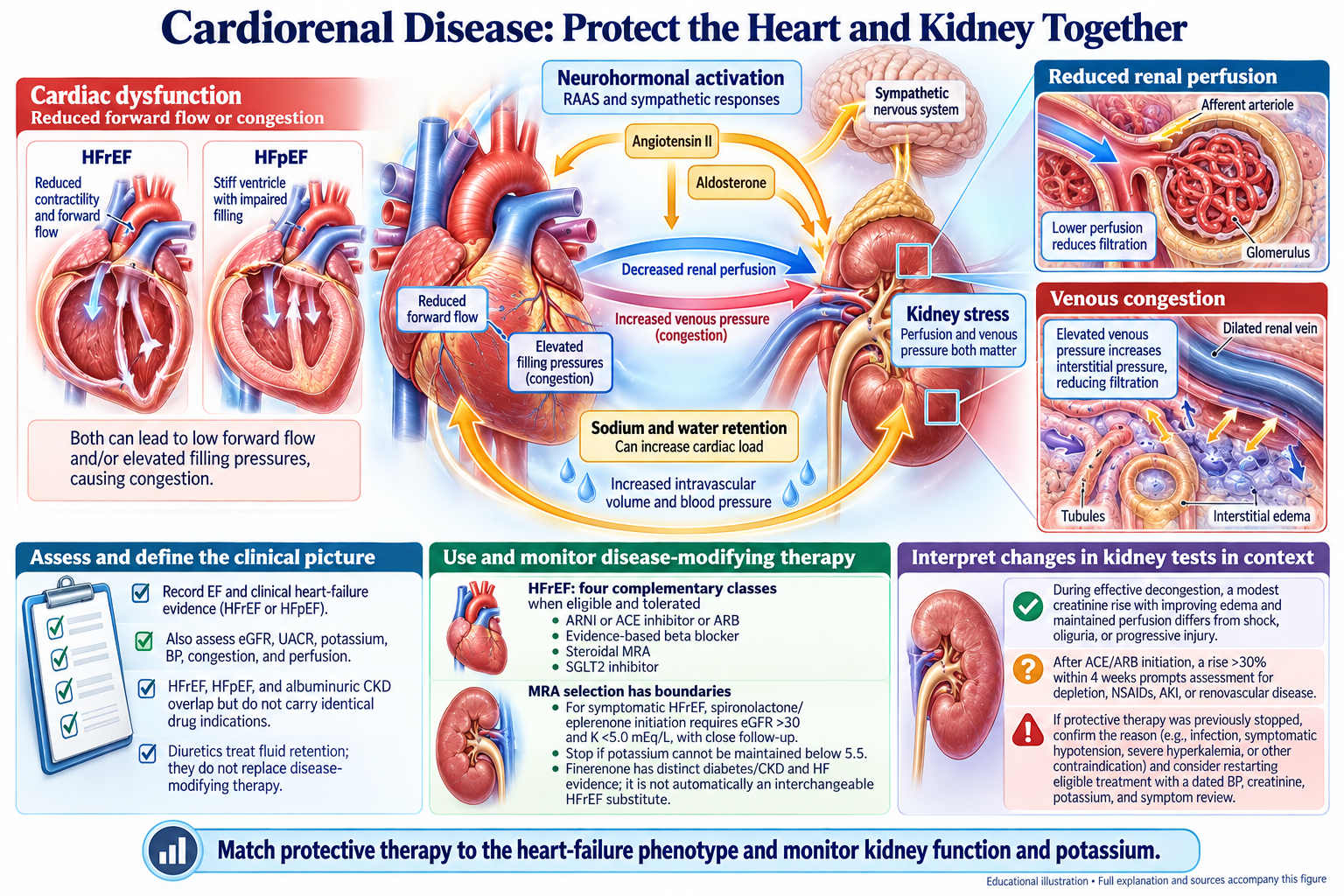
📝 Pre-Case Assessment: Test Your Baseline Knowledge
Answer these questions before reviewing the case to assess your understanding of cardiorenal syndrome and GDMT
Which of the following medications has proven mortality benefit in heart failure with reduced ejection fraction AND chronic kidney disease?
Learning Point: SGLT2 inhibitors reduce mortality and hospitalization in HFrEF patients with CKD, with benefits seen across the spectrum of kidney function down to eGFR 20 mL/min/1.73m². They should not be discontinued for minor side effects without careful consideration.
📚 Reference: CKD Management & SGLT2i Benefits
In obese women with difficulty obtaining clean-catch urine specimens, what is the most common cause of "positive" urine cultures?
Learning Point: Squamous epithelial cells and/or mucus threads indicate contamination, not infection. This is especially common in obese women who have difficulty with proper perineal cleaning. True UTI diagnosis requires symptoms (dysuria, frequency, urgency) plus a clean specimen. Remember: urine is NOT sterile - it has its own microbiome.
📚 Reference: Urinalysis & Urine Collection Techniques
What effect does sacubitril/valsartan (ARNI) have on BNP levels?
Learning Point: Sacubitril inhibits neprilysin, which normally degrades BNP. This causes BNP levels to rise even as heart failure improves. NT-proBNP is not affected by neprilysin and remains a reliable marker in patients on ARNI therapy.
📚 Reference: Cardiorenal Biomarkers & ARNI Therapy
👤 Case Presentation
Patient: 55-year-old obese woman (BMI 38)
Chief Complaint: "My doctors keep stopping my heart and kidney medications"
History of Present Illness:
- Diagnosed with heart failure with reduced ejection fraction (EF 30%) and CKD stage 3b (eGFR 42) two years ago
- SGLT2 inhibitor discontinued 6 months ago for "chronic UTIs" - patient reports no dysuria, frequency, or fever
- ARNI stopped 3 months ago for BP 95/60 (asymptomatic, no dizziness or syncope)
- Recent hospitalization for heart failure exacerbation with elevated BNP
- Developed AKI during aggressive diuresis, attributed to ARNI
Past Medical History:
- Type 2 diabetes mellitus (HbA1c 7.8%)
- Hypertension
- Obesity
- History of fungal leg infection (resolved with antifungal soap)
- Difficulty obtaining clean-catch urine due to body habitus
Current Medications:
- Furosemide 40 mg BID
- Metoprolol succinate 50 mg daily
- Metformin 1000 mg BID
- Atorvastatin 40 mg daily
- Empagliflozin 10 mg daily (stopped)
- Sacubitril/valsartan 97/103 mg BID (stopped)
🤔 Initial Clinical Reasoning Questions
What is the most likely explanation for this patient's "chronic UTIs" leading to SGLT2i discontinuation?
Clinical Reasoning: The patient had no UTI symptoms (dysuria, frequency, fever) and has difficulty obtaining clean-catch specimens due to obesity. Mixed vaginal flora contamination is commonly misinterpreted as UTI in this population. SGLT2i should not be stopped for asymptomatic bacteriuria or contaminated specimens.
📚 Reference: SGLT2i Management in CKD
Was discontinuation of ARNI for asymptomatic BP 95/60 appropriate in this patient?
Clinical Reasoning: Asymptomatic low BP without evidence of hypoperfusion (no dizziness, syncope, worsening renal function, or altered mentation) is not an indication to stop life-saving GDMT. The mortality benefit of ARNI far outweighs the risk of asymptomatic hypotension.
📚 Reference: GDMT in Cardiorenal Disease
🔬 Laboratory Data & Analysis
Current Laboratory Values
| Parameter | Current | 3 Months Ago (on GDMT) | Normal Range |
|---|---|---|---|
| Creatinine | 1.8 mg/dL | 1.5 mg/dL | 0.6-1.2 mg/dL |
| eGFR | 35 mL/min/1.73m² | 42 mL/min/1.73m² | >60 mL/min/1.73m² |
| BNP | 850 pg/mL | 450 pg/mL (on ARNI) | <100 pg/mL |
| NT-proBNP | 3200 pg/mL | 1100 pg/mL | <125 pg/mL |
| Potassium | 4.2 mEq/L | 4.5 mEq/L | 3.5-5.0 mEq/L |
| HbA1c | 7.8% | 7.2% | <7% |
Recent Urine Culture Results
Urine Culture #1 (6 months ago):
- Mixed flora >100,000 CFU/mL
- Multiple organisms including Lactobacillus, Enterococcus, E. coli
- Many squamous epithelial cells, mucus threads present
- Patient asymptomatic - no dysuria, frequency, or urgency
Urine Culture #2 (4 months ago):
- Mixed flora 50,000-100,000 CFU/mL
- Gardnerella vaginalis, mixed gram-positive cocci
- Moderate squamous epithelial cells with mucus threads
- Patient asymptomatic - no urinary symptoms
📊 Laboratory Analysis Questions
How should the urine culture results be interpreted?
Learning Point: Squamous epithelial cells and/or mucus threads indicate contamination, not infection. Lactobacillus and Gardnerella are vaginal flora. In men, squamous cells can occur from "dunking" where the penis head is submerged in collected urine because they can't stop urinating mid-stream. Without symptoms, this represents contamination and doesn't warrant treatment or medication discontinuation.
📚 Reference: Urinalysis Interpretation & Contamination
Why is the BNP elevated at 450 pg/mL while on ARNI, yet the patient was clinically stable?
Learning Point: ARNI increases BNP by inhibiting its degradation. The NT-proBNP of 1100 (much lower than current 3200) better reflects the patient's stable status while on ARNI. Using BNP to guide therapy in ARNI patients is inappropriate.
📚 Reference: Biomarkers in Cardiorenal Disease
What explains the worsening kidney function after stopping GDMT?
Learning Point: Both SGLT2i and ARNI provide renal protection in heart failure. Their discontinuation leads to loss of hemodynamic benefits, increased intraglomerular pressure, and accelerated CKD progression. The eGFR decline from 42 to 35 after stopping these agents demonstrates this effect.
📚 Reference: Renal Protection in Cardiorenal Syndrome
⏱️ Interactive Timeline: Critical Decision Points
Navigate through the patient's treatment timeline and make key clinical decisions
Timeline Point 1: Initial GDMT Optimization (2 years ago)
Patient newly diagnosed with HFrEF (EF 30%) and CKD 3b. What is the optimal initial GDMT approach?
Learning Point: HFrEF care should avoid unnecessary delays in implementing the four medication pillars, with selection and titration guided by blood pressure, kidney function, potassium, congestion, and tolerance. STRONG-HF tested rapid up-titration of renin–angiotensin blockers, beta-blockers, and MRAs with close follow-up after an acute-HF admission. It did not randomize simultaneous four-pillar initiation against rapid sequential initiation. Mebazaa et al., STRONG-HF, Lancet 2022.
📚 Reference: GDMT Initiation in Cardiorenal Disease
Timeline Point 2: SGLT2i Discontinuation (6 months ago)
Urine cultures show mixed flora. Patient asymptomatic. What is the appropriate action?
Learning Point: Contaminated specimens in asymptomatic patients don't warrant SGLT2i discontinuation. Proper education on perineal hygiene, urine collection technique, and perhaps straight catheterization for future specimens would be appropriate.
📚 Reference: SGLT2i Management Strategies in CKD
Timeline Point 3: Recent Hospitalization for HF
Patient admitted with volume overload, BNP 850. Developed AKI with diuresis (Cr 1.5→2.2). What is the appropriate GDMT management?
Learning Point: Mild creatinine elevation during decongestion is expected and acceptable. Stopping GDMT during hospitalization is associated with worse short- and long-term outcomes. Post-hoc analyses of EMPEROR-Reduced and DAPA-HF support continuation of SGLT2i during periods of mild kidney function decline, and pre-specified subgroups support ARNI continuation; however, dedicated RCTs proving benefit of continuation specifically during established AKI are limited, so individualized clinical judgment remains essential. [Softened 2026-05-03 — earlier "Studies show ... improves long-term outcomes" overstated the strength of dedicated AKI-episode RCT evidence.]
📚 Reference: AKI Management & GDMT Continuation
💊 Treatment Plan & GDMT Optimization
🌟 Critical GDMT Reinitiation Strategy
This patient requires immediate restart of both SGLT2i and ARNI with the following approach:
| Medication | Action | Rationale | Monitoring |
|---|---|---|---|
| Empagliflozin | Restart 10 mg daily immediately | No true UTI documented; mortality benefit outweighs theoretical risk | Education on genital hygiene; symptoms, not routine cultures |
| Sacubitril/valsartan | Restart at 24/26 mg BID, titrate up | Asymptomatic hypotension not a contraindication | Monitor symptoms, not absolute BP numbers; use NT-proBNP, not BNP |
| Spironolactone | Add 12.5-25 mg daily | Fourth pillar of GDMT not yet initiated | Potassium and creatinine in 1 week |
| Metoprolol | Continue, consider carvedilol switch | Carvedilol has additional benefits in HFrEF | Heart rate and BP tolerance |
💊 Treatment Decision Questions
What is the most appropriate strategy for preventing future "UTI" misdiagnosis in this patient?
Learning Point: Only check urine cultures when patients have symptoms (dysuria, frequency, urgency, fever). Asymptomatic bacteriuria should NOT be treated except in pregnancy. Urine is not sterile contrary to common belief - it contains a microbiome. Treating asymptomatic bacteriuria leads to resistance and unnecessary side effects.
📚 Reference: Urinalysis & Asymptomatic Bacteriuria
How should the mild fungal genital irritation risk with SGLT2i be managed?
Learning Point: Genital mycotic infections with SGLT2i are usually mild and easily managed. Prevention includes good perineal hygiene and keeping the area dry. If symptomatic candidiasis develops, a topical azole antifungal (clotrimazole or miconazole, available OTC) is highly effective. The cardiovascular and kidney benefit of SGLT2i far outweighs this manageable side effect.
📚 Reference: SGLT2i Side Effect Management
🔬 Module-Specific Deep Dive: Advanced Cardiorenal Concepts
What is the mechanism by which SGLT2 inhibitors provide cardiorenal protection beyond glucose lowering?
Deep Dive: SGLT2i restore tubuloglomerular feedback by increasing sodium delivery to the macula densa, causing afferent arteriole vasoconstriction and reduced intraglomerular pressure. Additional benefits include improved myocardial energetics, reduced sympathetic tone, and decreased volume overload.
📚 Reference: SGLT2i Mechanisms in Cardiorenal Disease
Why does combining ARNI with SGLT2i provide synergistic benefits in cardiorenal syndrome?
Deep Dive: ARNI provides neurohormonal modulation (RAAS blockade + natriuretic peptide augmentation) while SGLT2i offers metabolic reprogramming and hemodynamic benefits. Together they address multiple pathophysiologic pathways in cardiorenal syndrome.
📚 Reference: Combination Therapy in Cardiorenal Disease
In cardiorenal syndrome Type 2, what is the expected initial eGFR response to optimized GDMT?
Deep Dive: An initial "pseudo-worsening" of kidney function (eGFR dip up to 30%) is expected and acceptable with GDMT initiation. This reflects beneficial hemodynamic changes and is associated with better long-term renal outcomes. Don't stop therapy for this expected change.
📚 Reference: eGFR Changes in Cardiorenal Disease
🎓 Learning Objectives Assessment
Evaluate your mastery of the key learning objectives from this case
🎯 Learning Objective 1: GDMT Optimization in Cardiorenal Syndrome
Objective: Understand the importance of maintaining GDMT despite perceived barriers
A patient with HFrEF and CKD has potassium 5.6 mEq/L on spironolactone. What is the best approach?
Competency Demonstration: Using potassium binders (patiromer, sodium zirconium cyclosilicate) allows continuation of MRA therapy when hyperkalemia would otherwise force discontinuation. DIAMOND (Butler EHJ 2022) demonstrated patiromer enabled continued RAASi/MRA therapy with controlled potassium; while a direct mortality benefit attributable specifically to binder-enabled MRA continuation has not been proven in a dedicated mortality trial, the well-established mortality benefit of spironolactone in HFrEF (RALES PMID 10471456) supports preservation of MRA therapy through binder use rather than discontinuation. This represents optimal GDMT preservation. [Softened 2026-05-03 — earlier "mortality benefit ... outweighs" framing leaned on extrapolation from RALES rather than direct binder-MRA RCT evidence.]
📚 Master This: Potassium Management & Binders
🎯 Learning Objective 2: Diagnostic Accuracy in Complex Patients
Objective: Differentiate contamination from infection in challenging clinical scenarios
Which finding most strongly suggests urine contamination rather than UTI?
Competency Demonstration: Squamous epithelial cells and mucus threads are the key markers of contamination. In women, this indicates vaginal contamination. In men, squamous cells can result from "dunking" during collection. This knowledge prevents inappropriate antibiotic use and medication discontinuation. Always prioritize clinical symptoms over culture results.
📚 Master This: Advanced Urinalysis Interpretation
🎯 Learning Objective 3: Biomarker Interpretation with GDMT
Objective: Correctly interpret cardiac biomarkers in patients on neurohormonal therapy
In a patient on sacubitril/valsartan, which is most important for assessing heart failure status?
Competency Demonstration: Clinical symptoms (dyspnea, orthopnea, edema) and volume assessment are most important. NT-proBNP is more accurate than BNP when on ARNI (BNP is falsely elevated by neprilysin inhibition), but clinical assessment trumps all biomarkers. Treat the patient, not the numbers. This prevents misinterpretation and inappropriate therapy changes.
📚 Master This: Clinical Assessment in Cardiorenal Disease
🧩 Integration Challenge: Multi-System Synthesis
Apply integrated knowledge across multiple domains to solve complex clinical scenarios
This patient returns 3 months after GDMT restart with improved EF (30%→40%), stable Cr at 1.6, but new complaints of dizziness with standing. BP sitting 102/65, standing 88/58. What is the best management approach?
Integration Synthesis: The improved EF confirms GDMT efficacy. Orthostatic symptoms with stable renal function suggest overdiuresis rather than GDMT intolerance. Reducing loop diuretics and adding midodrine for symptomatic orthostasis preserves life-saving GDMT. This demonstrates integration of heart failure management, volume assessment, and medication optimization principles.
📚 Advanced Integration: Advanced Cardiorenal Management
Six months later, the patient has continued high proteinuria (UACR 800 mg/g) with stable creatinine. She remains on optimized GDMT. What additional intervention would provide the most renal protection?
Integration Synthesis: Finerenone (a non-steroidal MRA) provides additional renal and cardiovascular protection in diabetic CKD with persistent albuminuria, demonstrated in FIDELIO-DKD (Bakris NEJM 2020 PMID 33069326) and FIGARO-DKD (Pitt NEJM 2021 PMID 34449181). Finerenone has somewhat lower hyperkalemia rates than steroidal MRAs and demonstrated renal/cardiovascular benefit on top of background ACEi/ARB. Important: finerenone is generally NOT used in combination with a steroidal MRA (spironolactone/eplerenone) due to additive hyperkalemia risk — in this patient, who was started on spironolactone in the earlier treatment plan, the rational approach is to switch from spironolactone to finerenone (rather than add) when the indication shifts to CKD-T2DM-albuminuria-driven renal protection. [Clarified 2026-05-03 — original explanation could be misread as "add finerenone on top of spironolactone"; the swap is the safer construction.]
📚 Advanced Integration: Emerging Therapies in CKD
The patient asks about kidney transplant eligibility given her heart failure. Her EF is now 45% on GDMT. What counseling is appropriate?
Integration Synthesis: HFrEF with improved EF (HFimpEF) on GDMT is not an absolute contraindication to kidney transplant. Comprehensive cardiac evaluation including stress testing and right heart catheterization would determine candidacy. Many patients with controlled heart failure successfully undergo kidney transplant. This integrates transplant medicine, cardiac risk assessment, and long-term cardiorenal management.
📚 Advanced Integration: Transplant Evaluation in Cardiorenal Disease
🧠 Case Reflection & Multi-Module Integration
❤️ Cardiorenal Integration
- GDMT provides both cardiac and renal protection
- Initial eGFR dip is expected and acceptable
- Biomarker interpretation changes with therapy
💊 Medication Management
- Don't stop GDMT for minor side effects
- Use strategies to continue life-saving therapy
- Understand drug-specific monitoring needs
🔬 Diagnostic Accuracy
- Distinguish contamination from infection
- Proper specimen collection is crucial
- Treat patients, not lab values
🎯 Key Integration Concepts
This case demonstrates the critical importance of maintaining GDMT despite perceived barriers. Common reasons for inappropriate discontinuation include misinterpreted lab values (contaminated urines), expected physiologic responses (asymptomatic hypotension), and lack of understanding of drug effects (ARNI increasing BNP). The key to optimal cardiorenal outcomes is recognizing these pitfalls and using strategies to continue life-saving therapies. Integration across cardiology, nephrology, infectious disease, and diagnostic medicine is essential for optimal patient care.
📝 Case Summary & Clinical Pearls
This case illustrates the challenges and solutions in managing cardiorenal syndrome with GDMT. The patient's medications were inappropriately discontinued for questionable indications, leading to clinical deterioration. Proper interpretation of diagnostic tests, understanding of drug mechanisms, and commitment to evidence-based therapy are essential.
🔑 Top 5 Clinical Pearls from This Case:
- GDMT Persistence: The mortality benefit of GDMT far outweighs minor side effects - find ways to continue therapy
- Contamination vs Infection: Squamous cells and/or mucus threads = contamination, not UTI requiring treatment
- ARNI Biomarkers: Use NT-proBNP, not BNP, to monitor patients on sacubitril/valsartan
- Asymptomatic Hypotension: Low BP without symptoms or end-organ damage is not a reason to stop GDMT
- Expected Changes: Initial eGFR decline with GDMT is expected and associated with better long-term outcomes