Visual summary
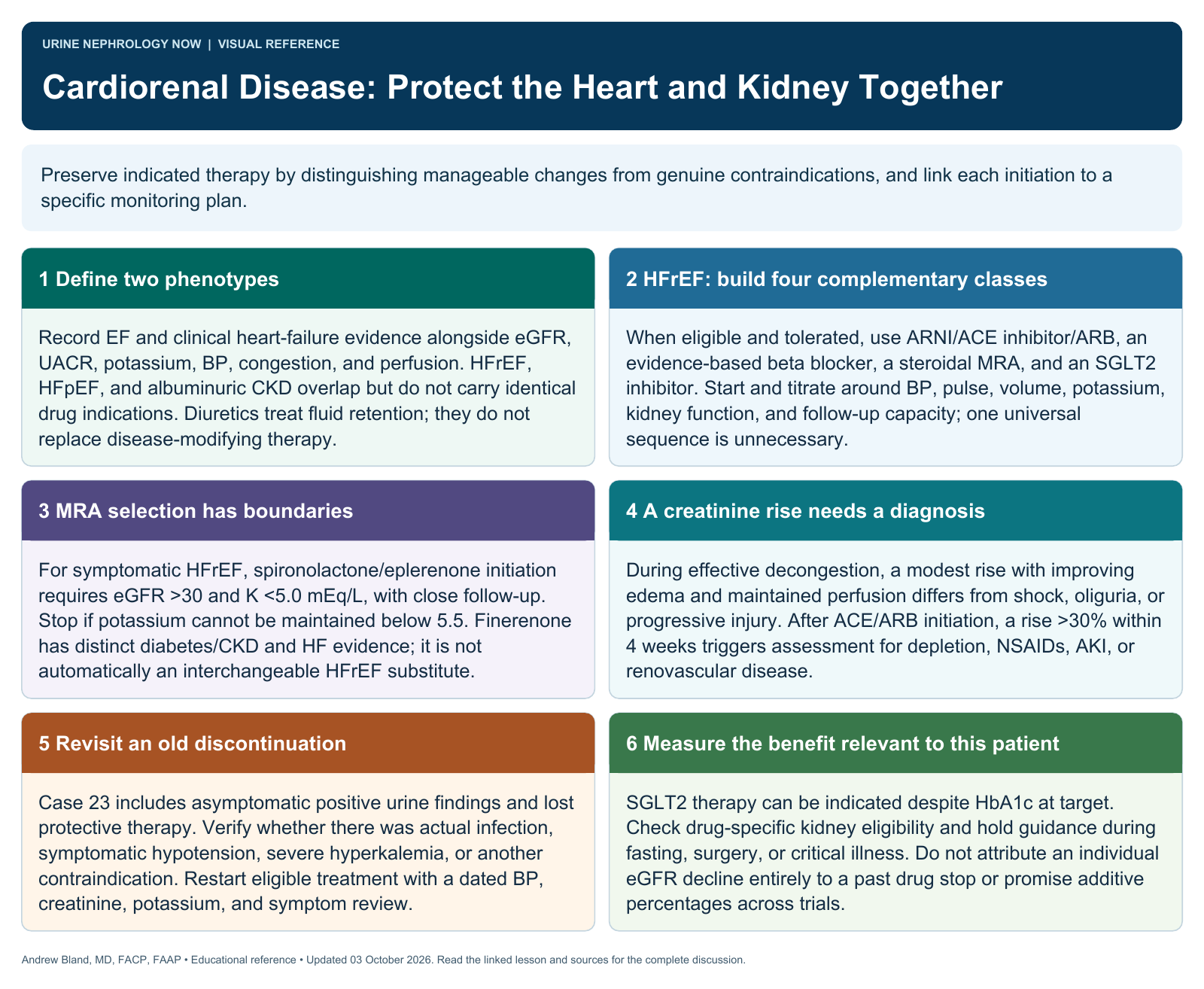
Preserve indicated therapy by distinguishing manageable changes from genuine contraindications, and link each initiation to a specific monitoring plan.
Text version
Define two phenotypes
Record EF and clinical heart-failure evidence alongside eGFR, UACR, potassium, BP, congestion, and perfusion. HFrEF, HFpEF, and albuminuric CKD overlap but do not carry identical drug indications. Diuretics treat fluid retention; they do not replace disease-modifying therapy.
HFrEF: build four complementary classes
When eligible and tolerated, use ARNI/ACE inhibitor/ARB, an evidence-based beta blocker, a steroidal MRA, and an SGLT2 inhibitor. Start and titrate around BP, pulse, volume, potassium, kidney function, and follow-up capacity; one universal sequence is unnecessary.
MRA selection has boundaries
For symptomatic HFrEF, spironolactone/eplerenone initiation requires eGFR >30 and K <5.0 mEq/L, with close follow-up. Stop if potassium cannot be maintained below 5.5. Finerenone has distinct diabetes/CKD and HF evidence; it is not automatically an interchangeable HFrEF substitute.
A creatinine rise needs a diagnosis
During effective decongestion, a modest rise with improving edema and maintained perfusion differs from shock, oliguria, or progressive injury. After ACE/ARB initiation, a rise >30% within 4 weeks triggers assessment for depletion, NSAIDs, AKI, or renovascular disease.
Revisit an old discontinuation
Case 23 includes asymptomatic positive urine findings and lost protective therapy. Verify whether there was actual infection, symptomatic hypotension, severe hyperkalemia, or another contraindication. Restart eligible treatment with a dated BP, creatinine, potassium, and symptom review.
Measure the benefit relevant to this patient
SGLT2 therapy can be indicated despite HbA1c at target. Check drug-specific kidney eligibility and hold guidance during fasting, surgery, or critical illness. Do not attribute an individual eGFR decline entirely to a past drug stop or promise additive percentages across trials.