Visual summary
Imagine taking both kidneys out of the circulation and placing them in a bucket. The patient’s true GFR is immediately zero, but the creatinine already in the blood does not instantly change. Muscle continues producing creatinine, so its concentration rises over time.
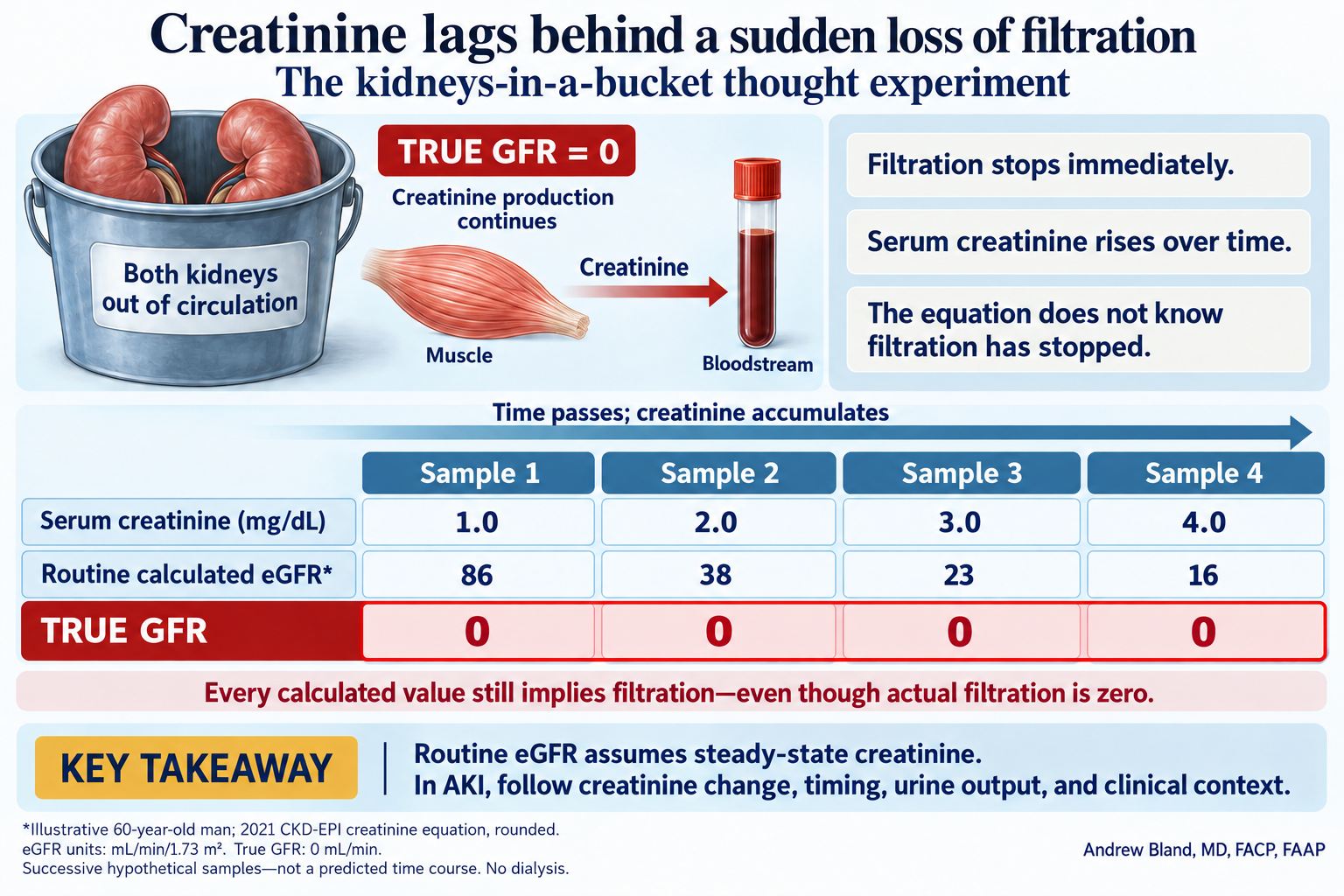
Illustration updated October 19, 2026. Educational schematic. Full teaching text and sources follow.
Diagram description
Two kidneys sit outside the circulation in a bucket. At successive hypothetical serum creatinine values of 1, 2, 3, and 4 mg/dL, the routine equation gives eGFR 86, 38, 23, and 16, while true GFR remains zero at every sample.
Text version
The changing creatinine does not require another change in GFR: filtration stays at zero throughout this thought experiment. The routine equation still returns positive numbers because it assumes steady-state creatinine. These values are not all normal, but every one overestimates actual filtration here.
| Sample | Serum creatinine (mg/dL) | Routine calculated eGFR (mL/min/1.73 m²) | True GFR (mL/min) |
|---|---|---|---|
| 1 | 1.0 | 86 | 0 |
| 2 | 2.0 | 38 | 0 |
| 3 | 3.0 | 23 | 0 |
| 4 | 4.0 | 16 | 0 |
Illustrative 60-year-old man; 2021 CKD-EPI creatinine equation, rounded. These are successive hypothetical samples, not fixed time intervals or a predicted rate of rise. No dialysis is assumed. In real AKI, creatinine production, distribution volume, and residual clearance also affect the trajectory.
The question to ask
When creatinine rises from 2 to 4, did GFR fall again? No. True GFR was already zero; creatinine continues to accumulate.
Apply it to AKI
Routine eGFR assumes steady-state creatinine. During rapidly changing kidney function, follow the creatinine trajectory, timing, urine output, and clinical context. A routine eGFR is not a measurement of current filtration and should not establish a CKD stage during an acute episode. During recovery, creatinine can lag in the other direction and routine eGFR can underestimate improving filtration. Specialized kinetic estimates differ from the routine reported eGFR.
Supporting evidence
NIDDK: 2021 CKD-EPI creatinine equation · KDIGO AKI Appendix A: creatinine lag and nonsteady-state eGFR · NIDDK: clinical limitations of eGFR