Visual summary
Follow the original lecture lanes: tonicity, urine dilution, then volume and urine sodium.
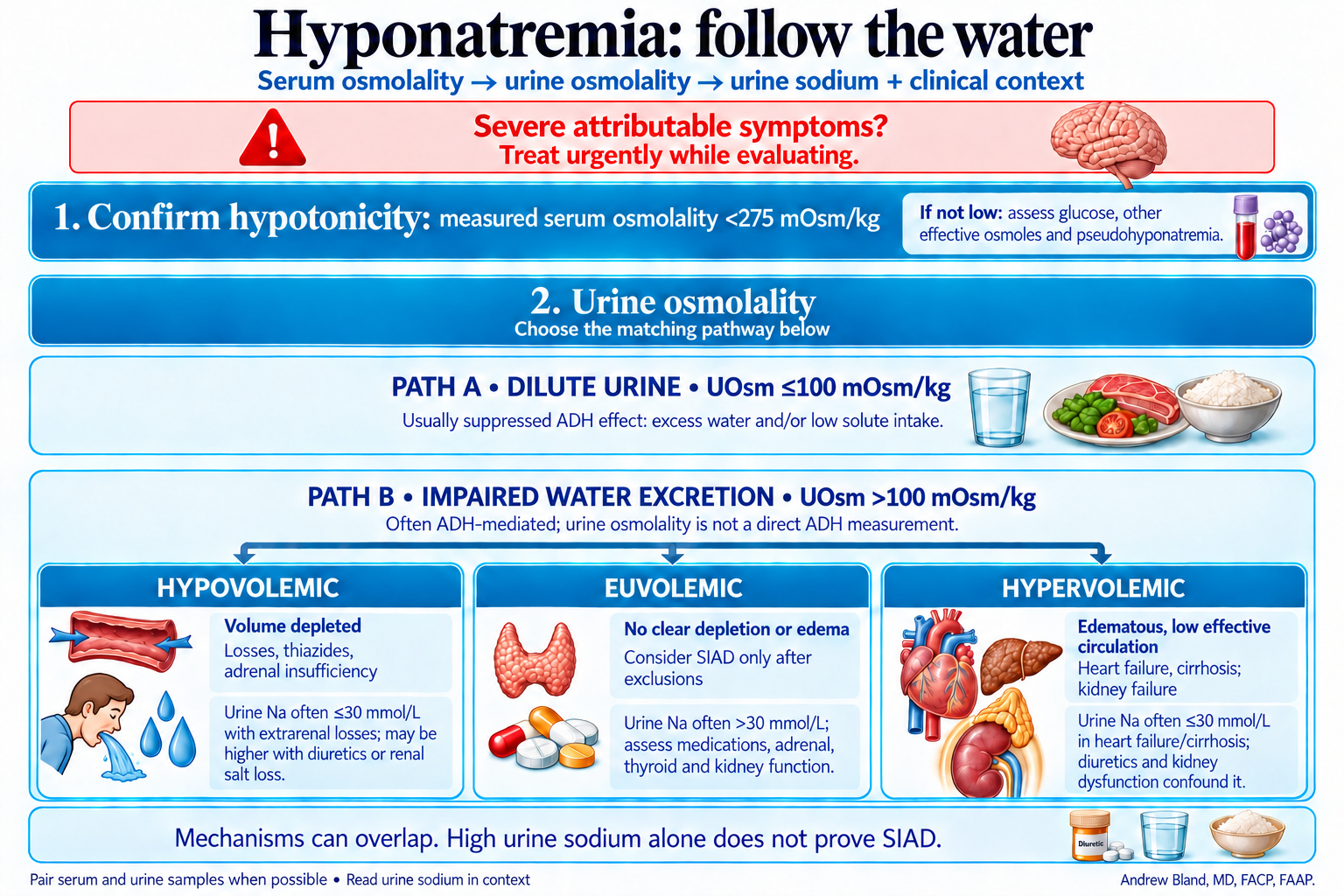
Follow the original lecture lanes: tonicity, urine dilution, then volume and urine sodium.
Teaching text
Confirm tonicity and identify urgent symptoms
Measured serum osmolality below 275 mOsm/kg confirms hypotonic hyponatremia. If it is not low, assess glucose, other osmoles and possible laboratory artifact; normal measured osmolality does not automatically prove pseudohyponatremia. Urea contributes to measured osmolality but little to effective tonicity. Obtain paired serum and urine samples when practical without delaying urgent care.
Choose the urine-osmolality pathway
Urine osmolality ≤100 mOsm/kg usually indicates appropriately suppressed ADH effect; consider excess water intake and low solute availability. Above 100, water excretion is impaired: follow the three volume lanes below. Urine osmolality is not a direct ADH assay, and thiazides or kidney dysfunction can impair dilution.
Hypovolemic lane
Look for losses, poor intake, orthostasis and weight loss. Urine sodium ≤30 mmol/L supports sodium conservation from low effective circulation; higher values may reflect diuretics, renal salt loss or adrenal insufficiency. A thiazide can raise urine sodium despite depletion.
Euvolemic lane
Consider SIAD when there is no convincing depletion or edema, but review medications and exclude adrenal insufficiency, relevant thyroid disease and impaired kidney function. Urine sodium often exceeds 30 mmol/L with adequate intake; that result alone does not establish SIAD.
Hypervolemic lane
Heart failure and cirrhosis can combine edema with low effective arterial circulation and persistent ADH release. Urine sodium is often low, but diuretics and kidney dysfunction complicate interpretation. Advanced kidney failure can also limit water excretion.
Apply the lanes to Case 2
Serum sodium 118 mEq/L with measured osmolality 248 mOsm/kg establishes hypotonicity. Urine osmolality 420 mOsm/kg shows impaired dilution. Urine sodium 55 mmol/L during thiazide use does not erase the clinical evidence of depletion. Thiazide exposure, low intake, nausea and ADH-mediated water retention can coexist.