Visual summary
Case 2: osmolality frames the problem; electrolytes explain the water balance
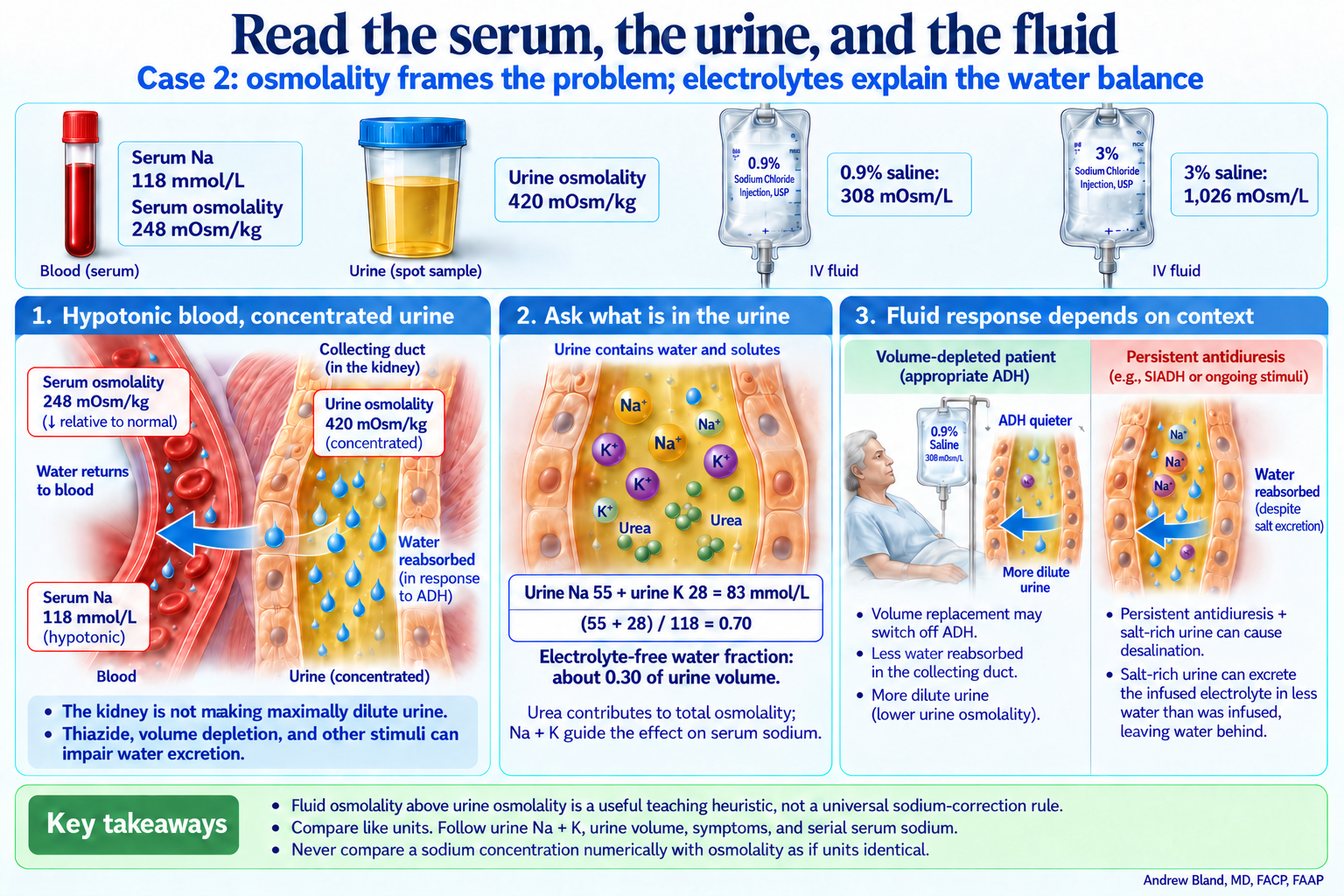
Case 2: osmolality frames the problem; electrolytes explain the water balance
Text version
Pair the specimens
Serum sodium 118 mEq/L and measured serum osmolality 248 mOsm/kg establish hypotonic hyponatremia. Urine osmolality 420 mOsm/kg shows that the kidney is not producing maximally dilute urine. The thiazide, volume depletion, nausea and other medications help explain the pattern; urine sodium alone does not diagnose SIAD.
Ask which solutes account for urine osmolality
Urine Na 55 + K 28 = 83 mEq/L. The urine-to-plasma electrolyte ratio is 83/118 = 0.70, giving electrolyte-free water clearance of about 0.30 × urine flow at this sampling point. Positive clearance can still be too small for the patient's water intake. Urea contributes to total urine osmolality but does not enter this electrolyte-free water calculation.
Compare like units and follow the response
Normal saline contains 154 mEq/L sodium and has an osmolarity near 308 mOsm/L; 3% saline contains 513 mEq/L sodium and is about 1,026 mOsm/L. Do not compare sodium concentration directly with osmolality. Fluid osmolality above urine osmolality is a useful heuristic, not a universal requirement for sodium to rise. With persistent antidiuresis, sufficiently electrolyte-rich urine can excrete the infused salt in less water than was infused, leaving water behind (desalination). In volume depletion, saline may instead suppress ADH and release a water diuresis. Follow serial serum sodium, urine Na + K and urine volume.
Does urine osmolality 420 mean that normal saline at 308 mOsm/L must lower this patient's sodium?
No. Total urine osmolality includes urea, and volume restoration can change ADH activity. Urine electrolyte content and flow, fluid inputs and the evolving volume state determine the sodium response. This case subsequently develops a brisk water diuresis and overcorrection.
Cases and related lectures
The linked case and lecture content provide the teaching sequence and patient data.