Visual summary
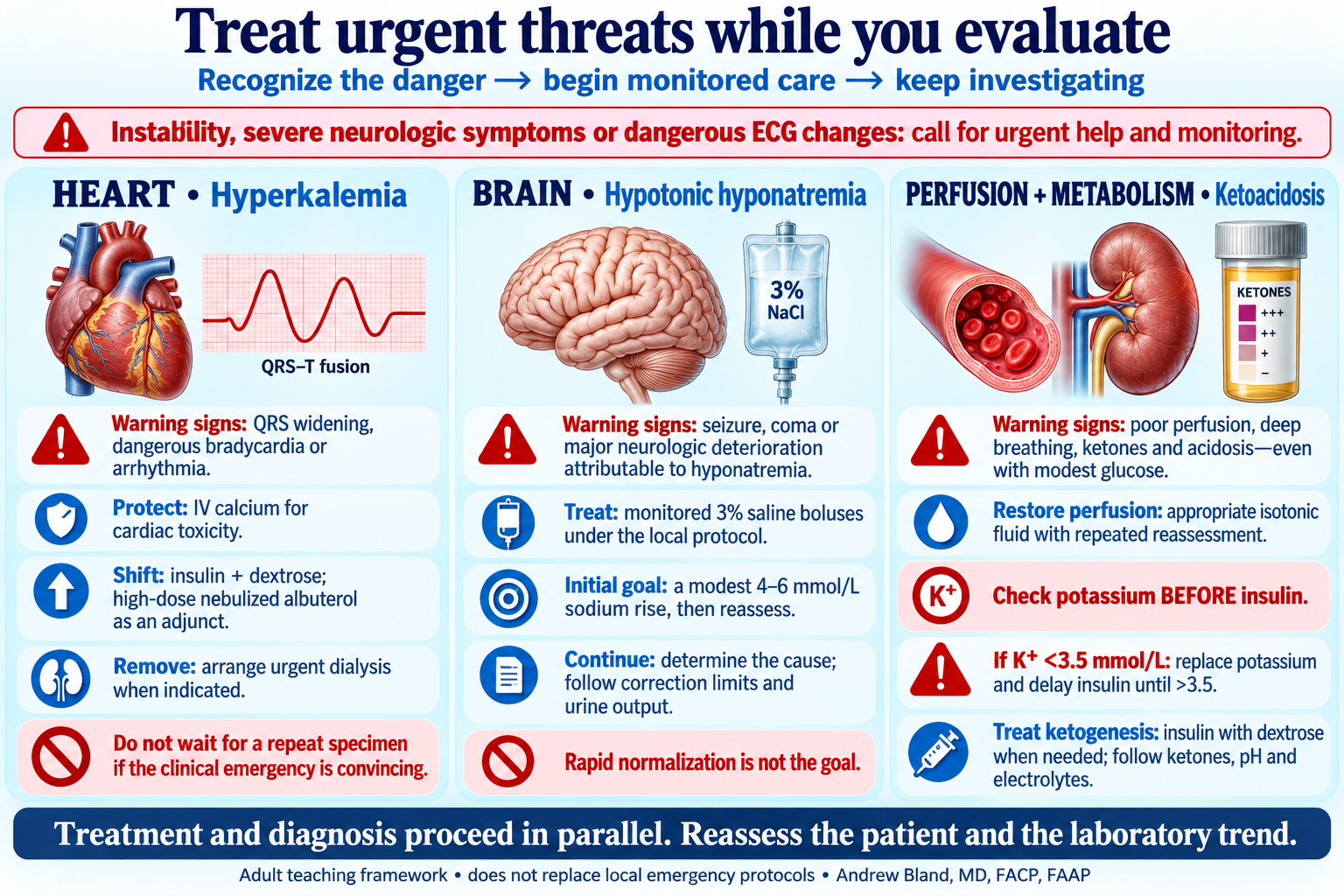
Recognize danger, begin monitored care and keep investigating in parallel.
Teaching text
Treat danger while establishing the cause
Clinical instability, dangerous ECG changes or severe neurologic symptoms call for urgent help and monitored care. Obtain focused tests without delaying treatment of a convincing emergency. Diagnostic reasoning continues alongside stabilization; a single improved number does not establish sustained safety.
Heart: hyperkalemia with cardiac toxicity
Prioritize hyperkalemic QRS widening, dangerous bradycardia or arrhythmia. Give IV calcium when indicated, shift potassium with insulin plus glucose support and adjunctive high-dose nebulized albuterol, and arrange effective removal. Follow ECG, potassium and glucose; calcium and shifting effects are temporary. The separate treatment-clock figure explains the isolated-peaked-T-wave nuance and treatment duration.
Brain: symptoms attributable to hypotonic hyponatremia
Seizure, coma or major neurologic deterioration attributable to hyponatremia warrants monitored 3% saline according to the local protocol. Aim initially for a modest effective rise of about 4–6 mmol/L, then reassess. Track urine output and correction limits while determining the cause. This urgent lane is driven by attributable symptoms, not by the sodium number alone.
Perfusion and metabolism: possible ketoacidosis
Poor perfusion, deep breathing and acidosis require urgent assessment; modest glucose does not exclude SGLT2-associated ketoacidosis. Restore circulation with an appropriate isotonic fluid and repeated reassessment. Measure potassium before insulin; if potassium is below 3.5 mmol/L, replace it and delay insulin until it exceeds 3.5. Use insulin with dextrose when needed to clear ketones. Prefer blood beta-hydroxybutyrate for assessing ketone burden and treatment response; follow pH, electrolytes and clinical status. A urine ketone dipstick can underestimate early disease.
Use the framework at every stage
Before the case, identify which findings would change the pace of care. As findings emerge, name the immediate threat, start indicated treatment and say what you will recheck. Use the later diagnosis-specific figures for doses, treatment clocks, correction limits and removal planning. Do not wait until the end of the workup to ask whether the patient needs urgent treatment.
Continue learning
Opening lecture · All Day 1 teaching · Standalone lecture collection