Visual summary
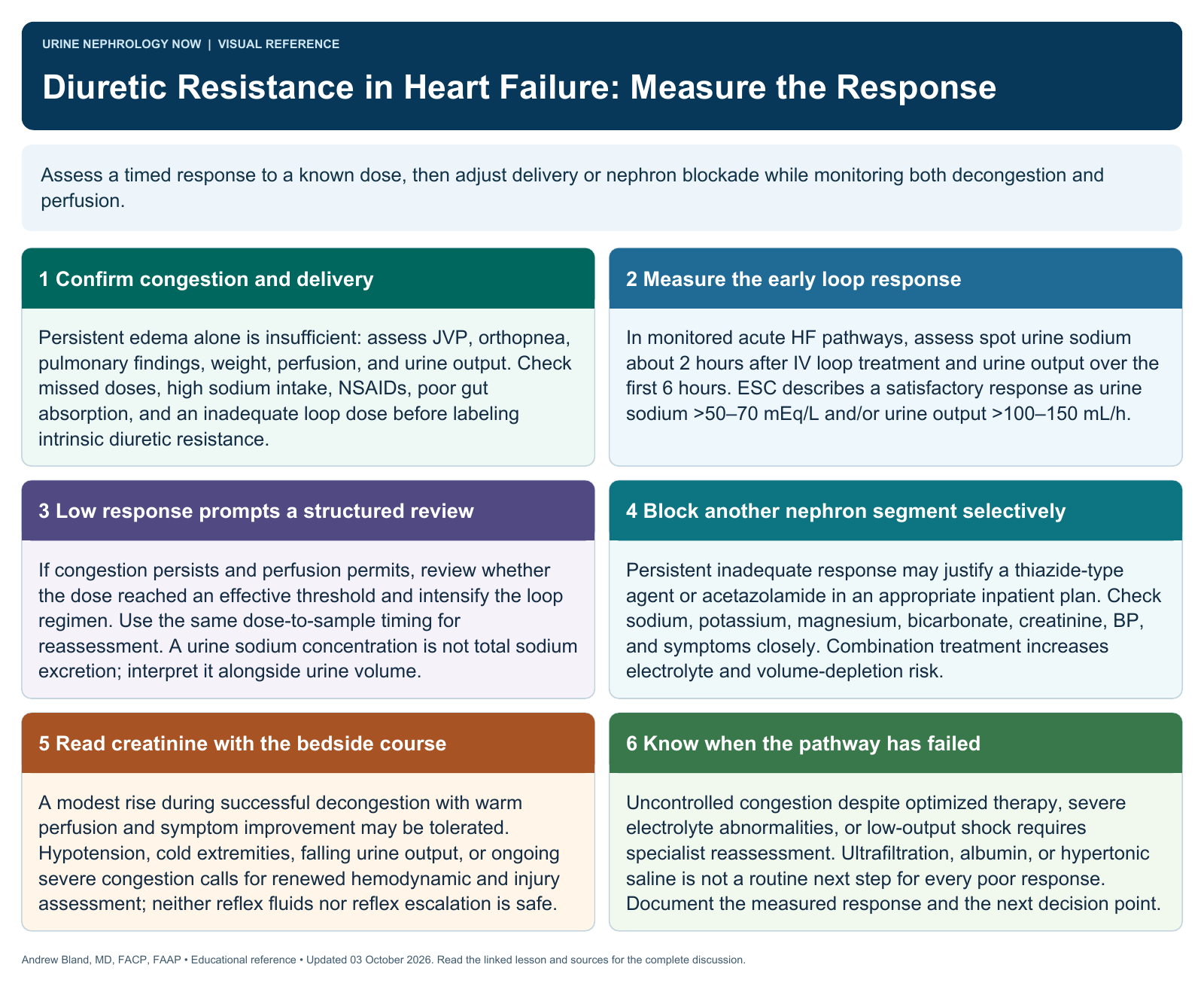
Assess a timed response to a known dose, then adjust delivery or nephron blockade while monitoring both decongestion and perfusion.
Text version
Confirm congestion and delivery
Persistent edema alone is insufficient: assess JVP, orthopnea, pulmonary findings, weight, perfusion, and urine output. Check missed doses, high sodium intake, NSAIDs, poor gut absorption, and an inadequate loop dose before labeling intrinsic diuretic resistance.
Measure the early loop response
In monitored acute HF pathways, assess spot urine sodium about 2 hours after IV loop treatment and urine output over the first 6 hours. ESC describes a satisfactory response as urine sodium >50–70 mEq/L and/or urine output >100–150 mL/h.
Low response prompts a structured review
If congestion persists and perfusion permits, review whether the dose reached an effective threshold and intensify the loop regimen. Use the same dose-to-sample timing for reassessment. A urine sodium concentration is not total sodium excretion; interpret it alongside urine volume.
Block another nephron segment selectively
Persistent inadequate response may justify a thiazide-type agent or acetazolamide in an appropriate inpatient plan. Check sodium, potassium, magnesium, bicarbonate, creatinine, BP, and symptoms closely. Combination treatment increases electrolyte and volume-depletion risk.
Read creatinine with the bedside course
A modest rise during successful decongestion with warm perfusion and symptom improvement may be tolerated. Hypotension, cold extremities, falling urine output, or ongoing severe congestion calls for renewed hemodynamic and injury assessment; neither reflex fluids nor reflex escalation is safe.
Know when the pathway has failed
Uncontrolled congestion despite optimized therapy, severe electrolyte abnormalities, or low-output shock requires specialist reassessment. Ultrafiltration, albumin, or hypertonic saline is not a routine next step for every poor response. Document the measured response and the next decision point.