Visual summary
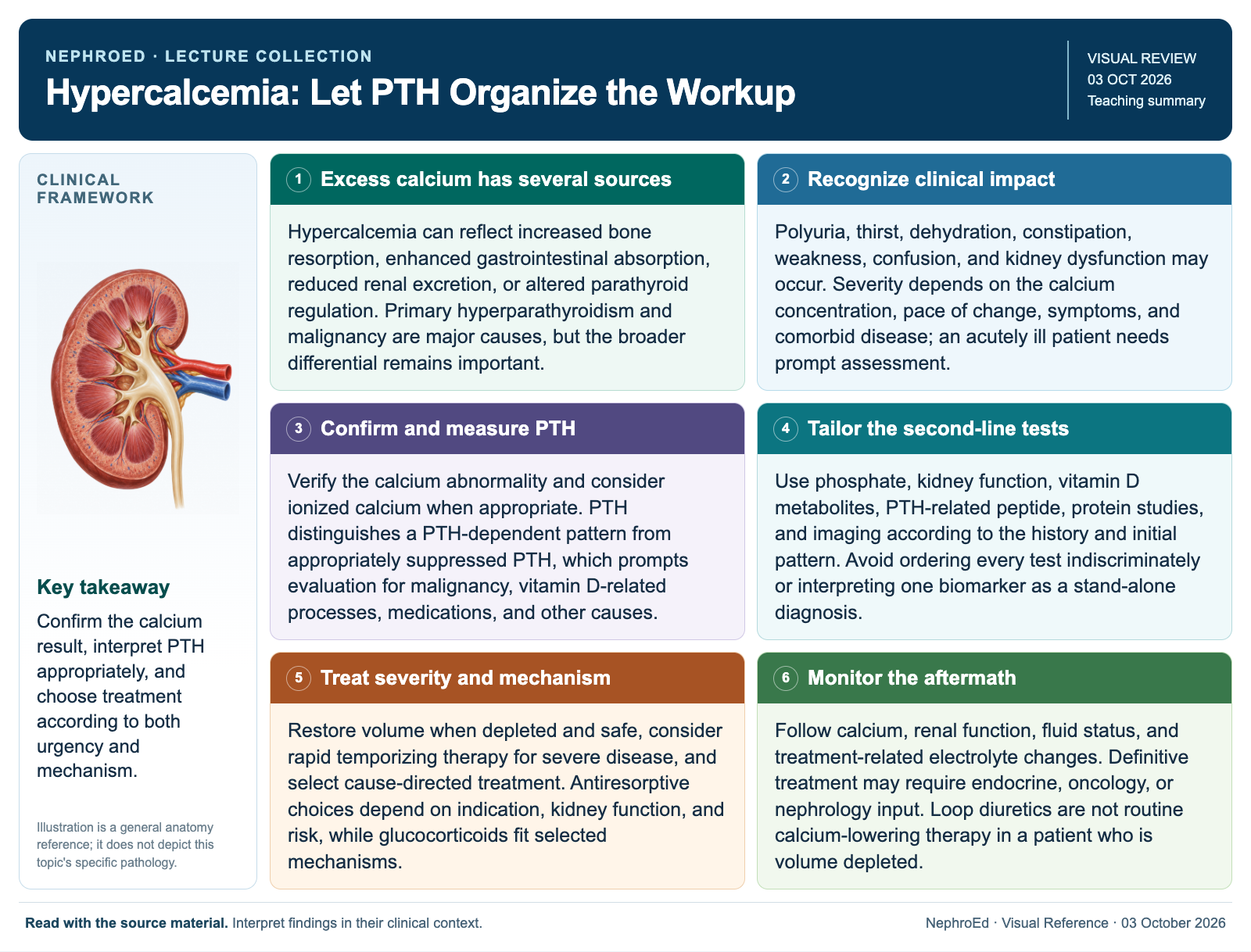
Confirm the calcium result, interpret PTH appropriately, and choose treatment according to both urgency and mechanism.
Text version
Excess calcium has several sources
Hypercalcemia can reflect increased bone resorption, enhanced gastrointestinal absorption, reduced renal excretion, or altered parathyroid regulation. Primary hyperparathyroidism and malignancy are major causes, but the broader differential remains important.
Recognize clinical impact
Polyuria, thirst, dehydration, constipation, weakness, confusion, and kidney dysfunction may occur. Severity depends on the calcium concentration, pace of change, symptoms, and comorbid disease; an acutely ill patient needs prompt assessment.
Confirm and measure PTH
Verify the calcium abnormality and consider ionized calcium when appropriate. PTH distinguishes a PTH-dependent pattern from appropriately suppressed PTH, which prompts evaluation for malignancy, vitamin D-related processes, medications, and other causes.
Tailor the second-line tests
Use phosphate, kidney function, vitamin D metabolites, PTH-related peptide, protein studies, and imaging according to the history and initial pattern. Avoid ordering every test indiscriminately or interpreting one biomarker as a stand-alone diagnosis.
Treat severity and mechanism
Restore volume when depleted and safe, consider rapid temporizing therapy for severe disease, and select cause-directed treatment. Antiresorptive choices depend on indication, kidney function, and risk, while glucocorticoids fit selected mechanisms.
Monitor the aftermath
Follow calcium, renal function, fluid status, and treatment-related electrolyte changes. Definitive treatment may require endocrine, oncology, or nephrology input. Loop diuretics are not routine calcium-lowering therapy in a patient who is volume depleted.
Continue learning
This graphic summarizes a topic. The full educational pages provide the broader discussion and references.