Visual summary
Determine whether potassium is lost or shifted, correct magnesium when deficient, and match replacement to the patient’s physiology.
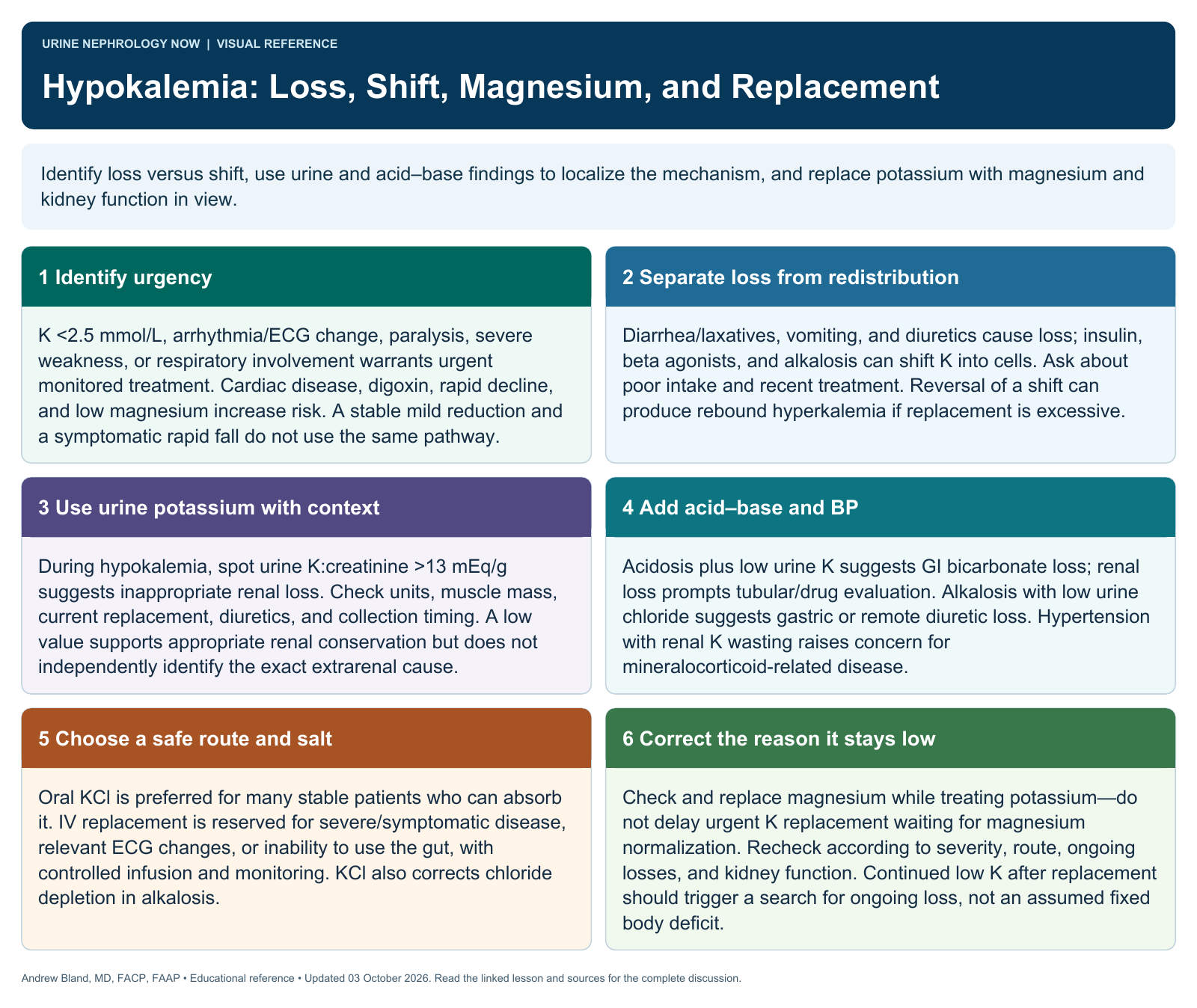
Text version
Low potassium has different mechanisms
Hypokalemia may result from gastrointestinal or renal loss, intracellular shifting, or inadequate intake. Losses and shifts may coexist, and the serum value does not directly quantify the total-body deficit in every setting.
Recognize clinical risk
Assess weakness, cramps, palpitations, ileus, respiratory compromise, and ECG findings when indicated. Severe symptoms, rapid change, cardiac disease, or interacting medications can make a given potassium concentration more dangerous.
Find the route of loss
Review vomiting, diarrhea, diuretics, laxatives, insulin, beta agonists, blood pressure, and acid–base status. Urinary potassium assessment can help identify renal wasting when interpreted with collection method, timing, and kidney function.
Check magnesium and replace safely
Magnesium deficiency can perpetuate renal potassium loss and make correction difficult. Oral replacement suits many stable patients; intravenous therapy requires an appropriate indication, controlled administration, and monitoring matched to the clinical risk.
Choose the formulation thoughtfully
Potassium chloride often addresses combined potassium and chloride depletion, while other salts may fit different acid–base or phosphate needs. Replacement must account for kidney function, ongoing losses, and concurrent medications that raise potassium.
Expect a changing response
Redistribution may reverse, so excessive replacement can lead to rebound hyperkalemia. Recheck potassium and magnesium as appropriate, treat the underlying cause, and avoid estimating an exact deficit from a simple fixed conversion alone.
Continue learning
This graphic summarizes a topic. The full educational pages provide the broader discussion and references.