This hub organizes potassium teaching around three questions: is the value real, does the patient need urgent stabilization, and what caused the disturbance? Kidney excretion, gastrointestinal loss, medicines, and shifts between cells and blood all matter.
Learning goal: Connect assessment, evidence, and a clear next clinical decision. Educational use; individual care requires the treating team’s assessment and applicable protocols.
Visual reference
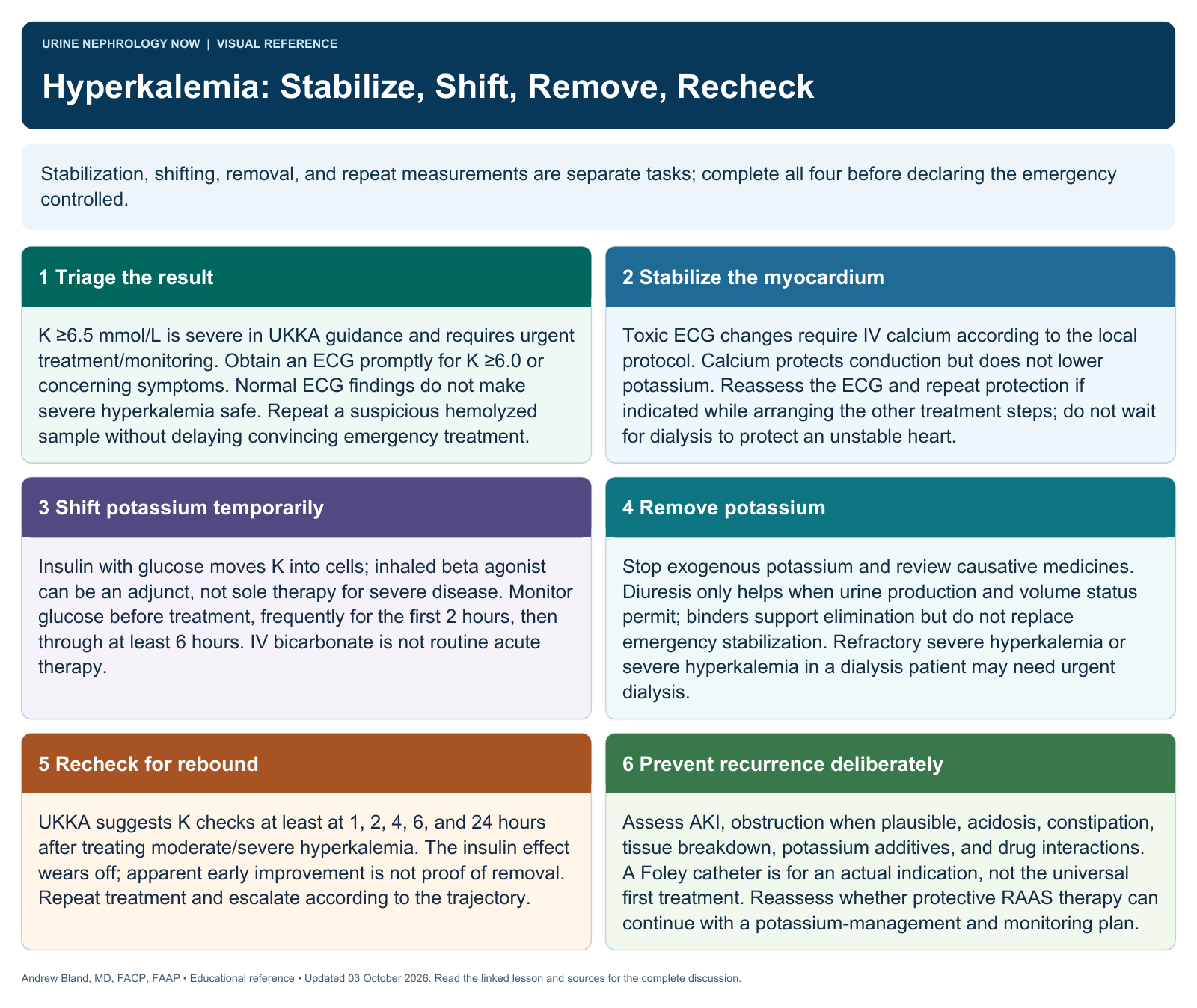
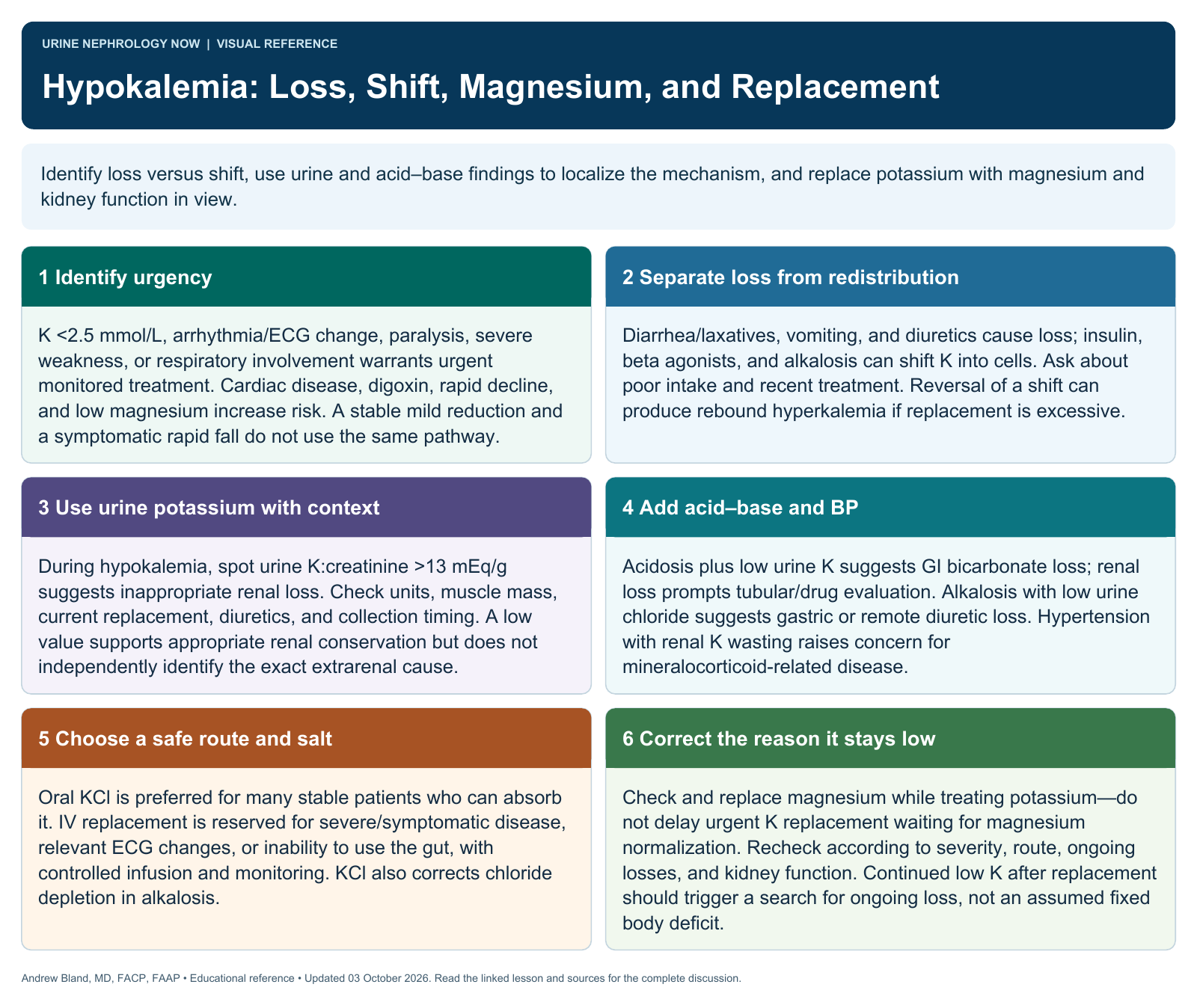
Browse the visual reference library · Download lesson Markdown
Assess urgency
Weakness, palpitations, syncope, an abnormal rhythm, or a critical potassium result needs immediate clinical assessment. Obtain ECG and monitoring when indicated. The urgency depends on the magnitude and trajectory of the disturbance and the patient’s condition; a normal ECG cannot reliably exclude dangerous hyperkalemia.
Question a surprising result
Hemolysis and collection or processing problems can create misleading potassium values. Compare with prior results and the clinical context, and repeat using appropriate collection when needed. Do not delay stabilization of a clinically concerning patient solely to prove that a result is genuine.
Distinguish balance from shifts
Total body potassium and measured serum potassium are related but different. Insulin, adrenergic activity, acid–base physiology, and cellular injury can alter distribution. Renal excretion, gastrointestinal losses, intake, and medicines determine ongoing balance; several factors commonly contribute at the same time.
Work through hyperkalemia
Review AKI or advanced CKD, medicines, missed dialysis, constipation, acidosis, and tissue breakdown. Emergency care may require cardiac membrane stabilization, movement into cells, and potassium removal under a monitored protocol. Recheck for rebound and treatment-related hypoglycemia; a binder is not the sole response to instability.
Work through hypokalemia
Review vomiting or diarrhea, diuretics, poor intake, and transcellular shifts. Check magnesium when clinically relevant because depletion can make correction difficult. Replacement route, amount, and monitoring depend on severity, symptoms, kidney function, and ongoing loss; avoid automatic replacement from a single postdialysis value.
Use the topic lessons
The hyperkalemia and hypokalemia pages below cover the clinical approach in more detail. Reconcile medicines and diet without unnecessary blanket restriction, and document the cause, monitoring interval, and responsible clinician. Recurrent abnormalities should trigger a prevention review rather than isolated repeated corrections.
Apply the framework
Can a normal ECG rule out a dangerous high potassium result?
Show the reasoning
No. Assess the potassium level, trajectory, symptoms, renal function, and clinical context while arranging the appropriate monitoring and treatment.
References and evidence
These sources support the teaching framework. Trial populations, endpoints, and limitations should be checked before applying a result to an individual patient.
- Ashby D, Borman N, Burton J et al.. Renal Association Clinical Practice Guideline on Haemodialysis. BMC Nephrol. 2019;20(1):379. PubMed 31623578
- Kidney Disease: Improving Global Outcomes (KDIGO) CKD Work Group. KDIGO 2024 Clinical Practice Guideline for the Evaluation and Management of Chronic Kidney Disease. Kidney Int. 2024;105(4S):S117-S314. PubMed 38490803