Visual summary
Urine chloride provides a branch, not a diagnosis: combine <20 versus ≥20 with BP, volume, kidney function, and diuretic timing.
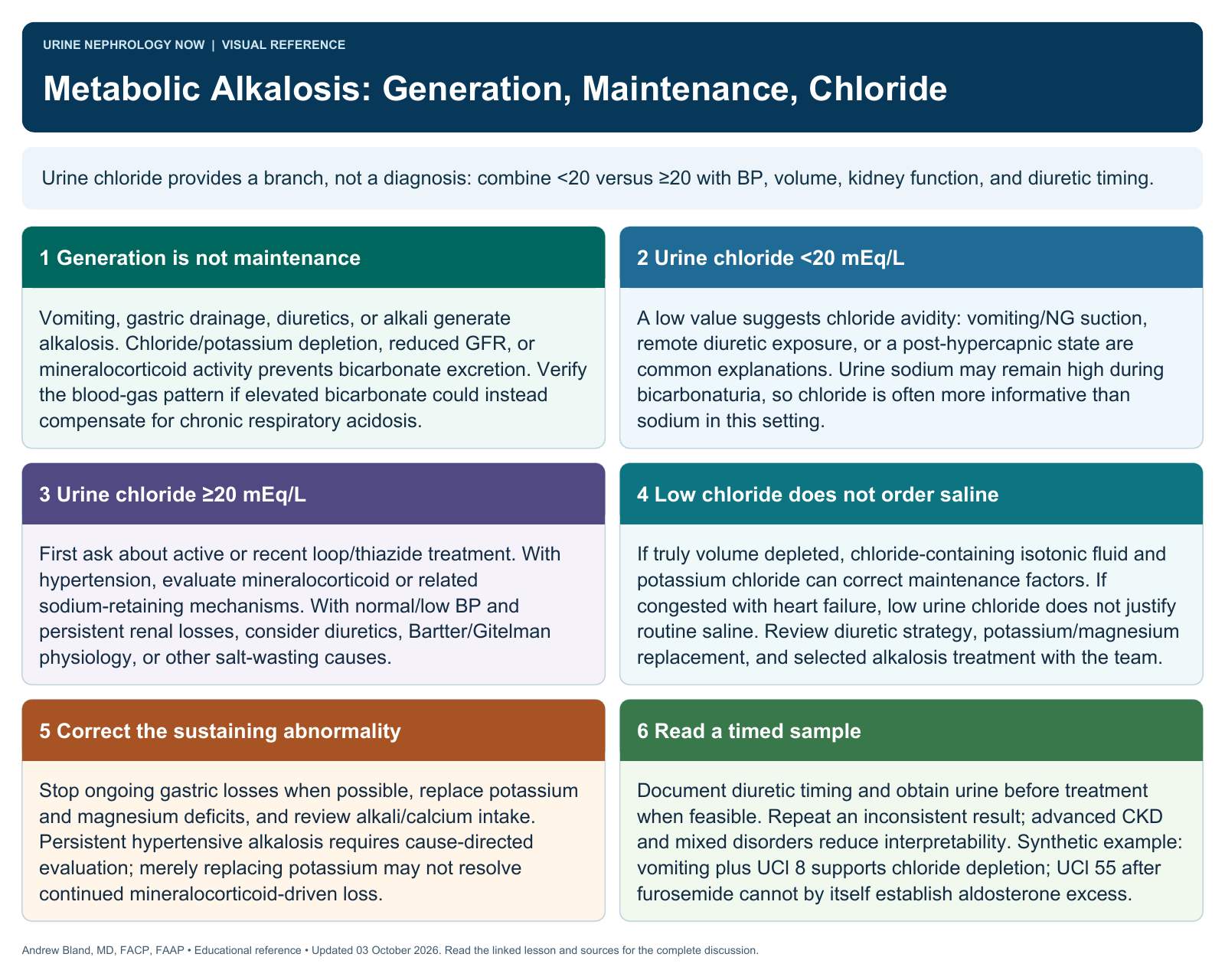
Text version
Generation is not maintenance
Vomiting, gastric drainage, diuretics, or alkali generate alkalosis. Chloride/potassium depletion, reduced GFR, or mineralocorticoid activity prevents bicarbonate excretion. Verify the blood-gas pattern if elevated bicarbonate could instead compensate for chronic respiratory acidosis.
Urine chloride <20 mEq/L
A low value suggests chloride avidity: vomiting/NG suction, remote diuretic exposure, or a post-hypercapnic state are common explanations. Urine sodium may remain high during bicarbonaturia, so chloride is often more informative than sodium in this setting.
Urine chloride ≥20 mEq/L
First ask about active or recent loop/thiazide treatment. With hypertension, evaluate mineralocorticoid or related sodium-retaining mechanisms. With normal/low BP and persistent renal losses, consider diuretics, Bartter/Gitelman physiology, or other salt-wasting causes.
Low chloride does not order saline
If truly volume depleted, chloride-containing isotonic fluid and potassium chloride can correct maintenance factors. If congested with heart failure, low urine chloride does not justify routine saline. Review diuretic strategy, potassium/magnesium replacement, and selected alkalosis treatment with the team.
Correct the sustaining abnormality
Stop ongoing gastric losses when possible, replace potassium and magnesium deficits, and review alkali/calcium intake. Persistent hypertensive alkalosis requires cause-directed evaluation; merely replacing potassium may not resolve continued mineralocorticoid-driven loss.
Read a timed sample
Document diuretic timing and obtain urine before treatment when feasible. Repeat an inconsistent result; advanced CKD and mixed disorders reduce interpretability. Synthetic example: vomiting plus UCl 8 supports chloride depletion; UCl 55 after furosemide cannot by itself establish aldosterone excess.