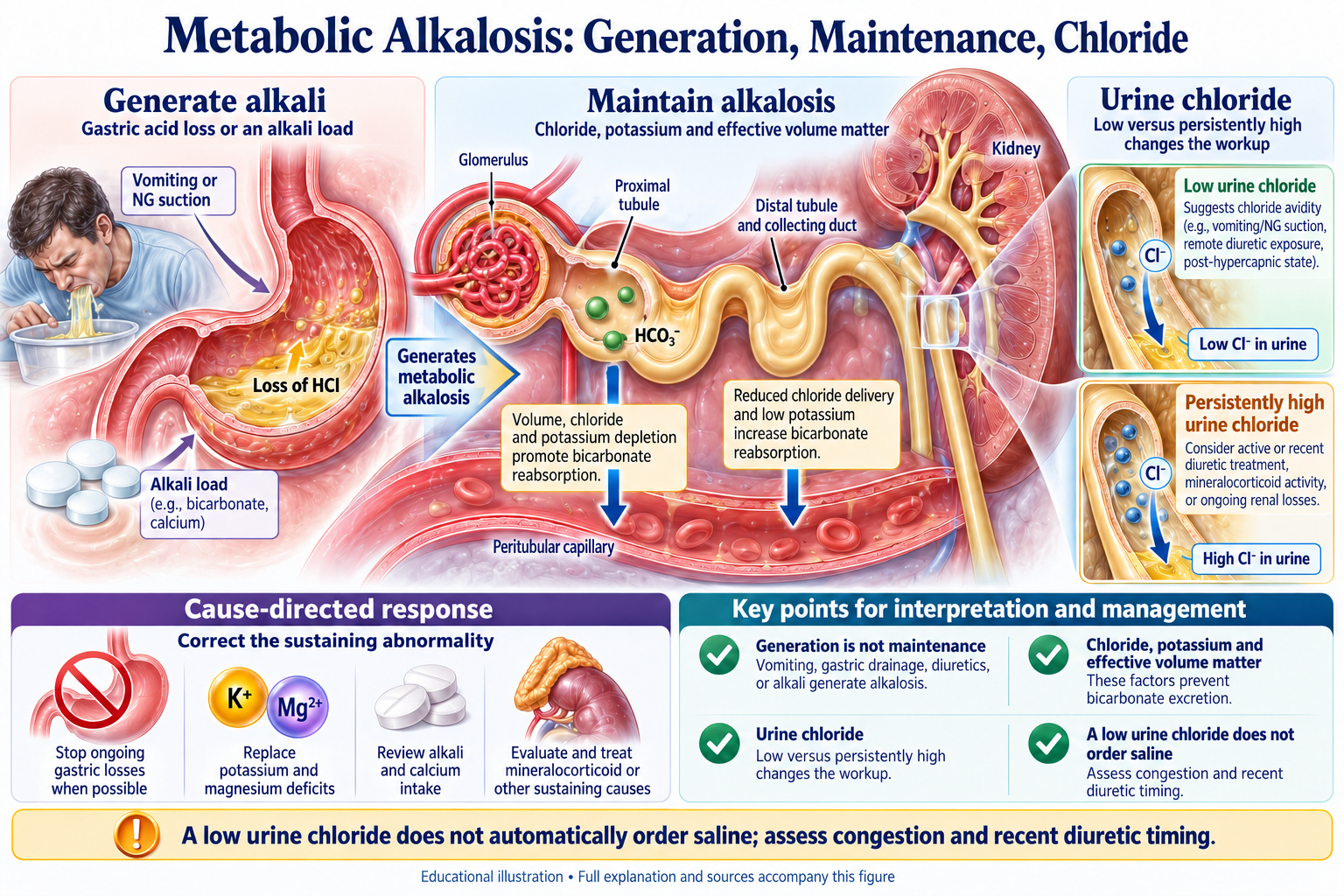
Pre-Case Assessment: Test Your Baseline Knowledge
Answer these questions before reviewing the case to assess your starting knowledge
Which urine chloride value is most consistent with hypokalemia due to upper GI losses?
Learning Point: Upper GI losses (vomiting) cause chloride depletion, leading to low urine chloride (<20 mEq/L) as the kidneys conserve chloride. This is key to differentiating from inherited tubulopathies like Gitelman/Bartter syndrome.
📚 Reference: Hypokalemia Evaluation Module
What serum bicarbonate level suggests significant metabolic alkalosis requiring evaluation?
Learning Point: Serum bicarbonate >30 mEq/L represents significant metabolic alkalosis that warrants investigation. Levels 24-30 may be compensatory or mild, while >30 suggests a primary metabolic process.
📚 Reference: Metabolic Alkalosis Module
Which laboratory finding helps distinguish Bartter/Gitelman syndrome from eating disorder-related hypokalemia?
Learning Point: Bartter/Gitelman syndromes cause persistently high urine chloride (>40 mEq/L) due to defective renal chloride reabsorption, while eating disorders with vomiting cause low urine chloride (<20 mEq/L) due to volume depletion.
📚 Reference: Hypokalemia Differential Diagnosis
Case Presentation
Patient: 22-year-old female college student
Chief Complaint: "Weakness, muscle cramps, and episodes of 'heart racing'"
History of Present Illness: 3-month history of progressive weakness, particularly with climbing stairs. Reports frequent muscle cramps, especially in her legs. Has experienced several episodes of palpitations and feeling "lightheaded." Denies chest pain, shortness of breath, or syncope. Initially attributed symptoms to stress from finals.
Past Medical History: No significant medical history, no medications
Social History: College sophomore studying dance. Lives in dormitory. Denies tobacco, alcohol, or recreational drug use. "Watches her diet carefully" and exercises 2-3 hours daily including dance and cardio.
Family History: No known kidney disease, hypertension, or genetic disorders
Review of Systems: Reports occasional nausea and "upset stomach," especially when stressed. Denies diarrhea, polyuria, or polydipsia.
🤔 Initial Clinical Reasoning Questions
Given this 22-year-old female dancer with weakness and palpitations, what is the most likely electrolyte abnormality?
Clinical Reasoning: Young female dancer with weakness, muscle cramps, and palpitations in the setting of "watching her diet carefully" suggests possible restrictive eating and compensatory behaviors leading to hypokalemia.
📚 Learn More: Hypokalemia Evaluation Module
What additional history would be most important to obtain in this case?
Clinical Reasoning: In a young person with potential eating disorder, understanding dietary restriction, purging behaviors (vomiting, laxatives), and exercise patterns is crucial for identifying the cause of electrolyte abnormalities.
📚 Learn More: Hypokalemia Differential Diagnosis
Physical Examination
Vital Signs & General Appearance
Vital Signs
- Blood Pressure: 102/68 mmHg
- Heart Rate: 88 bpm (regular)
- Respiratory Rate: 18/min
- Temperature: 36.8°C (98.2°F)
- BMI: 18.2 kg/m² (underweight)
- Oxygen Saturation: 98% on room air
General Appearance
- Overall: Thin appearing, anxious
- Hydration: Appears mildly volume depleted
- Activity: Fatigued with minimal exertion
- Posture: No apparent distress at rest
Focused Physical Findings
📍 Key Examination Findings
- HEENT: Dental enamel erosion on posterior teeth, parotid gland swelling
- Cardiovascular: Regular rate, no murmurs, orthostatic changes present (HR ↑15, BP ↓12 mmHg)
- Abdomen: Soft, non-tender, hypoactive bowel sounds
- Extremities: No edema, Russell's sign (calluses on knuckles)
🔍 Neuromuscular Assessment
- Muscle strength: Diminished in proximal muscle groups
- Deep tendon reflexes: Hypoactive (1+/4)
- Muscle cramps: Reproducible with calf palpation
- Sensory: Intact, no paresthesias
Laboratory Data & Analysis
Initial Laboratory Panel
| Parameter | Value | Normal Range | Clinical Significance |
|---|---|---|---|
| Potassium | 2.1 mEq/L | 3.5-5.0 mEq/L | Severe hypokalemia - emergency level |
| Chloride | 89 mEq/L | 98-107 mEq/L | Hypochloremia from GI losses |
| Bicarbonate | 34 mEq/L | 22-28 mEq/L | Significant metabolic alkalosis |
| Sodium | 138 mEq/L | 136-145 mEq/L | Normal |
| BUN | 28 mg/dL | 8-20 mg/dL | Elevated - suggests volume depletion |
| Creatinine | 1.1 mg/dL | 0.6-1.2 mg/dL | Normal kidney function |
| Magnesium | 1.8 mg/dL | 1.7-2.2 mg/dL | Normal (rules out hypomagnesemia) |
| Phosphorus | 3.2 mg/dL | 2.5-4.5 mg/dL | Normal |
📊 Laboratory Analysis Questions
The laboratory pattern of K+ 2.1, Cl- 89, HCO3- 34 is most consistent with:
Learning Point: The triad of hypokalemia, hypochloremia, and metabolic alkalosis is classic for upper GI losses (vomiting). Loss of HCl leads to chloride depletion and metabolic alkalosis, while volume depletion causes secondary hyperaldosteronism and potassium wasting.
📚 Reference: Metabolic Alkalosis Causes
What is the next most important test to order in this patient?
Learning Point: Spot urine chloride is the key diagnostic test to differentiate causes of hypokalemic metabolic alkalosis. Urine chloride <20 mEq/L suggests chloride depletion (vomiting), while >40 mEq/L suggests intrinsic renal causes (Bartter/Gitelman, hyperaldosteronism).
📚 Reference: Urine Electrolyte Interpretation
Focused History & Spot Urine Electrolyte Studies
Additional History (with Privacy and Trust)
After establishing rapport and explaining confidentiality, the patient reveals:
- Eating patterns: Severely restricts caloric intake, often <800 calories/day
- Compensatory behaviors: Self-induced vomiting 2-3 times daily, especially after eating
- Laxative use: Uses stimulant laxatives 4-5 times per week "to feel less bloated"
- Exercise: Excessive exercise regimen, feels guilty if she misses workouts
- Body image: Intense fear of weight gain despite being underweight
- Duration: Behaviors started 8 months ago but intensified in last 3 months
Spot Urine Electrolyte Studies
| Parameter | Patient Value | Expected Range | Interpretation |
|---|---|---|---|
| Urine Chloride | 8 mEq/L | >40 mEq/L (normal intake) | Very low - suggests chloride depletion |
| Urine Sodium | 12 mEq/L | >20 mEq/L | Low - volume depletion |
| Urine Potassium | 25 mEq/L | <20 mEq/L with hypokalemia | Inappropriately high for hypokalemia |
| Urine Specific Gravity | 1.025 | 1.010-1.025 | Concentrated - consistent with dehydration |
| Urine pH | 7.8 | 5.0-8.0 | Alkaline - reflects metabolic alkalosis |
🔬 Spot Urine Studies Interpretation
The spot urine chloride of 8 mEq/L in this patient indicates:
Learning Point: Urine chloride <20 mEq/L indicates chloride-responsive metabolic alkalosis, typically from GI losses or diuretics. The kidneys conserve chloride when depleted. This responds to chloride replacement with normal saline.
📚 Reference: Chloride-Responsive vs Resistant Alkalosis
Why is this NOT Gitelman or Bartter syndrome?
Learning Point: Bartter and Gitelman syndromes cause defective renal chloride reabsorption, leading to persistently high urine chloride (>40 mEq/L) even with volume depletion. The low urine chloride (8 mEq/L) indicates intact renal chloride conservation, ruling out these tubulopathies.
📚 Reference: Inherited Tubulopathies vs Acquired Causes
Interactive Diagnostic Algorithm
Use this tool to understand the diagnostic approach to hypokalemic metabolic alkalosis
Step-by-Step Diagnostic Process
Step 1: Confirm Metabolic Alkalosis
This Patient: HCO3- = 34 mEq/L (>30 = significant)
Expected PCO2: 0.7 × (34) + 21 = 23.8 + 21 = 44.8 mmHg (Narins-Emmett rule for metabolic alkalosis compensation, plus or minus 2)
Step 2: Assess Volume Status
This Patient: BP 102/68, orthostatic changes, BUN 28
Conclusion: Volume depleted
Step 3: Check Urine Chloride
This Patient: UCl = 8 mEq/L
Interpretation: <20 = Chloride-responsive
Step 4: Identify Source
This Patient: Upper GI losses (vomiting)
Mechanism: HCl loss → alkalosis + volume depletion
Comprehensive Differential Diagnosis
Hypokalemic Metabolic Alkalosis: Key Differentiating Features
| Condition | Urine Chloride | Blood Pressure | Other Features | This Patient |
|---|---|---|---|---|
| Vomiting/Bulimia | <20 mEq/L | Low/Normal | Dental erosion, volume depletion | ✓ MATCHES |
| Diuretic Use | <20 mEq/L (remote use) | Low/Normal | Recent medication history | No history |
| Gitelman Syndrome | >40 mEq/L | Low/Normal | Hypomagnesemia, genetic | UCl too low |
| Bartter Syndrome | >40 mEq/L | Low/Normal | Early onset, growth retardation | UCl too low |
| Primary Hyperaldosteronism | >40 mEq/L | High | Hypertension, suppressed renin | Hypotensive |
| Liddle Syndrome | >40 mEq/L | High | Early hypertension, family history | Hypotensive |
🔍 Differential Diagnosis Questions
The key laboratory finding that rules out Gitelman syndrome in this patient is:
Learning Point: Gitelman syndrome involves defective thiazide-sensitive NaCl cotransporter, causing persistent renal salt wasting and high urine chloride. The low urine chloride indicates intact renal chloride conservation, excluding this diagnosis.
📚 Learn More: Inherited Tubulopathies - Gitelman & Bartter
Treatment & Management Questions
What is the most appropriate initial treatment for this patient's electrolyte abnormalities?
Treatment Rationale: Chloride-responsive metabolic alkalosis requires chloride replacement (normal saline) to correct the alkalosis AND potassium replacement for hypokalemia. Chloride replacement is essential - alkalosis won't resolve with K+ alone.
📚 Reference: Hypokalemia Treatment Protocols
Why is it difficult to correct hypokalemia in the setting of metabolic alkalosis?
Treatment Rationale: Metabolic alkalosis enhances distal nephron potassium secretion through multiple mechanisms: increased aldosterone effect, enhanced epithelial sodium channel activity, and favorable electrochemical gradients. Must correct alkalosis to stop K+ wasting.
📚 Reference: Alkalosis and Potassium Handling
What is the most critical non-pharmacologic intervention for this patient?
Treatment Rationale: Eating disorders require specialized multidisciplinary care including medical monitoring, nutritional rehabilitation, and psychological treatment. Without addressing the underlying eating disorder, electrolyte abnormalities will recur.
📚 Reference: Eating Disorder Medical Complications
Learning Objectives Assessment
Evaluate your mastery of the key learning objectives from this case
🎯 Learning Objective 1: Hypokalemic Metabolic Alkalosis Evaluation
Objective: Students should demonstrate systematic approach to evaluating hypokalemic metabolic alkalosis using urine chloride
A 35-year-old man presents with K+ 2.8, Cl- 92, HCO3- 32, and urine chloride 45 mEq/L. The most likely diagnosis is:
Competency Demonstration: High urine chloride (>40 mEq/L) with hypokalemic metabolic alkalosis indicates chloride-resistant causes, most commonly mineralocorticoid excess. This requires aldosterone/renin studies.
📚 Master This: Advanced Hypokalemia Evaluation
🎯 Learning Objective 2: Inherited Tubulopathy Recognition
Objective: Students should differentiate acquired from inherited causes of hypokalemic alkalosis
Which finding would be most consistent with Gitelman syndrome rather than bulimia?
Competency Demonstration: Inherited tubulopathies cause defective renal electrolyte reabsorption, leading to persistent renal losses even with volume depletion. Normal kidneys would conserve chloride (UCl <20) when volume depleted.
📚 Master This: Genetic vs Acquired Hypokalemia
🎯 Learning Objective 3: Treatment of Chloride-Responsive Metabolic Alkalosis
Objective: Students should understand the pathophysiology-based treatment approach
Why is normal saline preferred over D5W for treating chloride-responsive metabolic alkalosis?
Competency Demonstration: Chloride-responsive metabolic alkalosis results from chloride depletion. The kidneys cannot correct alkalosis without adequate chloride. Normal saline provides both volume and chloride replacement.
📚 Master This: Chloride-Responsive Alkalosis Treatment
Integration Challenge: Complex Clinical Scenarios
Apply integrated knowledge across multiple domains
A patient with confirmed bulimia nervosa has been treated with NS + KCl for 3 days. Labs now show K+ 3.2, Cl- 98, HCO3- 28. Urine chloride is 35 mEq/L. What is the next step?
Integration Challenge: Rising urine chloride (35 mEq/L) suggests ongoing losses, likely continued vomiting. This demonstrates the importance of addressing the underlying behavioral disorder alongside medical treatment. Must integrate medical and psychiatric care.
📚 Master This: Comprehensive Eating Disorder Management
Integration Scenario: A 19-year-old presents with hypokalemic metabolic alkalosis. Urine chloride is 8 mEq/L, but the patient denies vomiting or laxative use. What additional assessment is most important?
Integration Challenge: Low urine chloride strongly suggests GI losses, but eating disorder behaviors are often concealed due to shame. Requires clinical skills combining medical knowledge with sensitive interviewing techniques and understanding of psychological barriers to disclosure.
📚 Master This: Sensitive Assessment Techniques
Advanced Electrolyte & Acid-Base Reasoning
Test deeper understanding of metabolic alkalosis pathophysiology and management
A patient with bulimia has a serum bicarbonate of 38 mEq/L and pH of 7.52. What is the expected pCO2 if respiratory compensation is appropriate?
Learning Point: For metabolic alkalosis, respiratory compensation follows the formula: expected pCO2 = 0.7 x [HCO3] + 21 (plus or minus 2). With HCO3 of 38: pCO2 = 0.7(38) + 21 = 26.6 + 21 = 47.6, so approximately 48-50 mmHg. A measured pCO2 significantly different from this suggests a concurrent respiratory disorder. Respiratory compensation for metabolic alkalosis is limited by hypoxic drive, rarely exceeding 55 mmHg.
📚 Reference: Acid-Base Module - Compensation Rules
Why does hypokalemia PERPETUATE metabolic alkalosis even after the initial cause (vomiting) has been treated?
Learning Point: Hypokalemia perpetuates metabolic alkalosis through multiple mechanisms: (1) stimulation of H+/K+-ATPase in collecting duct intercalated cells, which secretes H+ into urine in exchange for K+ reabsorption, generating new bicarbonate; (2) intracellular acidosis driving increased ammoniagenesis and acid excretion; (3) stimulation of proximal tubular bicarbonate reabsorption. This creates a vicious cycle where alkalosis causes renal K+ wasting, and K+ depletion maintains the alkalosis. This is why correcting BOTH chloride AND potassium is essential.
📚 Reference: Metabolic Alkalosis - Maintenance Mechanisms
A patient with chronic vomiting and metabolic alkalosis has a urine potassium of 45 mEq/L despite serum K of 2.8 mEq/L. What explains this paradoxical renal potassium wasting?
Learning Point: When serum bicarbonate exceeds the renal threshold for reabsorption (approximately 26 mEq/L), bicarbonate spills into the urine. This non-reabsorbable anion is accompanied by sodium, increasing distal sodium delivery. The increased sodium delivery to the collecting duct drives potassium secretion through ENaC-mediated sodium reabsorption creating a lumen-negative potential that favors K+ loss. Additionally, secondary hyperaldosteronism from volume depletion further enhances potassium excretion.
📚 Reference: Potassium Module - Renal K+ Handling
Case Reflection & Multi-Module Integration
⚡ Electrolyte Disorders Integration
- Systematic approach to hypokalemic metabolic alkalosis
- Urine chloride as key diagnostic tool
- Pathophysiology-based treatment strategies
🧪 Acid-Base Disorders Integration
- Metabolic alkalosis evaluation and compensation
- Chloride-responsive vs chloride-resistant categories
- Physiologic basis for treatment approaches
🔬 Diagnostic Testing Integration
- Urine electrolyte interpretation and utility
- Laboratory patterns in different disease states
- Cost-effective diagnostic approaches
🧠 Special Populations Integration
- Eating disorder medical complications
- Multidisciplinary care coordination
- Sensitive assessment techniques
🎯 Key Integration Concepts
This case demonstrates the critical importance of integrating basic science knowledge (electrolyte physiology), clinical reasoning (systematic diagnostic approach), laboratory interpretation (urine chloride significance), and psychosocial awareness (eating disorder recognition) to provide comprehensive patient care. The ability to distinguish inherited from acquired causes through understanding of underlying pathophysiology exemplifies evidence-based medical practice.
📝 Case Summary & Clinical Pearls
This case illustrates the systematic evaluation of hypokalemic metabolic alkalosis in a young woman with bulimia nervosa. Key learning points include understanding the diagnostic utility of urine chloride, recognizing why inherited tubulopathies present differently from acquired causes, and appreciating the importance of addressing underlying psychiatric conditions alongside medical complications.
🔑 Key Clinical Pearls from This Case:
- Urine Chloride is Diagnostic: <20 mEq/L = chloride-responsive (GI losses), >40 mEq/L = chloride-resistant (renal/hormonal causes)
- Gitelman/Bartter Rule-Out: Inherited tubulopathies cannot conserve chloride, so urine chloride remains high even with volume depletion
- Treatment Principle: Must replace chloride (normal saline) to correct chloride-responsive metabolic alkalosis - potassium alone is insufficient
- Multidisciplinary Care: Eating disorders require coordinated medical, nutritional, and psychiatric intervention for long-term success