Visual summary
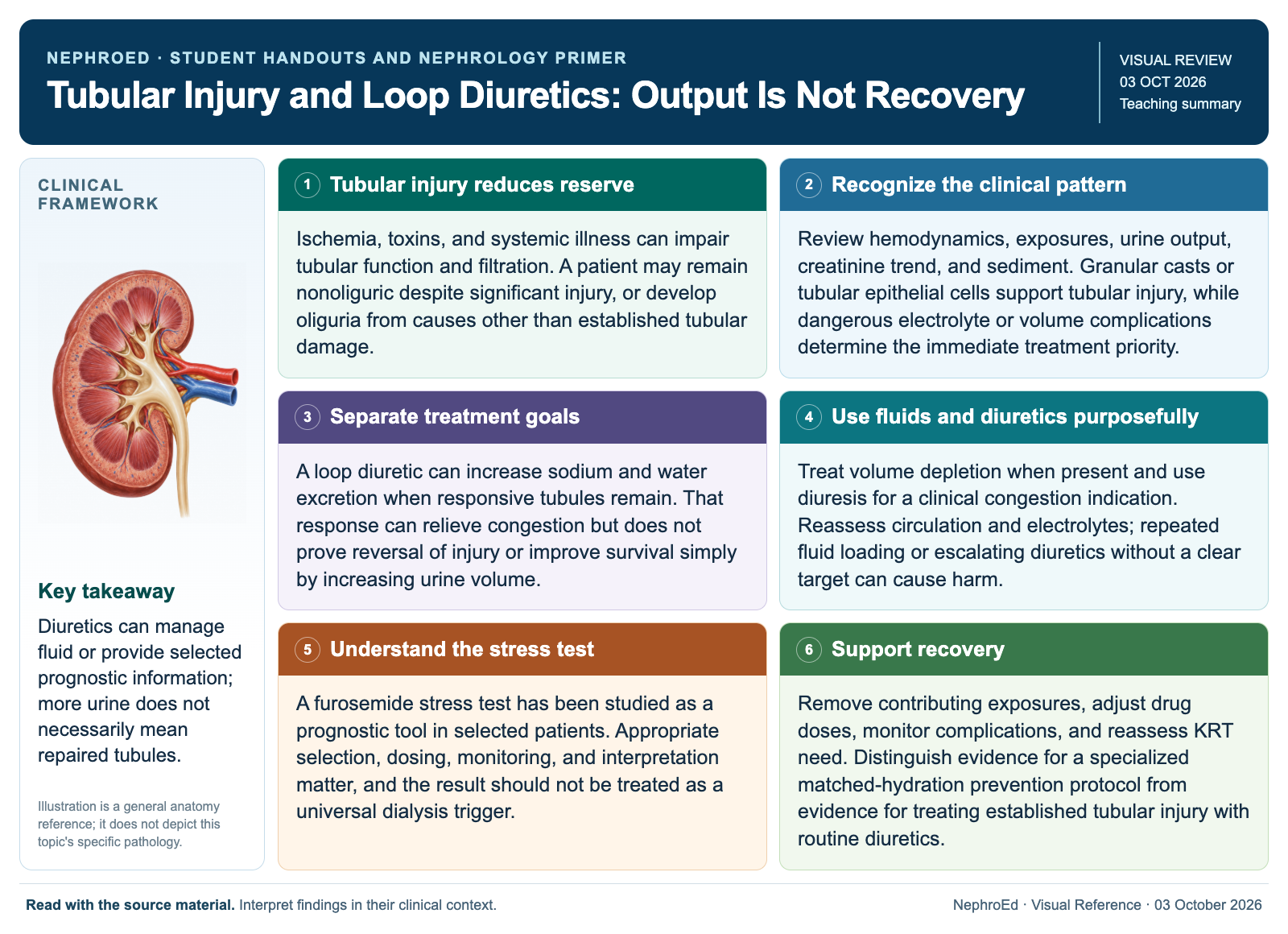
Diuretics can manage fluid or provide selected prognostic information; more urine does not necessarily mean repaired tubules.
Text version
Tubular injury reduces reserve
Ischemia, toxins, and systemic illness can impair tubular function and filtration. A patient may remain nonoliguric despite significant injury, or develop oliguria from causes other than established tubular damage.
Recognize the clinical pattern
Review hemodynamics, exposures, urine output, creatinine trend, and sediment. Granular casts or tubular epithelial cells support tubular injury, while dangerous electrolyte or volume complications determine the immediate treatment priority.
Separate treatment goals
A loop diuretic can increase sodium and water excretion when responsive tubules remain. That response can relieve congestion but does not prove reversal of injury or improve survival simply by increasing urine volume.
Use fluids and diuretics purposefully
Treat volume depletion when present and use diuresis for a clinical congestion indication. Reassess circulation and electrolytes; repeated fluid loading or escalating diuretics without a clear target can cause harm.
Understand the stress test
A furosemide stress test has been studied as a prognostic tool in selected patients. Appropriate selection, dosing, monitoring, and interpretation matter, and the result should not be treated as a universal dialysis trigger.
Support recovery
Remove contributing exposures, adjust drug doses, monitor complications, and reassess KRT need. Distinguish evidence for a specialized matched-hydration prevention protocol from evidence for treating established tubular injury with routine diuretics.
Continue learning
This graphic summarizes a topic. The full educational pages provide the broader discussion and references.