Visual summary
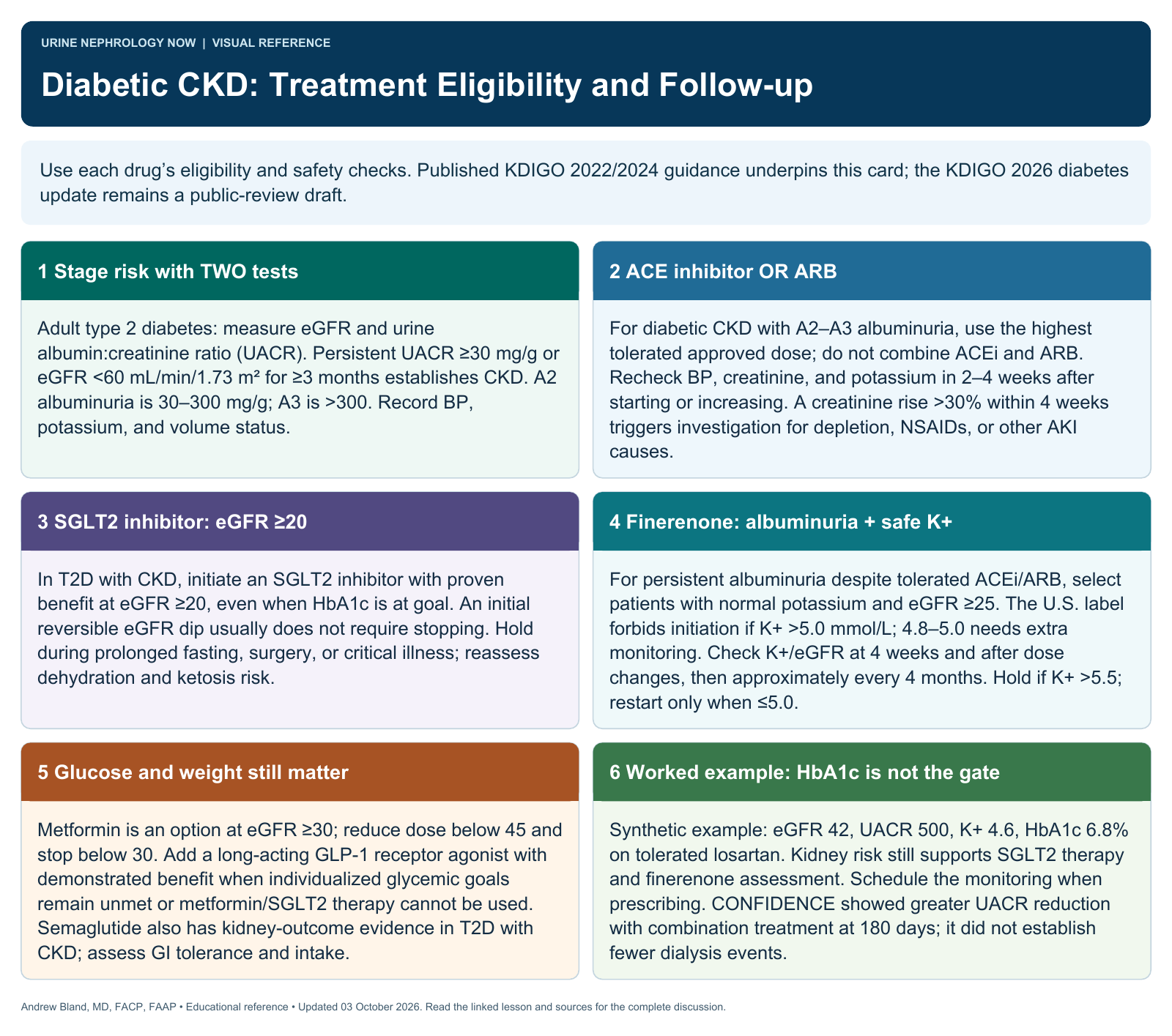
Use each drug’s eligibility and safety checks. Published KDIGO 2022/2024 guidance underpins this card; the KDIGO 2026 diabetes update remains a public-review draft.
Text version
Stage risk with TWO tests
Adult type 2 diabetes: measure eGFR and urine albumin:creatinine ratio (UACR). Persistent UACR ≥30 mg/g or eGFR <60 mL/min/1.73 m² for ≥3 months establishes CKD. A2 albuminuria is 30–300 mg/g; A3 is >300. Record BP, potassium, and volume status.
ACE inhibitor OR ARB
For diabetic CKD with A2–A3 albuminuria, use the highest tolerated approved dose; do not combine ACEi and ARB. Recheck BP, creatinine, and potassium in 2–4 weeks after starting or increasing. A creatinine rise >30% within 4 weeks triggers investigation for depletion, NSAIDs, or other AKI causes.
SGLT2 inhibitor: eGFR ≥20
In T2D with CKD, initiate an SGLT2 inhibitor with proven benefit at eGFR ≥20, even when HbA1c is at goal. An initial reversible eGFR dip usually does not require stopping. Hold during prolonged fasting, surgery, or critical illness; reassess dehydration and ketosis risk.
Finerenone: albuminuria + safe K⁺
For persistent albuminuria despite tolerated ACEi/ARB, select patients with normal potassium and eGFR ≥25. The U.S. label forbids initiation if K⁺ >5.0 mmol/L; 4.8–5.0 needs extra monitoring. Check K⁺/eGFR at 4 weeks and after dose changes, then approximately every 4 months. Hold if K⁺ >5.5; restart only when ≤5.0.
Glucose and weight still matter
Metformin is an option at eGFR ≥30; reduce dose below 45 and stop below 30. Add a long-acting GLP-1 receptor agonist with demonstrated benefit when individualized glycemic goals remain unmet or metformin/SGLT2 therapy cannot be used. Semaglutide also has kidney-outcome evidence in T2D with CKD; assess GI tolerance and intake.
Worked example: HbA1c is not the gate
Synthetic example: eGFR 42, UACR 500, K⁺ 4.6, HbA1c 6.8% on tolerated losartan. Kidney risk still supports SGLT2 therapy and finerenone assessment. Schedule the monitoring when prescribing. CONFIDENCE showed greater UACR reduction with combination treatment at 180 days; it did not establish fewer dialysis events.
Supporting evidence
- Kerendia U.S. prescribing information: CKD/T2D initiation and potassium monitoring
- KDIGO diabetes guideline publication status
- KDIGO 2024 Clinical Practice Guideline for the Evaluation and Management of Chronic Kidney Disease.
- KDIGO 2022 Clinical Practice Guideline for Diabetes Management in Chronic Kidney Disease.
- Effects of Semaglutide on Chronic Kidney Disease in Patients with Type 2 Diabetes.
- Finerenone with Empagliflozin in Chronic Kidney Disease and Type 2 Diabetes.