Visual summary
Ask separately about effective concentration, total sodium, total fluid, and the patient’s capacity to handle each.
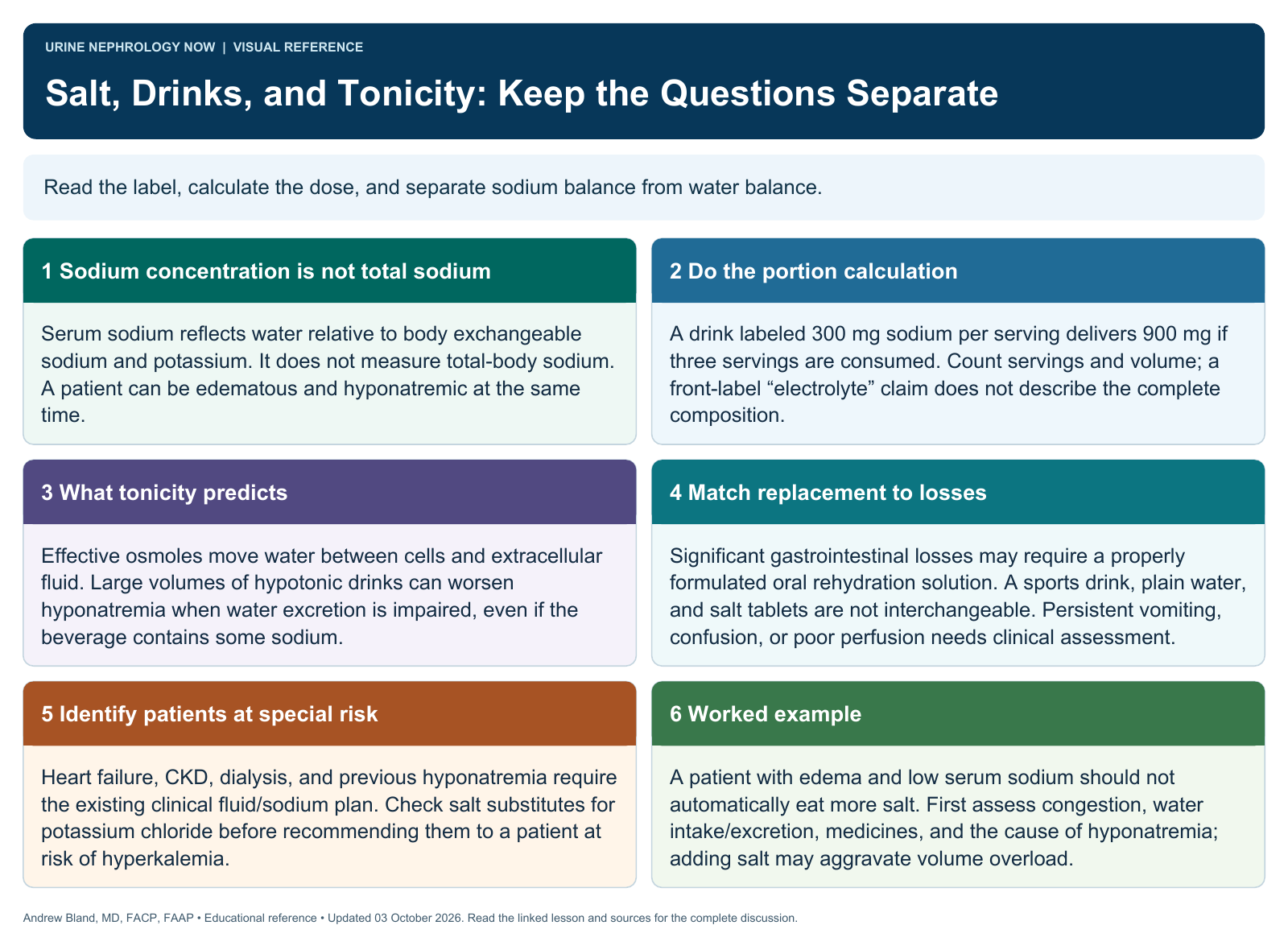
Text version
Concentration and total intake differ
Tonicity describes effective osmotic forces across cell membranes, while sodium intake and fluid volume influence extracellular balance. A food or drink cannot be judged only by whether it tastes salty.
Recognize the clinical setting
Sweat loss, gastrointestinal illness, low solute intake, heart failure, CKD, and hypertension create different needs. Extra salt can help selected prescribed strategies but can worsen congestion or pressure in another patient.
Read the actual composition
Check portion size, sodium, carbohydrate, fluid volume, and potassium-containing substitutes. Compare the patient’s total intake and losses rather than assuming an “electrolyte” label makes a product equivalent to an oral rehydration solution.
Use a targeted plan
When replacement is needed, choose a formulation suited to the clinical situation and follow the treating team’s advice. Rehabilitation staff should coordinate salt tablets or disease-specific fluid prescriptions rather than improvise them.
Explain a common mismatch
Large volumes of relatively hypotonic fluid may exceed excretory capacity despite containing some sodium. Conversely, eating salty food does not automatically correct a water-balance disorder or make unrestricted drinking safe.
Avoid overgeneralization
Sodium advice for hypertension or congestion differs from advice for selected orthostatic or replacement needs. Review symptoms, BP, kidney function, and the reason for the recommendation before encouraging either restriction or supplementation.
Continue learning
This graphic summarizes a topic. The full educational pages provide the broader discussion and references.