High-Salt Foods & the Tonicity-Decoupling Framework
Level: DPT Student · Duration: 20–30 minutes · Version: 2026-04-19
What this handout gets you
- The physiology-first reason sports drinks are usually suboptimal for what PTs actually see — and when they are the right answer.
- The tonicity-decoupling framework: separate the sodium load from the free-water load so the intake matches the deficit.
- A master table of Na-containing options — from plain water through pickle juice — with practical PT use for each.
- A decision algorithm for the most common PT intake scenarios: cardiac rehab heat day · POTS / orthostatic intolerance · thiazide or SSRI patient · post-op older adult · pediatric gastro · endurance athlete.
- The red-flag populations who need LESS salt, not more — and the patient-safety limits of this framework.
Visual reference
Browse the visual reference library · Download lesson Markdown
1. Why This Matters to You as a PT
"Grab a Gatorade" is the reflexive clinical answer to "I feel a little off." It is often wrong. A sports drink locks tonicity at a fixed ratio of water to sodium — approximately 10–20 mEq Na per liter, which is severely hypotonic to plasma (140 mEq/L). For the patient whose deficit is pure sweat volume with a minor sodium gap, that ratio is fine. For every other PT scenario — older adult on a thiazide, cardiac-rehab patient at Week 4, POTS patient, post-op geriatric, endurance athlete who has been drinking every mile — it is either too little sodium or the wrong ratio, and occasionally it is lethal (see Module 2 Hydration Section 3 for EAH deep-dive and the Jennifer Strange case that will appear in Case 2f).
The physiology is straightforward: the kidney excretes approximately 0.8–1.0 L/hr of free water at maximum capacity. Exceeding that rate with any beverage that is still hypotonic — plain water, sports drinks, most oral rehydration solutions — drops serum sodium. Thirst, ADH, and appetite usually keep people on the right side of that ceiling in daily life. What breaks the system: endurance exertion with scheduled drinking, SIADH triggers (stress, anesthesia, certain drugs), thiazide-induced renal free-water handling impairment, chronic SSRIs, post-op ADH surges, and contest drinking of the Wii-case variety.
The tonicity-decoupling framework — the organizing principle
Instead of locking the water-to-sodium ratio in a bottle, pick the two separately:
- Sodium load — from salty food, broth, pickle juice, a salt tab, or (if Na is really low) a prescribed sodium chloride tablet or medical-grade oral rehydration.
- Free-water load — plain water, drunk to thirst, titrated to the deficit.
This is how the ICU replaces volume: normal saline (154 mEq Na/L) plus free water separately, not pre-mixed in a bottle. For ambulatory PT, the equivalent is "broth + water" or "pretzels + water" or "salt tab + water." It gives the clinician and patient control over tonicity; sports drinks give it away.
The PT's job on this topic is threefold:
- Recognize which scenarios fit the tonicity-decoupling approach vs the sports-drink-is-fine approach.
- Teach the patient a handful of practical pick-list options (broth, pickle juice, pretzels, salt tabs, ORS — not only Gatorade).
- Recognize the small group of patients for whom the whole framework flips and they need less salt, not more — decompensated HFrEF, advanced cirrhosis, dialysis, severe resistant HTN.
2. What Tonicity Actually Is (Physiology, Minimal)
Osmolality vs Tonicity — the Distinction That Matters
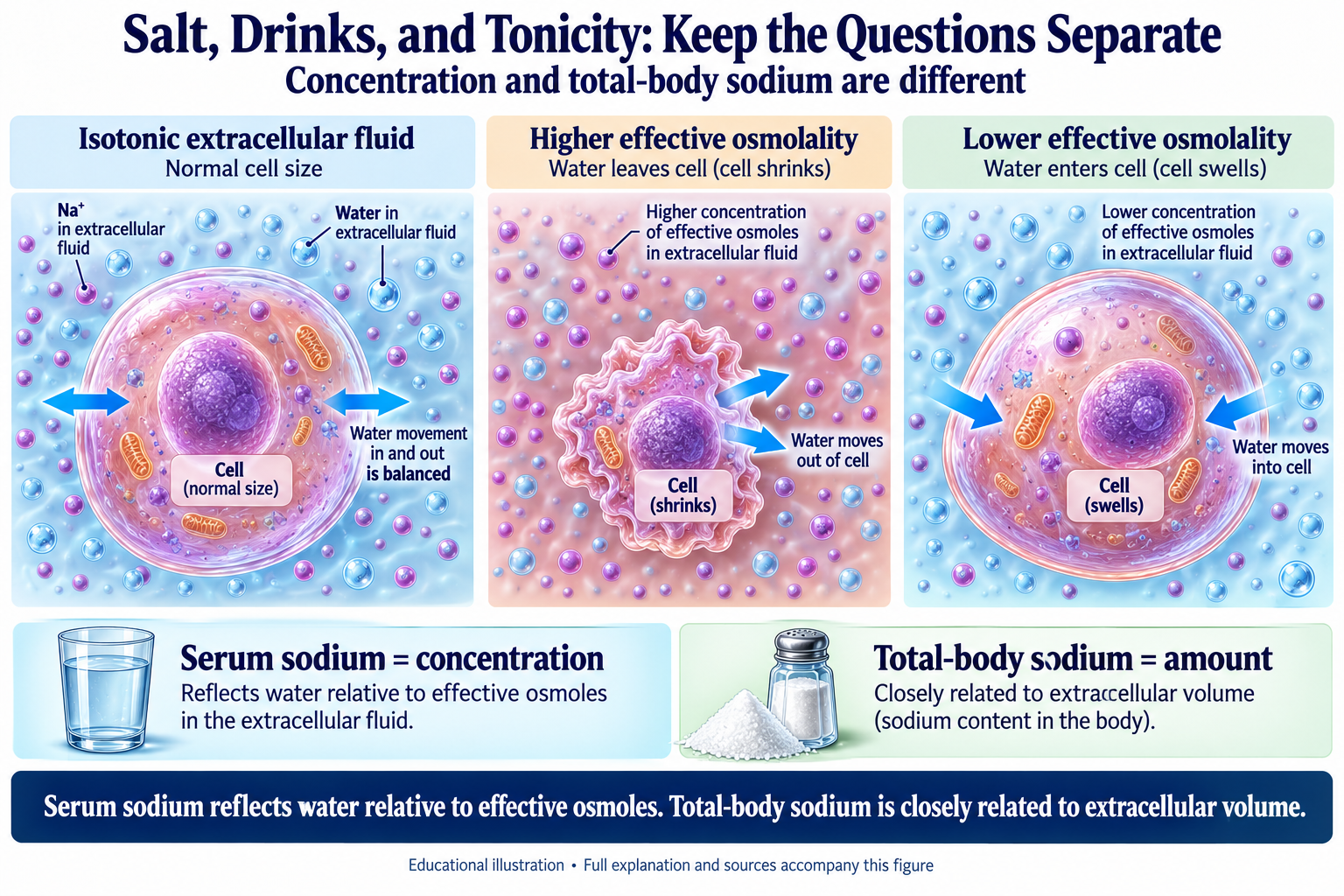
Osmolality is the total solute concentration of a solution — everything dissolved, counted together. Plasma osmolality is approximately 280–295 mOsm/kg, dominated by sodium (×2, accounting for its anion) plus glucose and urea.
Tonicity is the effective osmolality — only the solutes that do not freely cross the cell membrane and thus drive water movement. Sodium counts. Glucose counts partly (depends on insulin-driven uptake). Urea does not count (it crosses cell membranes freely).
For the PT, the operative solute is sodium. A sports drink with 10 mEq Na/L (approximately 200 mg Na/L) has an osmolality around 200–330 mOsm/kg (from the sugar) — close to plasma on paper — but is hypotonic because the tonically effective solute (sodium) is vastly below plasma. Drink enough of it, and net free water enters cells. The brain is especially unforgiving when this happens fast.
The Free-Water Excretion Ceiling
Healthy kidneys in a normal adult can excrete at most approximately 0.8–1.0 L/hr of free water. Exceed that rate for several hours — by drinking plain water, dilute sports drinks, or any hypotonic beverage faster than the kidney can dump it — and serum sodium drops. Several states lower the ceiling further:
- Stress / exertion / pain / anesthesia raise ADH non-osmotically → reduce free-water excretion capacity. This is why endurance athletes develop hyponatremia more easily mid-race than at rest, and why post-op patients hit hyponatremia in hospital.
- Thiazide diuretics impair the kidney's ability to dilute urine (unlike loops) — smaller overdrink is needed to become hyponatremic. Classic "thiazide hyponatremia" in older women. Cross-link: Case 28 Diuretics.
- SSRIs (sertraline, fluoxetine, etc.) can produce SIADH, lowering the ceiling further.
- HFrEF, advanced cirrhosis, advanced CKD — the kidneys are volume-confused and cannot dilute urine effectively; free-water load goes in but cannot come out.
⚠️ The Jennifer Strange case (2007) — acute water intoxication
28-year-old contestant in a Sacramento radio contest ("Hold Your Wee for a Wii") drank approximately 2 gallons of water over 3 hours without urinating. Died later that day of cerebral edema from acute dilutional hyponatremia. Lawsuit settled for $16.5 M. The mechanism: free-water intake exceeded excretion capacity by several-fold for hours; serum sodium dropped precipitously; cerebral edema → seizure → herniation. Even plain water can kill when ingested faster than the kidneys can excrete. Sports drinks do not rescue this — they are still hypotonic. This is the limit-case anchor for why "push fluids" is not a universal instruction.
Sweat Math — What Exertion Actually Loses
- Typical exertional sweat rate: 0.5–1 L/hr; hot humid conditions can push this to 2 L/hr.
- Typical sweat sodium concentration: 20–60 mEq/L (approximately 460–1400 mg Na/L). Heat-acclimatized athletes lose less sodium per liter; salty sweaters lose more.
- Net: a runner losing 2 L/hr of moderately salty sweat can lose approximately 50–120 mEq Na (approximately 1200–2800 mg) per hour.
- A typical sports drink (approximately 20 mEq Na/L) provides 20 mEq Na per liter — about 0.5 L of the sweat's worth per liter consumed. The math is always behind. That is fine for short exertion with whole-food meals before and after. It fails at multi-hour endurance without salty food in the mix.
3. Intake Options — Master Table
Sorted from lowest-Na to highest-Na. "Tonicity vs plasma" compares free-drinking volumes (for liquids) or per-serving sodium load (for foods) to plasma's approximately 140 mEq Na/L.
| Option | Sodium content | Tonicity vs plasma | Practical PT use |
|---|---|---|---|
| Plain water | 0 mEq/L | Severely hypotonic | Default for everyday hydration at rest or short exertion. Dangerous in excess during endurance exertion, in SIADH-prone patients, or in Wii-case conditions. |
| Gatorade / Powerade / generic sports drink | 10–20 mEq/L (approximately 200–460 mg Na/L) | Severely hypotonic | OK for exertion in Na-normal patients, short/moderate duration, when solid food is not practical. Suboptimal for most PT scenarios because tonicity is locked. |
| Pedialyte | approximately 45 mEq/L (approximately 1,035 mg Na/L) | Hypotonic (but closer to target) | Pediatric mild gastroenteritis. Also adult sick-day when tolerated. Better Na content than typical sports drinks. |
| WHO Oral Rehydration Solution (reduced-osmolarity) | 75 mEq/L Na + 75 mEq/L glucose | Hypotonic but glucose-cotransport-optimized for enteric absorption | Acute diarrheal illness, cholera-like volume loss. Commercial packets (Trioral, DripDrop) approximate this ratio. |
| LMNT / Liquid IV / DripDrop packets | approximately 500–1,000 mg Na per packet (user-mixed) | Adjustable — mix into a smaller volume for higher tonicity | Portable, controllable tonicity. Useful for POTS, endurance athletes, hot-weather cardiac rehab. Cost is the limit. |
| Pickle juice / olive brine | approximately 150–200 mEq/L (approximately 3,500–4,600 mg Na/L) | Mildly HYPERtonic | Exercise-induced muscle cramps (Miller 2010 RCT showed relief faster than expected from absorption alone — likely oropharyngeal TRP-receptor reflex[3]). Also practical ambulatory salt bolus. Small volumes (2–3 oz). |
| Broth / bouillon / miso / chicken stock | approximately 800–1,200 mg Na per cup (approximately 35–52 mEq/cup) | Hypotonic by volume but delivers meaningful Na | Sick-day staple. Warm, tolerable with nausea, decouples Na from free-water load beautifully. Offer first before sports drinks. |
| V8 / tomato juice | approximately 650 mg Na per cup (approximately 28 mEq/cup) | Isotonic-ish by Na content | Underused for sodium + potassium + calorie replacement in older-adult rehab. Cardiac-rehab caution if HFrEF with strict Na limit. |
| Pretzels / saltines / salted nuts | approximately 200–400 mg Na per serving | Solid, paired with water | Classic ambulatory salt source. Pair with water-to-thirst for decoupled replacement. Works on long hikes, bike rides, and in-clinic during long PT sessions. |
| Olives | approximately 300–400 mg Na per serving (approximately 10 olives) | Solid salt delivery | Satisfying, palatable, portable. Keeps in a purse or gym bag. |
| Cottage cheese / feta | approximately 300–700 mg Na per serving | Solid; Na + protein in one hit | Protein-plus-salt, especially useful in older-adult rehab combining the Protein PT handout targets with salt needs. |
| Canned soup | approximately 800–1,200 mg Na per cup | Sick-day friendly | One of the easiest sick-day vehicles when appetite is poor. Chicken noodle is the American default; miso or pho for variety. Avoid "low-sodium" canned soup for this purpose — defeats the point. |
| NaCl salt tablet (1 g) | 393 mg Na / 17 mEq per tablet | Pharmacologic dose adjunct | POTS / orthostatic intolerance under MD guidance. SIADH-chronic (per specialist). Salty-sweater endurance athletes. Pair with water-to-thirst. NOT a freelance PT tool — coordinate with prescriber. |
4. What to Do — The Decision Framework
The Algorithm
Patient needs volume + Na replacement?
        ↓
Step 1 — Is the patient in a LESS-salt population?
  (decompensated HFrEF, cirrhosis with ascites,
   hemodialysis, advanced CKD on Na-restriction,
   resistant HTN, chronic SIADH)
        ├── YES → Do NOT apply this framework.
        │        Follow the prescribed Na/fluid target.
        │
        └── NO  → Continue.
        ↓
Step 2 — Scenario type?

  A. EXERTION in Na-normal patient, solid food impractical
     mid-session (endurance run, bike, long hike)
        → Sports drink is acceptable.
        → Better: plain water + pretzels + electrolyte packet.

  B. PEDIATRIC mild gastroenteritis
        → Pedialyte.

  C. ACUTE DIARRHEAL ILLNESS / heavy volume loss
        → WHO-ORS–style formulation (glucose + Na cotransport).

  D. POTS / orthostatic intolerance
        → Salt tabs + water + high-Na food stacked daily
           (under MD direction). See Freeman consensus and
           POTS care pathways[1].

  E. CARDIAC REHAB heat day / hot outdoor PT session
        → Decouple. Broth + water before, pretzels + water
          during, canned-soup meal after. Monitor for signs
          in Hydration PT handout Module 2.

  F. THIAZIDE or SSRI patient reporting fatigue / confusion
        → Suspect hyponatremia. Do NOT give sports drinks.
           Escalate for Na check; coordinate with prescriber.
           Decoupling is the SAFE intake framework if labs
           are normal.

  G. POST-OP older adult in PT
        → Decouple. Protein-plus-salt snacks (cheese, nuts,
          broth-based soup), water to thirst.

  H. MUSCLE CRAMPS during exertion
        → Try pickle juice / olive brine (Miller 2010[3]).
          Not the same mechanism as Na repletion.
Who Needs LESS Salt, Not More — the Override
🚩 These patients override the framework. Do NOT recommend salt.
- Decompensated HFrEF / volume-overloaded HF — current Na prescription from the HF team is usually 2–3 g/day. More salt worsens congestion. Cross-link Case 28 Diuretics.
- Advanced cirrhosis with ascites — prescribed Na restriction (often <2 g/day) + fluid restriction. Extra salt triggers paracentesis.
- Hemodialysis patients — Na drives interdialytic weight gain and BP swings. Target is tight Na and fluid restriction, not replacement.
- Advanced CKD on Na-restricted diet — follow nephrology target.
- Severe resistant hypertension — Na restriction is part of the management; adding salt undermines combination therapy.
- Chronic SIADH — treated with fluid restriction, sometimes salt tabs under specialist direction. Never freelance salt in chronic SIADH.
For these patients, the "tonicity-decoupling" concept still applies — but the sodium set-point is already chosen by the prescribing team. PT follows that target.
Salt Tablets — the Prescribing-Coordinated Tool
NaCl 1-g tablets (393 mg Na, 17 mEq) are useful in three populations, always in coordination with the prescribing clinician:
- POTS / orthostatic intolerance — often prescribed at 3–10 g/day total Na (food + tabs) as first-line expansion, per Freeman 2011 consensus framing[1].
- Salty-sweater endurance athletes — individual sweat-rate calculation.
- Chronic SIADH — specialist-directed.
The PT role: recognize the patient for whom this tool fits, relay the observation, do not freelance the prescription.
5. Patient Teaching Scripts
The "why I'm recommending pickle juice instead of Gatorade" script
"Pickle juice — 2 or 3 ounces of it — gets you about as much sodium as four Gatorades, without the sugar and without the volume. For cramping or a hot session where you need a quick sodium hit, it's faster and it's cheaper. If you don't love pickles, broth works. Salty pretzels with water works. The principle is the same: pick your salt, pick your water, don't drink them pre-mixed at the wrong ratio."
The "salt tab" script (when the prescriber has added salt tabs)
"The salt tablet is doing one thing — giving you a measured dose of sodium so your blood volume holds up when you stand and when you move. It's not a substitute for water. Take the tab, drink water to thirst, and the two together keep you where your cardiologist [or autonomic doctor] wants you. Never double the dose on your own — if you're feeling worse, call them."
The "sick-day: broth, not Gatorade alone" script
"For a day when you're not feeling great — flu, stomach bug, just run-down — warm broth plus water, sipped slowly, is the better move than Gatorade alone. The broth gives you real sodium; the water hydrates separately. Canned chicken-noodle soup counts. Miso counts. Pho counts. Low-sodium versions don't — you want the real thing on sick days."
The "the HFrEF patient who needs LESS salt" script
"Everything I just said about adding salt — that's for most people. For you, it's the opposite. Your heart can't handle the extra salt, and your cardiologist has you on a specific limit. Stick to their target. The salty broth or pretzels advice is for a different patient. For you, read labels, avoid canned soup, skip the restaurant pho, and weigh yourself every morning."
The "when sports drinks ARE the right answer" script
"I'm not against Gatorade. For a long hot session, a weekend soccer tournament, or mid-event endurance when you can't eat real food, it's a perfectly reasonable tool. What I don't want you doing is reaching for it every time something feels 'off' at home. 'Off' can be low blood sugar, low sodium, dehydration, a medication effect — sports drinks don't fix all of those and for some they make it worse."
6. Quick-Reference Card
Tonicity-Decoupling at a Glance
THE PRINCIPLE: pick sodium and water separately so the ratio matches the deficit. Don't rely on a pre-mixed sports drink to do both at a ratio that's locked.
THE TIER LIST:
- Everyday hydration → plain water
- Exertion <60 min, Na-normal → water ± sports drink
- Exertion >90 min / heat → water + pretzels / LMNT / broth
- Sick day → broth + water first
- Pediatric gastro → Pedialyte
- Diarrheal illness → WHO-ORS–style
- POTS / orthostatic intolerance → salt tabs + water + high-Na food (MD-directed)
- Cramp rescue → pickle juice / olive brine (Miller 2010[3])
LESS-SALT OVERRIDE: decompensated HFrEF · cirrhosis w/ ascites · HD · advanced CKD on Na-restriction · severe resistant HTN · chronic SIADH → follow the prescribed target, not this framework.
FREE-WATER CEILING: approximately 0.8–1.0 L/hr healthy kidney. Lowered by exertion-ADH, thiazides, SSRIs, SIADH, advanced heart/liver/kidney disease. Wii-case physiology: 2 gallons in 3 hours exceeds the ceiling by 2–3×. Even plain water can kill at that rate.
CROSS-LINKS: Hydration PT handout (Module 2) · Protein PT handout (salty-protein foods) · Case 28 Diuretics · Case 29 ACEi/ARB/ARNI · Cases 2e & 2f (when published) will build directly on this framework.
References
- Freeman R, Wieling W, Axelrod FB, Benditt DG, Benarroch E, Biaggioni I, Cheshire WP, Chelimsky T, Cortelli P, Gibbons CH, et al. Consensus statement on the definition of orthostatic hypotension, neurally mediated syncope and the postural tachycardia syndrome. Clin Auton Res 2011;21(2):69–72. PMID: 21431947. PubMed — anchor reference for salt-based volume expansion in POTS + orthostatic intolerance.
- Sawka MN, Burke LM, Eichner ER, Maughan RJ, Montain SJ, Stachenfeld NS. American College of Sports Medicine position stand. Exercise and fluid replacement. Med Sci Sports Exerc 2007;39(2):377–90. PMID: 17277604. PubMed — ACSM framework for exertional fluid and Na replacement; cross-cite from Module 2.
- Miller KC, Mack GW, Knight KL, Hopkins JT, Draper DO, Fields PJ, Hunter I. Reflex inhibition of electrically induced muscle cramps in hypohydrated humans. Med Sci Sports Exerc 2010;42(5):953–61. PMID: 19997012. PubMed — pickle-juice-and-cramp RCT; onset faster than systemic absorption → likely oropharyngeal / TRP-mediated reflex mechanism.
- Hew-Butler T, Rosner MH, Fowkes-Godek S, et al. Statement of the 3rd International Exercise-Associated Hyponatremia Consensus Development Conference, Carlsbad, California, 2015. Br J Sports Med 2015;49(22):1432–46. PMID: 26227507. PubMed — drink-to-thirst, not schedule; cross-cite from Module 2 Hydration.
- Almond CSD, Shin AY, Fortescue EB, et al. Hyponatremia among runners in the Boston Marathon. N Engl J Med 2005;352(15):1550–6. PMID: 15829535. PubMed — classic EAH cohort; the endurance-scenario anchor. Cross-cite from Module 2.
- Verbalis JG, Goldsmith SR, Greenberg A, Korzelius C, Schrier RW, Sterns RH, Thompson CJ. Diagnosis, evaluation, and treatment of hyponatremia: expert panel recommendations. Am J Med 2013;126(10 Suppl 1):S1–42. PMID: 24074529. PubMed — hyponatremia diagnosis and management framework; cross-cite from Module 2.
- Heidenreich PA, Bozkurt B, Aguilar D, et al. 2022 AHA/ACC/HFSA Guideline for the Management of Heart Failure. Circulation 2022;145(18):e895–e1032. PMID: 35363499. PubMed — anchor for the "less-salt" populations (decompensated HFrEF Na prescription). Cross-cite from Cases 26–29.
- World Health Organization. Oral rehydration salts (ORS) — reduced osmolarity formulation. Standard WHO/UNICEF recommendation (90 mEq/L Na in earlier formulations; current reduced-osmolarity formulation 75 mEq/L Na + 75 mEq/L glucose in 245 mOsm/L total). WHO Model List of Essential Medicines. WHO — background for ORS formulation; not a PubMed-indexed single paper.