Visual reference
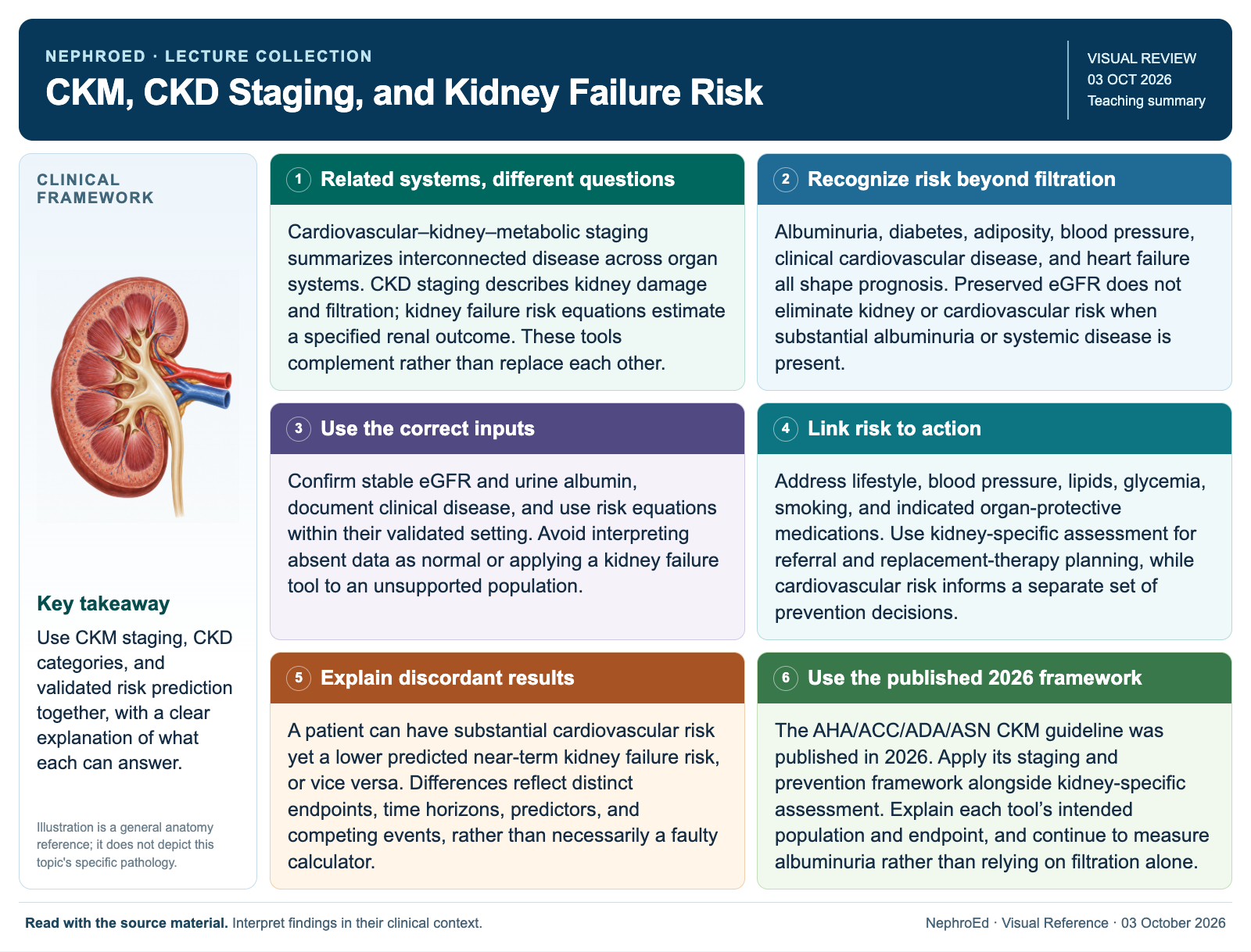
Browse the visual reference library · Download lesson Markdown
📋 Why the 2026 guideline matters
The staging construct began as the 2023 AHA presidential advisory. The 2026 AHA/ACC/ADA/ASN guideline converts that advisory into a graded clinical practice guideline with formal COR/LOE recommendations, extends it across the life course, and retires and replaces the 2013 AHA/ACC/TOS obesity guideline.
🎯 The five stages at a glance
🧠 The one-sentence version
📈 PREVENT — the risk engine underneath
PREVENT estimates 10- and 30-year risk of ASCVD, heart failure and total CVD, and takes eGFR and optionally UACR and HbA1c directly as inputs. It is recommended in stages 0–3; in stage 4 the patient already has clinical disease and prediction is superseded by secondary prevention.
| Threshold | Action |
|---|---|
| PREVENT-CVD 10-year at or above 7.5% | Prioritize pharmacotherapy |
| PREVENT-CVD 10-year at or above 20% | Meets a stage 3 criterion as a risk equivalent |
| PREVENT-HF 10-year at or above 5% in prediabetes or T2D | Obtain natriuretic peptide with or without hs-troponin; image if elevated |
💊 Therapy by stage
| Stage | Architecture |
|---|---|
| 1 | Lifestyle as the foundation; obesity pharmacotherapy and metabolic/bariatric surgery as adjuncts, explicitly framed as tools to prevent progression and promote stage regression. First guideline to endorse GLP-1-based therapy for cardiovascular event reduction in selected patients with obesity, with or without T2D. |
| 2 | Metabolic: GLP-1-based agent or SGLT2 inhibitor with proven benefit when PREVENT-CVD is at or above 7.5%, or age over 50 with added risk factors. Metformin is adjunctive — layered onto cardioprotective agents rather than preceding them. Kidney: measure eGFR and UACR; RASi plus SGLT2i first-line. |
| 3 | Same architecture, intensified. Combination SGLT2i plus GLP-1-based therapy may be considered. Very-high-risk CKD alone qualifies — treat it as a CVD risk equivalent, not a kidney problem awaiting a cardiac indication. |
| 4 | ASCVD plus T2D: at least one agent with proven CV benefit in all patients. HFrEF: RASi (ARNI preferred), beta blocker, steroidal MRA, SGLT2i. HFmrEF/HFpEF: SGLT2i first-line. Obesity and kidney-protective therapy continue in parallel. |
Persistent albuminuria on first-line therapy
| Add-on | Threshold | Favored when |
|---|---|---|
| Finerenone | UACR at or above 30 mg/g | Normokalemic, albuminuria-predominant phenotype |
| Semaglutide | UACR at or above 100 mg/g | Obesity, uncontrolled diabetes, or MASLD present |
SGLT2i is the first-line cardioprotective antihyperglycemic in T2D with heart failure or CKD, and is initiable down to eGFR 20 mL/min/1.73 m².
📚 Deep dives
🪶 Nephrology-specific traps
Euglycemic DKA
Relative insulinopenia plus SGLT2i is the classic setup. At HbA1c above 10% with catabolic features, establish insulin before or alongside the SGLT2i.
eGFR floors
SGLT2i initiation down to eGFR 20 with continuation thereafter. Metformin contraindicated below 30. Finerenone requires potassium surveillance. GLP-1 RA dosing is not eGFR-adjusted.
Cardiorenal indication is not glycemic control
SGLT2i retains cardiorenal benefit to eGFR 20 but is not a glucose-lowering agent at G4. Do not let the cardiorenal indication substitute for glycemic management.
Dialysis (stage 4b)
HbA1c has low reliability, pre-HF biomarker cut points are uninterpretable, and PREVENT is not applicable. Three of the framework's instruments go dark at once.
🔍 Source and verification
Primary source: the 2026 AHA/ACC/ADA/ASN guideline for the prevention, detection, evaluation, and management of cardiovascular-kidney-metabolic syndrome (Circulation. 2026;154(4):e50–e158, PMID 42263157), published Free Access and read in full for these pages. Glycemic triggers are from the ADA Standards of Care in Diabetes — 2026, Section 9 (PMID 41358900), read in full via PubMed Central. Kidney staging and glycemic targets in CKD are from KDIGO 2024 and KDIGO 2022 (PMID 36272764), the latter verified against its peer-reviewed synopsis (PMID 36623286).
Every numeric threshold on this page was checked against the source text. Figures that could not be confirmed in a primary source were removed rather than published with a caveat — including a set of pre-HF biomarker cut points that circulate in secondary summaries but appear nowhere in the guideline.
📚 Key references
- Ndumele CE, Rodriguez F, Dixon DL, et al. 2026 AHA/ACC/ADA/ASN guideline for the prevention, detection, evaluation, and management of cardiovascular-kidney-metabolic syndrome. Circulation. 2026;154(4):e50–e158. PMID 42263157.
- Ndumele CE, Rangaswami J, Chow SL, et al. Cardiovascular-kidney-metabolic health: a presidential advisory from the AHA. Circulation. 2023;148(20):1606–1635. PMID 37807924.
- Khan SS, Matsushita K, Sang Y, et al. Development and validation of the AHA's PREVENT equations. Circulation. 2024;149(6):430–449. PMID 37947085.
- Bakris GL, Agarwal R, Anker SD, et al. Effect of finerenone on CKD outcomes in type 2 diabetes (FIDELIO-DKD). N Engl J Med. 2020;383(23):2219–2229. PMID 33264825.
- Perkovic V, Tuttle KR, Rossing P, et al. Effects of semaglutide on CKD in patients with type 2 diabetes (FLOW). N Engl J Med. 2024;391(2):109–121. PMID 38785209.