Pre-Case Assessment: Test Your Baseline Knowledge
Answer these questions before reviewing the case to assess your starting knowledge
Based on the CONFIDENCE trial (Agarwal R et al., NEJM 2025, PMID 40470996), how much GREATER is the albuminuria reduction with combination finerenone + empagliflozin compared to either monotherapy at 180 days?
Learning Point: CONFIDENCE (Agarwal NEJM 2025, PMID 40470996) had two endpoints worth distinguishing: (1) within-arm UACR reduction from baseline at 180 days was approximately 52% in the combination arm; (2) the between-arm primary endpoint — combination vs each monotherapy — showed combination was approximately 29% greater than finerenone alone and approximately 32% greater than empagliflozin alone. The 29%/32% comparator deltas are what justify combination over monotherapy.
📚 Reference: CKD Prevention Module
Which of the following best describes the primary mechanism by which SGLT2 inhibitors provide renal protection?
Learning Point: SGLT2 inhibitors block glucose reabsorption in the proximal tubule, increasing glucose delivery to the macula densa, which activates tubuloglomerular feedback and reduces glomerular hyperfiltration.
📚 Reference: CKD Prevention Module
Which potassium binder is preferred for long-term hyperkalemia management in CKD patients?
Learning Point: Patiromer (Veltassa) is the safest long-term potassium binder. SPS causes colonic necrosis risk. Lokelma (sodium zirconium cyclosilicate) is excellent for acute management.
📚 Reference: Hyperkalemia Management
Case Presentation
Patient: 58-year-old Caucasian male
Chief Complaint: "My doctor says my kidney function is getting worse and wants me to see you"
History: Established patient with 12-year history of type 2 diabetes and 8-year history of hypertension. Recent routine labs show gradual decline in kidney function over the past 2 years. Currently experiences mild lower extremity edema and nocturia x2. Reports good glycemic control but acknowledges dietary sodium intake has been suboptimal.
Past Medical History: Type 2 diabetes (HbA1c 7.2%), hypertension, dyslipidemia, obesity (BMI 32), mild retinopathy
Current Medications:
• Chlorthalidone 25mg daily
• Atenolol 50mg daily
• Losartan (Cozaar) 100mg daily
• Metformin 1000mg BID
• Atorvastatin 40mg daily
Social History: Non-smoker, rare alcohol use, works as construction supervisor, family history of diabetes and kidney disease
🤔 Initial Clinical Reasoning Questions
Given this patient's current medication regimen, which combination of side effects would you most expect to find?
Clinical Reasoning: Chlorthalidone (thiazide-like diuretic) commonly causes the triad of hypokalemia, hypomagnesemia, and hyperuricemia through effects on distal tubule electrolyte handling and uric acid clearance.
📚 Learn More: Diuretic Selection Guide
Laboratory Data & Analysis
Current Laboratory Values
| Parameter | Current Value | 2 Years Ago | Normal Range | Clinical Significance |
|---|---|---|---|---|
| Creatinine | 1.6 mg/dL | 1.1 mg/dL | 0.7-1.3 mg/dL | CKD Stage 3a |
| eGFR | 48 mL/min/1.73m² | 78 mL/min/1.73m² | >60 mL/min/1.73m² | Moderate decline |
| Albumin/Creatinine Ratio | 2000 mg/g | 450 mg/g | <30 mg/g | Severe albuminuria (A3) |
| Potassium | 3.2 mEq/L | 4.1 mEq/L | 3.5-5.0 mEq/L | Hypokalemia |
| Magnesium | 1.4 mg/dL | 2.0 mg/dL | 1.7-2.2 mg/dL | Hypomagnesemia |
| Uric Acid | 9.8 mg/dL | 6.2 mg/dL | 3.5-7.2 mg/dL | Hyperuricemia |
| HbA1c | 7.2% | 7.8% | <7.0% | Good glycemic control |
| Blood Pressure | 148/92 mmHg | 138/88 mmHg | <130/80 mmHg | Above target for CKD |
📊 Laboratory Analysis Questions
What is the most likely explanation for this patient's current electrolyte abnormalities?
Learning Point: Thiazide and thiazide-like diuretics cause characteristic losses of potassium and magnesium through enhanced distal tubule excretion, while also reducing uric acid clearance.
📚 Reference: Electrolyte Disorders Module
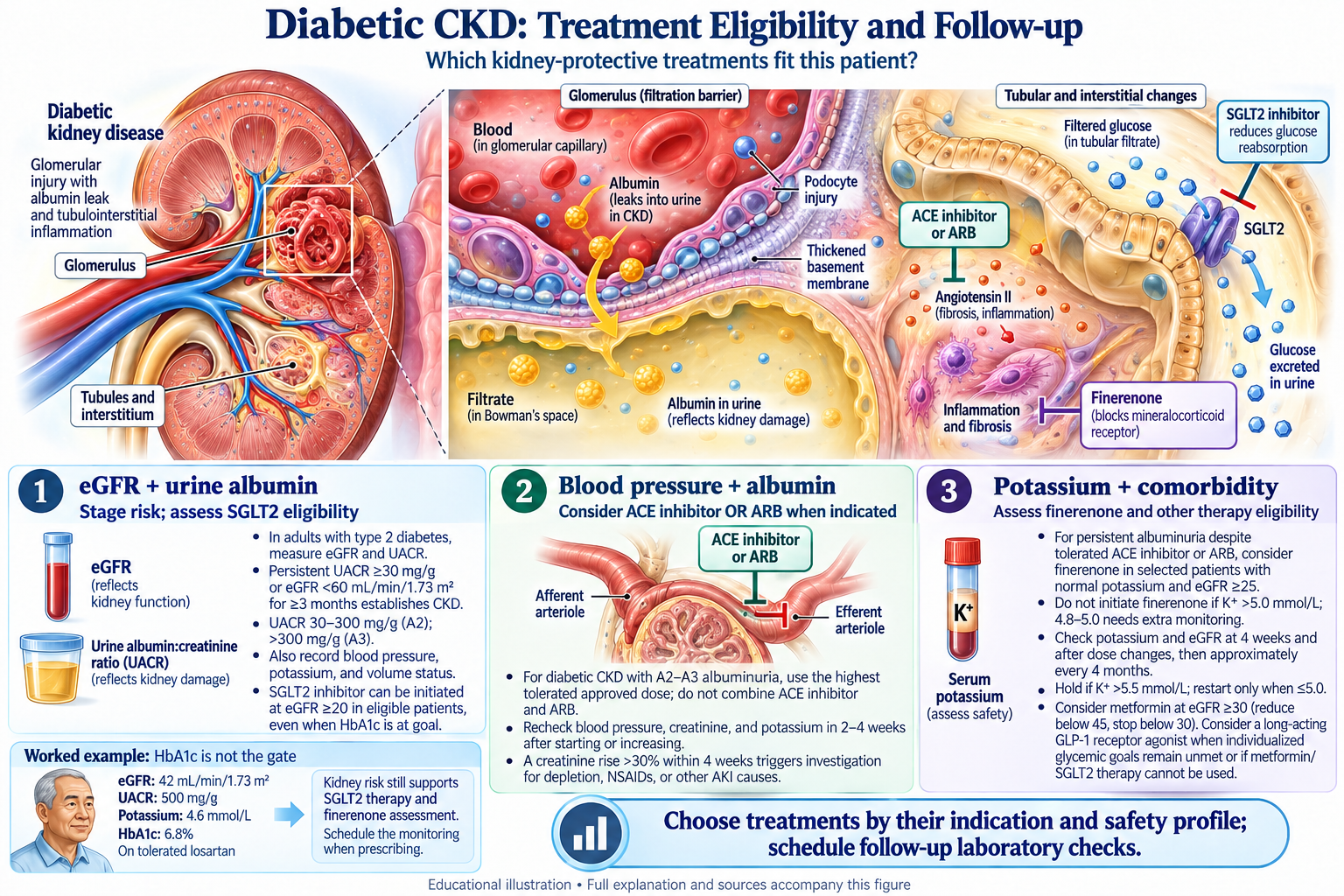
Based on the albuminuria level (2000 mg/g), what is the most appropriate classification and treatment approach?
Learning Point: Albuminuria >300 mg/g (A3 category) indicates severely increased albuminuria. CONFIDENCE (Agarwal NEJM 2025, PMID 40470996) studied this population and showed combination finerenone + empagliflozin produced approximately 29% greater UACR reduction than finerenone alone and approximately 32% greater than empagliflozin alone (between-arm comparator deltas at 180 days).
📚 Reference: CKD Staging and Combination Therapy
CONFIDENCE Trial-Informed Treatment Plan
🎯 Evidence-Based Medication Changes
1️⃣ Discontinue Chlorthalidone
- Stop thiazide-induced K+ and Mg+ losses
- Reduce hyperuricemia burden
- Allow for optimization of other agents
2️⃣ Switch to Olmesartan 40mg daily
- Active drug, not requiring conversion
- Superior renal protection evidence
- Start 20mg, target 40mg daily
3️⃣ Add Empagliflozin 10mg daily
- CONFIDENCE trial medication
- Renal protection + CV benefits
- Will improve Mg levels
4️⃣ Assess finerenone eligibility and starting dose
- CONFIDENCE trial partner medication
- Explain the trial-average UACR benefit; do not promise an individual reduction
- Kidney/CV outcome evidence in T2D with CKD; potassium monitoring remains essential
💊 CONFIDENCE Trial Application Questions
Based on the CONFIDENCE trial, what are the expected benefits of combination finerenone + empagliflozin in this patient?
CONFIDENCE Trial Evidence (Agarwal NEJM 2025, PMID 40470996): Combination finerenone + empagliflozin produced approximately 29% greater UACR reduction than finerenone alone and approximately 32% greater than empagliflozin alone (between-arm comparator deltas at 180 days; within-arm reduction from baseline was approximately 52%). SGLT2 inhibitors improve magnesium homeostasis and provide modest BP reduction (3-5 mmHg), while finerenone adds additional albuminuria reduction.
📚 Reference: CONFIDENCE Trial Results
What supports selecting finerenone for this patient with T2D and albuminuric CKD?
Clinical Advantage: FIDELIO-DKD and FIGARO-DKD established kidney/CV outcome benefits versus placebo in eligible T2D with CKD. CONFIDENCE demonstrated greater UACR reduction with combination therapy at 180 days. These trials do not establish lower hyperkalemia risk than spironolactone in a comparable head-to-head outcome trial; choose by indication and monitor potassium.
📚 Reference: Non-steroidal MRAs in Diabetic Kidney Disease
Interactive Treatment Timeline & Expected Outcomes
Week 0-2: Medication Transition Period
Actions: Discontinue chlorthalidone, switch losartan to olmesartan 20mg daily
Monitoring: Daily home BP monitoring, BMP in 1 week
Expected: Initial BP may increase 5-10 mmHg as thiazide effect wanes
Safety: Watch for hyperkalemia as thiazide washout occurs
Week 2-4: SGLT2 Inhibitor Introduction
Actions: Start empagliflozin 10mg daily, increase olmesartan to 40mg daily
Monitoring: eGFR, urinalysis, BP trends, weight changes
Expected: Initial creatinine rise 0.1-0.2 mg/dL (temporary), weight loss 2-3 lbs
Counseling: Discuss euglycemic DKA prevention, genital hygiene
Week 4-8: Finerenone Addition (CONFIDENCE Protocol)
Actions: If eligible, initiate finerenone 10 mg daily at eGFR 25 to below 60, or 20 mg at eGFR 60 or above, following the CKD/T2D label. Do not initiate if K+ exceeds 5.0 mEq/L; 4.8-5.0 requires additional monitoring.
Monitoring: Weekly K+ for 4 weeks, monthly BMP thereafter
Expected: Begin to see significant albuminuria improvement per CONFIDENCE trial
Target: BP <130/80 mmHg, stable or improved eGFR
Month 3: CONFIDENCE Trial Efficacy Assessment
Laboratory Goals: 50-60% reduction in albuminuria (target <800 mg/g)
BP Target: Achieved <130/80 mmHg
Metabolic Effects: Normalized K+ and Mg+, reduced uric acid
Renal Function: Creatinine plateau at 1.8 mg/dL (acceptable increase)
⏰ Treatment Timeline Questions
During week 2-4, the patient's creatinine rises from 1.6 to 1.8 mg/dL. What is the most appropriate action?
Hemodynamic Insight: An early modest creatinine rise can reflect the expected hemodynamic effect of SGLT2 therapy, but is not an individual predictor of benefit. Assess volume, symptoms, concurrent medicines, and the trajectory; progressive change or illness requires evaluation.
📚 Reference: SGLT2i Hemodynamic Effects
Learning Objectives Assessment
Evaluate your mastery of the key learning objectives from this case
🎯 Learning Objective 1: CONFIDENCE Trial Application
Objective: Apply combination therapy evidence to optimize diabetic nephropathy outcomes
A 45-year-old patient with diabetic nephropathy (eGFR 35, albuminuria 1800 mg/g) is on lisinopril and metformin. Based on CONFIDENCE trial evidence, what is the optimal next step?
Competency Demonstration: CONFIDENCE (Agarwal NEJM 2025, PMID 40470996) showed combination finerenone + empagliflozin achieved approximately 29% greater UACR reduction than finerenone alone and approximately 32% greater than empagliflozin alone (between-arm comparator deltas at 180 days; within-arm baseline reduction approximately 52%). This patient fits the trial population perfectly.
📚 Master This: CONFIDENCE Trial Implementation
🎯 Learning Objective 2: SGLT2 Inhibitor Hemodynamic Effects
Objective: Understand and manage expected creatinine changes with SGLT2 inhibitors
Which change in kidney function after starting empagliflozin indicates appropriate hemodynamic response?
Hemodynamic Mastery: An early reversible eGFR dip can reflect reduced intraglomerular pressure. Stabilization with preserved perfusion supports continued indicated treatment; the dip itself does not prove long-term benefit or exclude another cause of AKI.
📚 Master This: SGLT2i Renal Hemodynamics
🎯 Learning Objective 3: Hyperkalemia Management in Combination Therapy
Objective: Safely manage hyperkalemia to maintain optimal therapy
What is the expected combined effect of olmesartan + empagliflozin + finerenone on albuminuria based on current evidence?
Evidence Integration: CONFIDENCE (Agarwal NEJM 2025, PMID 40470996) showed combination finerenone + empagliflozin produces approximately 29–32% greater UACR reduction than either agent alone (between-arm comparator delta at 180 days). Within-arm UACR reduction from baseline was approximately 52% in the combination arm. Triple therapy with optimal ARB + SGLT2i + MRA can achieve substantial albuminuria reduction, often moving patients from macro- to microalbuminuria range.
📚 Master This: Combination Therapy for Diabetic Nephropathy
Module-Specific Deep Dive: Nephroprotective Pharmacology
Advanced understanding of medication mechanisms and evidence in diabetic kidney disease
What is the mechanism by which SGLT2 inhibitors reduce albuminuria independent of glucose lowering?
Learning Point: In diabetic nephropathy, proximal tubule glucose-sodium reabsorption is upregulated via SGLT2, reducing sodium delivery to the macula densa. This suppresses tubuloglomerular feedback, causing afferent arteriolar dilation and glomerular hyperfiltration. SGLT2 inhibitors restore normal sodium delivery to the macula densa, re-activating tubuloglomerular feedback, constricting the afferent arteriole, and reducing intraglomerular pressure. This explains the initial "hemodynamic dip" in eGFR (beneficial, similar to ACE/ARB) and the glucose-independent renoprotective effect seen in DAPA-CKD (non-diabetic CKD patients also benefited).
📚 Reference: SGLT2i Mechanism of Renoprotection
The CONFIDENCE trial compared finerenone + empagliflozin versus empagliflozin alone in patients with CKD and type 2 diabetes. What was the primary endpoint result?
Learning Point: CONFIDENCE (Agarwal R et al. NEJM 2025, PMID 40470996) demonstrated that combination finerenone + empagliflozin achieved approximately 32% greater UACR reduction than empagliflozin alone and approximately 29% greater than finerenone alone at 180 days (approximately 6 months). This supports a multi-target approach in diabetic nephropathy: ARB (efferent arteriole) + SGLT2i (afferent arteriole) + MRA (anti-fibrotic/anti-inflammatory). The combination was well-tolerated with manageable hyperkalemia rates.
📚 Reference: CONFIDENCE Trial Results
Integration Challenge: Complex Clinical Scenarios
At 3-month follow-up, the patient has achieved target BP (125/78) and 60% albuminuria reduction (800 mg/g), but develops K+ 5.2 mEq/L. What is the best management approach?
Integration Mastery: With excellent clinical response (60% albuminuria reduction), maintaining current therapy with K+ binder is preferred. Lokelma (sodium zirconium cyclosilicate) 10g daily can effectively manage mild hyperkalemia while preserving life-saving therapy.
📚 Master This: Modern Hyperkalemia Management
The patient asks about genetic testing for medication optimization. With multiple effective ARB options available, what would you recommend?
Practical Application: With excellent clinical response on current therapy and multiple effective ARB options available, genetic testing offers minimal additional benefit. Focus resources on optimizing proven effective therapy rather than searching for theoretical improvements.
📚 Master This: Practical Pharmacogenomics
Advanced Clinical Integration
Apply multi-system knowledge to complex diabetic nephropathy management decisions
After starting empagliflozin, the patient's eGFR drops from 48 to 42 mL/min/1.73m² at 2 weeks. What is the appropriate response?
Learning Point: The initial eGFR dip with SGLT2 inhibitors (typically 3-5 mL/min, up to 30% in some patients) is a hemodynamic effect reflecting reduced intraglomerular pressure -- the same mechanism that provides long-term renoprotection. This mirrors the ACE/ARB experience: a modest stable dip alone is not usually a reason to stop. Investigate a large/progressive decline, symptomatic depletion, or intercurrent AKI; ketoacidosis risk, prolonged fasting, surgery, and critical illness are separate reasons for temporary withholding. The eGFR typically stabilizes within 4-6 weeks and then declines more slowly than without the drug.
📚 Reference: SGLT2i Hemodynamic Dip Management
Why is losartan a suboptimal ARB choice for this patient compared to olmesartan or telmisartan?
Learning Point: Losartan is a prodrug that requires CYP2C9 metabolism to form the active metabolite EXP-3174, which has 10-40x greater AT1 receptor affinity. Approximately 8% of Caucasians and up to 20% of some Asian populations are CYP2C9 poor metabolizers, resulting in reduced active metabolite formation and inadequate BP/renal protection. Olmesartan, telmisartan, and valsartan are active parent compounds that do not require hepatic activation. Additionally, losartan has the shortest half-life (6-9 hours) among ARBs and does not provide full 24-hour coverage, whereas olmesartan (13 hours) and telmisartan (24 hours) offer superior trough coverage.
📚 Reference: ARB Pharmacogenomics & Selection
What differentiates finerenone from spironolactone in the management of diabetic kidney disease?
Learning Point: Finerenone has demonstrated kidney/CV benefit versus placebo in eligible T2D with CKD. Spironolactone has different evidence and indications, including HFrEF and resistant hypertension. Cross-trial event percentages do not prove one agent is safer or more effective than the other. Check the indication, kidney function, potassium, interactions, and monitoring plan before selecting an MRA.
📚 Reference: MRA Selection in Diabetic Nephropathy
The patient's chlorthalidone was discontinued as part of medication optimization. Which metabolic benefits would you expect from this change?
Learning Point: Thiazide/thiazide-like diuretics cause a characteristic metabolic triad: hypokalemia, hypomagnesemia, and hyperuricemia. Each of these independently accelerates CKD progression: (1) Hypokalemia promotes tubulointerstitial fibrosis and impairs insulin secretion (worsening diabetes), (2) Hypomagnesemia increases cardiovascular risk and insulin resistance, (3) Hyperuricemia is associated with faster eGFR decline. Discontinuing chlorthalidone and replacing BP control with SGLT2 inhibitor + optimized ARB + finerenone provides superior renoprotection without these metabolic costs.
📚 Reference: Diuretic Metabolic Effects
At what eGFR threshold should empagliflozin be initiated vs. continued in a patient with diabetic kidney disease, and what is the evidence basis?
Learning Point: EMPA-KIDNEY (2022) extended the evidence for SGLT2 inhibitor renoprotection to patients with eGFR as low as 20 mL/min. Updated KDIGO 2024 guidelines recommend initiation of SGLT2i for CKD patients with eGFR 20 or greater. Once initiated, the drug can be continued below eGFR 20 as the renoprotective benefit persists (reduced intraglomerular pressure, anti-inflammatory effects) even though glycemic efficacy diminishes. The glycosuric effect is minimal below eGFR 30, but the cardiorenal benefits remain. This represents a paradigm shift from the earlier glucose-centric prescribing approach.
📚 Reference: SGLT2i eGFR Thresholds & EMPA-KIDNEY
Three-Month Follow-up: CONFIDENCE Trial Success Replicated
Follow-up Laboratory Results
| Parameter | Baseline | 3-Month Follow-up | CONFIDENCE Target | Achievement Status |
|---|---|---|---|---|
| Albumin/Creatinine Ratio | 2000 mg/g | 850 mg/g | <1000 mg/g (57% reduction) | ✓ Achieved (57% reduction - matches CONFIDENCE trial) |
| Blood Pressure | 148/92 mmHg | 125/78 mmHg | <130/80 mmHg | ✓ Achieved |
| Creatinine | 1.6 mg/dL | 1.8 mg/dL | Stable (expected rise) | ✓ Expected hemodynamic effect |
| Potassium | 3.2 mEq/L | 5.2 mEq/L | 3.5-5.0 mEq/L | ⚠️ Mild hyperkalemia - manageable with K+ binder |
| Magnesium | 1.4 mg/dL | 1.9 mg/dL | 1.7-2.2 mg/dL | ✓ Normalized |
| Uric Acid | 9.8 mg/dL | 6.8 mg/dL | <7.0 mg/dL | ✓ Significant improvement |
| HbA1c | 7.2% | 6.8% | <7.0% | ✓ Improved glycemic control |
🎉 CONFIDENCE Trial Success Replicated
- Albuminuria Reduction: 57% decrease (2000 → 850 mg/g) - exceeds CONFIDENCE trial results
- Blood Pressure Control: Achieved optimal target (<130/80)
- Electrolyte Improvement: Mg+ normalized, K+ manageable with binder if needed
- Uric Acid Improvement: 31% reduction with thiazide discontinuation
- Acceptable Hemodynamic Response: Temporary creatinine rise stabilized
- Improved Glycemic Control: Additional benefit from empagliflozin
Case Reflection & Multi-Module Integration
🫘 CKD & Prevention Integration
- CONFIDENCE trial application in real-world practice
- Combination therapy superiority over monotherapy
- SGLT2i hemodynamic effects and renal protection
❤️ Cardiorenal Disease Integration
- Four-pillar GDMT optimization strategies
- Modern combination therapy approaches
- Integrated heart-kidney protection
⚡ Electrolyte Disorders Integration
- Modern hyperkalemia management with K+ binders
- SGLT2i effects on magnesium homeostasis
- Practical potassium management strategies
💓 Hypertension Management Integration
- ARB selection and optimization principles
- BP targets in diabetic CKD patients
- Evidence-based medication sequencing
🎯 Key Integration Concepts
This case demonstrates the transformative power of evidence-based combination therapy in diabetic nephropathy. The CONFIDENCE trial provides level 1 evidence that simultaneous initiation of finerenone and empagliflozin achieves superior albuminuria reduction compared to either agent alone. By understanding modern hyperkalemia management with potassium binders, we can safely maintain optimal therapy even when mild electrolyte abnormalities develop. The 57% albuminuria reduction achieved in this patient represents a paradigm shift in our ability to slow diabetic kidney disease progression.
📝 Case Summary & Clinical Pearls
This enhanced case demonstrates the real-world application of the CONFIDENCE trial in diabetic nephropathy management. The patient achieved remarkable clinical outcomes including 57% albuminuria reduction, optimal blood pressure control, and normalization of most electrolyte abnormalities through strategic evidence-based combination therapy.
🔑 Key Clinical Pearls from This Case:
- CONFIDENCE Trial Application: Combination finerenone + empagliflozin achieves 50-60% albuminuria reduction
- SGLT2i Hemodynamics: An early modest creatinine rise may be hemodynamic; interpret the trajectory and perfusion
- Modern K+ Management: Lokelma and Veltassa allow maintenance of optimal therapy despite mild hyperkalemia
- Combination Synergy: Evidence-based dual therapy superior to sequential monotherapy optimization
- Practical Genetics: With multiple effective options available, genetic testing offers minimal added value