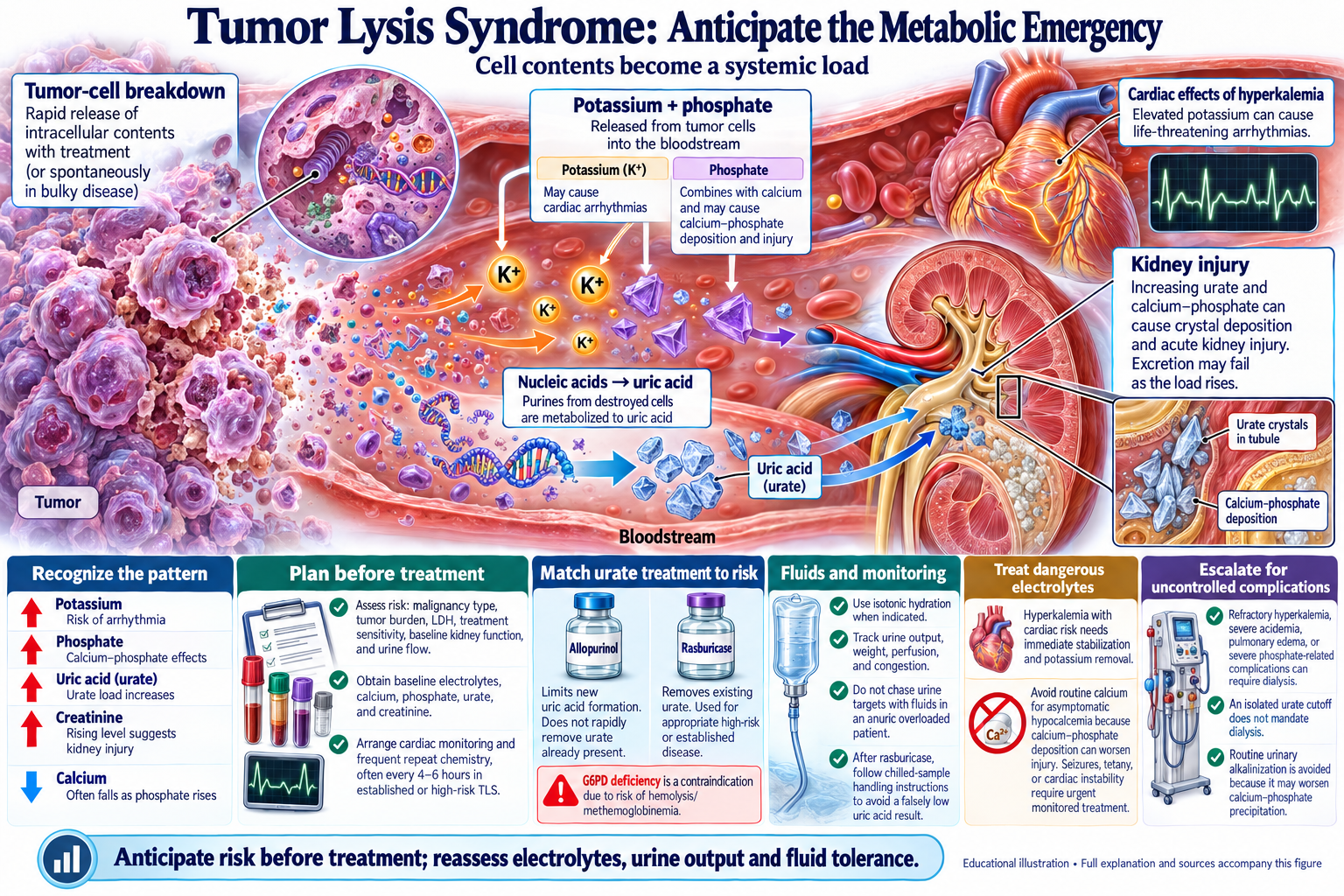
Pre-Case Assessment: Test Your Baseline Knowledge
Answer these questions before reviewing the case to assess your starting knowledge
Which tumor type has the highest risk for developing tumor lysis syndrome?
Learning Point: Burkitt lymphoma has the highest risk for TLS due to its extremely high proliferation rate and chemosensitivity. Hematologic malignancies, especially high-grade lymphomas and acute leukemias, have much higher TLS risk than solid tumors.
📚 Reference: AKI Module: Metabolic Causes
What is the most common electrolyte abnormality that leads to death in tumor lysis syndrome?
Learning Point: Hyperkalemia is the most immediately life-threatening complication of TLS, causing cardiac arrhythmias and sudden death. Levels >6.5 mEq/L require emergency treatment to prevent fatal arrhythmias.
📚 Reference: Hyperkalemia Emergency Management
Rasburicase works by which mechanism of action?
Learning Point: Rasburicase is recombinant urate oxidase that converts uric acid to allantoin, which is 5-10 times more soluble than uric acid. This bypasses the normal purine catabolism pathway and rapidly reduces uric acid levels.
📚 Reference: Drug-Induced AKI: Therapeutic Agents
What is the timeline for peak TLS risk after chemotherapy initiation?
Learning Point: TLS typically peaks 12-72 hours after chemotherapy initiation, corresponding to the time of maximal tumor cell lysis. However, it can occur as early as 6 hours or as late as 7 days post-treatment.
📚 Reference: AKI Module: Timeline and Recognition
Emergency Case Presentation
Patient: 42-year-old woman
Chief Complaint: "I can't breathe and I'm feeling confused since starting my cancer treatment"
History: Recently diagnosed high-grade B-cell lymphoma with bulky mediastinal and abdominal masses. Started R-CHOP chemotherapy 18 hours ago. Developed progressive dyspnea, confusion, and decreased urine output over the past 6 hours. Family brought her to emergency department due to increasing lethargy.
Past Medical History: Previously healthy, recent 20-pound weight loss and night sweats led to diagnosis
Medications: Cyclophosphamide, doxorubicin, vincristine, prednisone, rituximab (R-CHOP cycle 1, day 1)
Social History: Marketing executive, no tobacco/alcohol use, married with two children
🤔 Initial Clinical Reasoning Questions
Based on the timeline and presentation, what is the most likely diagnosis?
Clinical Reasoning: The combination of high-grade lymphoma (high TLS risk), recent chemotherapy (18 hours ago), neurological changes (confusion), and oliguria in a previously healthy patient is classic for TLS. The timing is within the peak risk window.
📚 Learn More: Tumor Lysis Syndrome Lecture
What are the priority laboratory studies needed immediately?
Clinical Reasoning: TLS diagnosis requires the four key electrolyte measurements: uric acid, potassium, phosphorus, and calcium. These need to be obtained immediately to assess for Cairo-Bishop criteria and guide emergency management.
📚 Learn More: Tumor Lysis Syndrome - Cairo-Bishop Criteria
Physical Examination Findings
Vital Signs
- Blood Pressure: 165/95 mmHg
- Heart Rate: 115 bpm
- Temperature: 37.2°C (99.0°F)
- Respiratory Rate: 28/min
- Oxygen Saturation: 92% on room air
- Weight: 65 kg (family reports 2 kg gain since yesterday)
Neurological Findings
- Mental status: Confused, oriented to person only
- Speech: Slow, slurred
- Reflexes: Hyperreflexic with clonus
- Chvostek sign: Positive
- Trousseau sign: Positive
🎯 Physical Examination Analysis
The positive Chvostek and Trousseau signs indicate which electrolyte abnormality?
Learning Point: Chvostek and Trousseau signs are classic indicators of hypocalcemia-induced neuromuscular irritability. In TLS, hypocalcemia results from calcium-phosphate precipitation as phosphorus levels rise dramatically.
📚 Reference: Hypocalcemia Recognition and Management
What is the significance of the 2 kg weight gain since yesterday?
Learning Point: Rapid weight gain (2 kg in 24 hours) represents approximately 2 liters of fluid retention, typically indicating AKI with oliguria and volume overload. This is a common complication of TLS-induced kidney injury.
📚 Learn More: AKI Module - Volume Assessment
Critical Laboratory Results
🚨 Emergency Electrolyte Panel
| Parameter | Value | Normal Range | TLS Significance |
|---|---|---|---|
| Uric Acid | 18.5 mg/dL | 2.4-6.0 mg/dL | Severe hyperuricemia (3× upper limit) |
| Potassium | 7.2 mEq/L | 3.5-5.0 mEq/L | Life-threatening hyperkalemia |
| Phosphorus | 8.8 mg/dL | 2.5-4.5 mg/dL | Severe hyperphosphatemia |
| Calcium (ionized) | 0.85 mmol/L | 1.15-1.35 mmol/L | Severe hypocalcemia |
| Creatinine | 4.2 mg/dL | 0.6-1.1 mg/dL | Acute kidney injury from TLS |
📊 Laboratory Analysis Questions
According to Cairo-Bishop criteria, this patient has:
Learning Point: This patient meets all 4 laboratory TLS criteria (elevated uric acid, K+, PO4, and low Ca2+) PLUS clinical criteria (AKI with Cr >1.5× upper limit), confirming Clinical TLS diagnosis.
📚 Reference: AKI Module: TLS Recognition
What is the most immediate life-threatening laboratory abnormality?
Learning Point: Hyperkalemia >7.0 mEq/L can cause fatal cardiac arrhythmias within minutes. This requires immediate membrane stabilization and potassium-lowering interventions before addressing other abnormalities.
📚 Reference: Hyperkalemia Emergency Protocols
Interactive Timeline: Emergency Management Decisions
Navigate through critical decision points in the first hours of TLS management
Hour 0-1: What is the FIRST priority intervention for this patient?
Emergency Priority: With K+ 7.2 mEq/L, immediate cardiac monitoring and hyperkalemia treatment (calcium gluconate, insulin/D50, albuterol) takes priority to prevent fatal arrhythmias. ABCs always come first.
📚 Reference: Emergency Hyperkalemia Management
Hour 1-2: After stabilizing hyperkalemia, what is the next intervention?
Treatment Rationale: With severe hyperuricemia (18.5 mg/dL) and clinical TLS, rasburicase is indicated to rapidly reduce uric acid levels. The dose is 0.2 mg/kg IV (13 mg for this 65 kg patient).
📚 Reference: Rasburicase Therapy Protocols
Hour 2-4: Patient has severe hypocalcemia (ionized Ca 0.85 mmol/L) with positive Chvostek/Trousseau signs, K+ 5.8 mEq/L (post-treatment, no ECG changes), and PO4 8.8 mg/dL. What is the appropriate calcium replacement strategy?
Critical Concept (Coiffier 2008 evidence-based review, PMID 18509186; Howard NEJM 2011): Symptomatic hypocalcemia in TLS (tetany, seizures, hypotension, cardiac dysfunction, +Chvostek/Trousseau) warrants cautious IV calcium gluconate at the lowest dose required to relieve symptoms. Calcium-phosphate precipitation risk is governed by the Ca×P product: this patient's product is approximately 3.4 mg/dL × 8.8 mg/dL = 30 mg²/dL² (well below the typical >55–70 precipitation threshold). Withholding calcium in the face of overt tetany risks seizure, laryngospasm, and arrhythmia. Lower phosphorus concurrently (binders, dialysis if severe). Asymptomatic hypocalcemia in TLS does NOT require replacement.
📚 Reference: Hypocalcemia in Hyperphosphatemic States
Module-Specific Deep Dive: Advanced Pathophysiology
Explore advanced concepts and mechanisms underlying TLS
What is the primary mechanism by which hyperuricemia causes AKI in TLS?
Pathophysiology: Uric acid has limited solubility, especially in acidic urine. High concentrations lead to crystal formation in renal tubules, causing obstruction and AKI.
📚 Reference: AKI Module: Crystalline Nephropathy
Why is rasburicase contraindicated in G6PD deficiency?
Mechanism: Rasburicase produces hydrogen peroxide as a byproduct. In G6PD deficiency, red blood cells cannot adequately handle oxidative stress, leading to severe hemolysis. G6PD testing is essential before rasburicase use.
📚 Reference: Drug Safety in Special Populations
In TLS, what drives the development of hypocalcemia?
Mechanism: The massive release of intracellular phosphate overwhelms renal excretory capacity. High phosphate levels bind with calcium, forming calcium-phosphate complexes that precipitate in tissues, effectively removing calcium from circulation.
📚 Reference: Hyperphosphatemia and Calcium Homeostasis
Learning Objectives Assessment
Evaluate your mastery of the key learning objectives from this case
🎯 Learning Objective 1: TLS Recognition and Risk Stratification
Objective: Demonstrate ability to identify high-risk patients and apply Cairo-Bishop criteria for TLS diagnosis
A 35-year-old man with acute lymphoblastic leukemia (ALL) is starting induction chemotherapy. His baseline labs show WBC 150,000, LDH 2,500 U/L, and uric acid 8.2 mg/dL. What is his TLS risk category?
Competency Demonstration: ALL with high WBC (>100,000), elevated LDH (>2× normal), and elevated baseline uric acid represents high TLS risk. This requires prophylactic rasburicase, aggressive hydration, and intensive monitoring.
📚 Master This: AKI Module: TLS Risk Stratification
🎯 Learning Objective 2: Emergency Management Protocols
Objective: Execute evidence-based emergency management for life-threatening TLS complications
A patient with TLS has K+ 6.8 mEq/L and wide QRS complexes on ECG. List the correct sequence of emergency interventions:
Competency Demonstration: Wide QRS indicates cardiotoxicity requiring immediate membrane stabilization (calcium gluconate first), then K+ shifting (insulin/D50, albuterol), then elimination (dialysis if medical management insufficient).
📚 Master This: Emergency Hyperkalemia Protocols
🎯 Learning Objective 3: Dialysis Decision-Making
Objective: Apply appropriate criteria for emergency dialysis initiation in TLS
Which finding would be an absolute indication for emergency dialysis in TLS?
Competency Demonstration: Refractory hyperkalemia (K+ >6.5 mEq/L not responding to medical therapy) is an absolute dialysis indication due to the risk of fatal arrhythmias. Other indications include volume overload and severe acidosis.
📚 Master This: Emergency Dialysis Indications
Integration Challenge: Complex Clinical Scenarios
Apply integrated knowledge across multiple systems and specialties
A TLS patient has K+ 6.5 mEq/L, PO4 9.2 mg/dL, and Ca 6.8 mg/dL. The team debates whether to prioritize hyperkalemia treatment (risking cardiac arrest) or avoid calcium (preventing Ca-PO4 precipitation). What is the correct approach?
Integration Synthesis: While Ca-PO4 precipitation is concerning, hyperkalemia >6.5 mEq/L poses immediate risk of fatal arrhythmias. Cardiac arrest kills within minutes; precipitation complications develop over hours-days. ABCs take priority - stabilize the heart first, then address metabolic complications.
📚 Integrate: Emergency Hyperkalemia vs Other Electrolyte Disorders
A patient with TLS on CRRT shows improving electrolytes but develops fever, hypotension, and altered mental status on day 3. What is the most likely complication and management?
Integration Synthesis: Fever, hypotension, and altered mental status in a patient with central venous catheter suggests catheter-related bloodstream infection (CRBSI). Requires immediate blood cultures, empiric antibiotics, and possible catheter removal.
📚 Integrate: Dialysis Access Complications
Multi-System Challenge: A patient recovers from TLS but now has Stage 3 AKI, hyperphosphatemia, and needs to continue chemotherapy. Prioritize the management approach:
Integration Synthesis: Balancing cancer treatment urgency with kidney protection requires: dose-adjusted chemotherapy for reduced GFR, prophylactic rasburicase (proven TLS risk), phosphate binders for mineral metabolism, and intensive monitoring for recurrent TLS.
📚 Integrate: CKD and Drug Dosing
Case Reflection & Multi-Module Integration
🚨 AKI Module Integration
- Metabolic causes of acute kidney injury
- KDIGO staging and progression monitoring
- Crystalline nephropathy mechanisms
- Emergency recognition and intervention
⚡ Electrolytes Module Integration
- Life-threatening hyperkalemia management
- Hyperphosphatemia and calcium homeostasis
- Emergency electrolyte protocols
- Membrane stabilization techniques
🩺 Dialysis Module Integration
- Emergency RRT indications
- CRRT vs intermittent HD selection
- Monitoring during renal replacement
- Access and complication management
💊 Drug Safety Integration
- Rasburicase mechanism and dosing
- Contraindications and safety monitoring
- Drug interactions in critical illness
- Special population considerations
🎯 Key Integration Concepts
This case demonstrates the critical importance of rapid recognition and systematic management of tumor lysis syndrome as a true medical emergency. The integration of oncology, nephrology, critical care, and emergency medicine principles is essential for optimal patient outcomes. Understanding the pathophysiology allows for logical, evidence-based interventions that address each component of this complex syndrome while prioritizing life-threatening complications.
📝 Case Summary & Clinical Pearls
This enhanced case explored tumor lysis syndrome as a life-threatening oncologic emergency requiring immediate recognition and multidisciplinary management. The patient's presentation with high-grade lymphoma, recent chemotherapy, and multiple electrolyte abnormalities exemplifies the classic TLS syndrome requiring aggressive intervention.
🔑 Key Clinical Pearls from This Case:
- TLS is Predictable: Risk stratification based on tumor type, burden, and patient factors allows for preventive interventions
- Hyperkalemia Kills First: While all four electrolyte abnormalities are serious, hyperkalemia requires immediate attention due to cardiac toxicity
- Calcium Paradox: Despite severe hypocalcemia, calcium replacement is contraindicated in hyperphosphatemic states due to precipitation risk
- Rasburicase is Revolutionary: This enzyme therapy can rapidly reduce uric acid levels but requires careful patient selection and contraindication screening
- Early Dialysis Saves Lives: Don't delay RRT when multiple absolute indications are present