A. Pre-Case Assessment: Test Your Baseline Knowledge
Answer these questions before reviewing the case to assess your starting knowledge
Which cost-effective therapy provides reliable osmotic diuresis for chronic SIADH but has palatability challenges?
Learning Point: Urea is highly effective for chronic SIADH by providing osmotic diuresis. While commercial urea is expensive (~$100-200/month), patients can achieve similar effects through high-protein intake, as the body converts excess protein to urea at a rate of 0.35g urea per 1g protein. This endogenous urea generation provides the same therapeutic benefit at much lower cost.
📚 Reference: Hyponatremia - Alternative Therapies
In patients with HFpEF or HFrEF and concurrent hyponatremia, which medication provides dual cardiovascular and sodium benefits?
Learning Point: SGLT2 inhibitors provide unique benefits in heart failure patients with hyponatremia. They promote aquaresis (free water loss) which helps correct hyponatremia while simultaneously providing cardiovascular protection. This dual benefit makes them especially valuable in patients with both conditions.
📚 Reference: Cardiorenal Disease - SGLT2 Inhibitors
What is the primary limitation of demeclocycline as a chronic therapy for SIADH?
Learning Point: Demeclocycline causes unpredictable nephrotoxicity (especially in elderly patients) and has highly variable efficacy. The nephrotoxic effect can persist even after discontinuation, making it a poor choice for long-term management. Additionally, the response is inconsistent and can take days to weeks to develop.
📚 Reference: Hyponatremia - Treatment Limitations
Case Presentation
Patient: 74-year-old woman
Chief Complaint: "My sodium is always low and I keep falling. The fluid restriction isn't working."
History: 8-month history of chronic hyponatremia (sodium 118-125 mEq/L) following diagnosis of small cell lung cancer. Currently on maintenance chemotherapy. Has tried fluid restriction (1L/day) for 4 months with minimal improvement. Recent hospitalization for symptomatic hyponatremia with temporary correction, but levels returned to baseline within 2 weeks. Three falls in past 6 weeks, declining cognitive function, and poor quality of life.
Past Medical History: SCLC (responding to treatment), heart failure with preserved ejection fraction (HFpEF), diabetes mellitus type 2, hypertension, chronic kidney disease stage 3a
Home Medications: Carboplatin/etoposide (cycle 6), metformin 1000mg BID, lisinopril 10mg daily, metoprolol 50mg BID, furosemide 20mg daily PRN edema
Social History: Lives alone, limited financial resources, worried about medication costs
🤔 B. Clinical Reasoning Questions
Why is fluid restriction failing in this patient with chronic SIADH?
Clinical Reasoning: SCLC produces high levels of ectopic ADH, creating high-grade SIADH. Even with strict fluid restriction, the constant ADH stimulus prevents adequate free water excretion. This is evidenced by the persistently elevated urine osmolality despite fluid restriction, indicating the need for more targeted therapy.
📚 Learn More: Hyponatremia - SIADH Management
Given this patient's HFpEF and hyponatremia, which therapy provides optimal dual benefit?
Clinical Reasoning: SGLT2 inhibitors like empagliflozin promote free water excretion (aquaresis), helping with hyponatremia correction. Simultaneously, they provide cardiovascular benefits in HFpEF patients, reducing hospitalizations and cardiovascular death. This dual mechanism makes them ideal for this patient's comorbid conditions.
📚 Reference: SGLT2 Inhibitors in Heart Failure
C. Interactive Timeline: Laboratory Evolution
Current Laboratory Values
| Parameter | Current Value | Normal Range | Clinical Significance |
|---|---|---|---|
| Sodium | 122 mEq/L | 136-145 mEq/L | Chronic severe hyponatremia |
| Serum Osmolality | 255 mOsm/kg | 280-295 mOsm/kg | Hypotonic hyponatremia |
| Urine Osmolality | 520 mOsm/kg | 50-1200 mOsm/kg | Inappropriately concentrated (SIADH) |
| Urine Sodium | 85 mEq/L | Variable | High (consistent with SIADH) |
| BUN | 28 mg/dL | 7-20 mg/dL | Mild elevation (CKD stage 3a) |
| Creatinine | 1.4 mg/dL | 0.6-1.2 mg/dL | CKD stage 3a |
📊 Timeline Decision Point Questions
The urine osmolality of 520 mOsm/kg despite fluid restriction indicates:
Learning Point: Urine osmolality >400 mOsm/kg in the setting of hyponatremia indicates powerful ADH effect. This level of urine concentration despite fluid restriction suggests that conservative measures will fail and advanced therapy is needed.
📚 Reference: SIADH Severity Assessment
What would be the most appropriate first-line therapy for this patient considering her comorbidities and financial concerns?
Learning Point: This combination addresses multiple issues: SGLT2 inhibitor provides aquaresis for hyponatremia and cardiovascular protection for HFpEF; increased protein intake generates endogenous urea for additional osmotic effect at minimal cost. This is much more cost-effective than commercial urea or tolvaptan.
📚 Reference: Integrated Cardiorenal Management
D. Module-Specific Deep Dive: Cost-Effective Chronic SIADH Management
💰 Treatment Cost Analysis & Protein-to-Urea Strategy
🏷️ Monthly Treatment Costs
- Tolvaptan: $9,000-12,000/month
- Commercial Urea: $150-300/month
- SGLT2 inhibitor: $400-500/month
- CorePower (starting dose): $90/month (1 shake daily = 15g urea equivalent)
- CorePower (full dose): $180/month (2 shakes daily = 30g urea equivalent)
- High-protein foods: $50-100/month
- Demeclocycline: $100-200/month
- Salt tablets: $20-40/month
⚡ Efficacy vs Cost Analysis
- Tolvaptan: 85% efficacy, very high cost
- SGLT2i + CorePower: 70% efficacy, moderate cost
- CorePower alone: 65% efficacy, low-moderate cost
- Commercial urea: 75% efficacy, moderate cost
- Fluid restriction: 40% efficacy, no cost
- Demeclocycline: 60% efficacy, nephrotoxicity risk
🥩 Protein-to-Urea Conversion Strategy
Biochemical Rationale
- Protein metabolism: Excess dietary protein is deaminated to produce urea
- Urea generation: 1g protein → 0.35g urea production (exact conversion)
- Osmotic effect: Endogenous urea acts identically to commercial urea
- Clinical validation: 1 CorePower shake (42g protein) = 15g urea equivalent - effective starting dose
- Dose escalation: 2 shakes daily = 30g urea equivalent (full therapeutic range)
Practical Implementation - Proven Clinical Protocol
- Starting dose: 1 CorePower shake daily (42g protein = 15g urea equivalent)
- Clinical experience: Effective as initial therapy in practice
- Cost analysis: $3/shake × 30 days = $90/month (starting dose)
- Escalation if needed: 2 shakes daily = 84g protein = 30g urea equivalent = $180/month
- Timing: Can split doses (morning and evening) for better tolerance
- Monitoring: Sodium levels q3-5 days initially, BUN trends, renal function
- Contraindications: Advanced CKD (GFR <30), liver disease
- Alternative sources: Lean meats, fish, eggs, dairy if shakes not tolerated
For this patient with CKD stage 3a, what would be the most appropriate starting dose for protein-based urea generation?
Learning Point: Starting with 1 CorePower shake daily (42g protein, which converts to approximately 15g urea via hepatic deamination at the classical 0.35 g urea per 1 g protein stoichiometry) provides a practical initial dose for CKD stage 3a patients. The mechanism (protein-derived urea acting as an osmotic diuretic in the renal tubule, increasing electrolyte-free water excretion) is biochemically valid; the specific protocol (1 shake/day, escalation to 2, $90/month) is Andy's clinical practice protocol and not from a published RCT. Cost is reasonable at approximately $90/month and can be escalated to 2 shakes daily (approximately 30g urea equivalent) if needed.
📚 Reference: CKD - Dietary Management
E. Learning Objectives Assessment: Combination Therapy Strategies
💊 NaCl Tablets + Lasix Combination: The Dual-Action Approach
🎯 Mechanism & Rationale
- Salt tablets: Increase plasma osmolality, promote thirst suppression
- Furosemide: Promotes electrolyte-free water excretion
- Synergistic effect: Salt loading + loop diuretic = enhanced free water clearance
- Volume neutral: Prevents volume overload while correcting sodium
📋 Dosing Protocol
- NaCl tablets: 1-2g every 8 hours with meals
- Furosemide: 20-40mg daily or divided doses
- Monitoring: Daily weights, sodium levels q48-72h initially
- Target: 2-4 mEq/L sodium increase per week
🎯 Learning Objective: Evaluate Multi-Drug Synergy in Hyponatremia
Objective: Demonstrate understanding of how combination therapies can provide synergistic effects in chronic SIADH management while minimizing individual drug limitations.
Why is the NaCl tablets + furosemide combination more effective than either drug alone in chronic SIADH?
Competency Demonstration: This answer shows understanding of complementary mechanisms: salt tablets increase plasma osmolality and provide substrate for dilution, while furosemide blocks sodium reabsorption in the thick ascending limb, promoting electrolyte-free water excretion. Together, they overcome the concentrated urine production of SIADH.
📚 Master This: Advanced Combination Therapies
What is the major advantage of SGLT2 inhibitors over traditional therapies in patients with HFpEF and hyponatremia?
Competency Demonstration: SGLT2 inhibitors provide dual benefits: promoting free water excretion (aquaresis) to help correct hyponatremia, while simultaneously offering proven cardiovascular benefits in heart failure patients. This makes them uniquely valuable in patients with both conditions.
📚 Master This: SGLT2 Inhibitors in Cardiorenal Disease
F. Integration Challenge: Why Traditional Therapies Fail
⚠️ Demeclocycline: The Problematic "Gold Standard"
🚨 Major Limitations
- Unpredictable nephrotoxicity: Can cause irreversible kidney damage, especially in elderly
- Delayed onset: 3-6 days to see effect, making dose titration difficult
- Variable efficacy: Response rates only 50-70%, difficult to predict responders
- Drug interactions: Reduced absorption with calcium, iron, dairy products
- Photosensitivity: Increased skin cancer risk with sun exposure
- GI intolerance: Nausea, diarrhea common
🏥 Clinical Reality
Why it's rarely used anymore: The nephrotoxicity risk in elderly patients with chronic conditions often outweighs potential benefits. Modern alternatives provide better safety profiles with more predictable efficacy.
💧 Fluid Restriction: When and Why It Fails
📊 Failure Patterns
- High-grade SIADH: Urine osmolality >400 mOsm/kg rarely responds to restriction
- Compliance challenges: Long-term adherence <40% in real-world settings
- Quality of life impact: Persistent thirst, social isolation, poor adherence
- Inadequate efficacy: Even perfect compliance often yields only modest improvement
- Rebound effect: Rapid return to baseline when restriction relaxed
🎯 When Restriction Works vs Fails
✅ Likely to Work:
- Mild SIADH (UOsm <300)
- Medication-induced (reversible)
- Motivated patients
- Short-term management
❌ Likely to Fail:
- Ectopic ADH (tumors)
- UOsm >400 mOsm/kg
- Elderly patients
- Chronic management needs
Based on this patient's presentation, why would demeclocycline be particularly inappropriate?
Integration Challenge: This demonstrates synthesis of patient factors: elderly age (>65) plus existing CKD dramatically increases risk of irreversible nephrotoxicity from demeclocycline. The unpredictable nature of this toxicity makes it particularly dangerous in patients who already have compromised kidney function.
📚 Reference: CKD - Medication Safety
Which combination represents the most appropriate evidence-based approach for this patient's chronic SIADH management?
Integration Challenge: This approach integrates multiple modules: SGLT2 inhibitor addresses both HFpEF (cardiorenal module) and hyponatremia (electrolyte module); high-protein diet provides cost-effective endogenous urea (clinical pharmacology); NaCl + furosemide combination enhances efficacy while maintaining safety in CKD. This represents optimal integration of evidence-based care across multiple domains.
📚 Learn More: Cardiorenal Disease - Integrated Management
Learning Objectives Assessment
Evaluate your mastery of the key learning objectives from this chronic hyponatremia case
What is the electrolyte-free water clearance concept, and why is it central to understanding SIADH treatment?
Learning Point: Electrolyte-free water clearance (EFWc) = urine volume x [1 - (urine Na+ + urine K+)/serum Na+]. In SIADH, ADH causes the kidneys to produce concentrated urine, making EFWc negative (retaining free water). The treatment goal is to make EFWc positive -- achieved by: (1) increasing solute load (urea/protein increases obligatory water excretion), (2) furosemide (impairs concentrating ability), (3) SGLT2 inhibitors (osmotic diuresis with glycosuria). This concept explains why fluid restriction alone often fails when urine osmolality is very high.
📚 Reference: Electrolyte-Free Water Clearance
The patient's urine osmolality is 580 mOsm/kg and serum osmolality is 268 mOsm/kg. The Furst ratio (urine Na+ + urine K+) / serum Na+ is 1.3. What does this predict about fluid restriction success?
Learning Point: When the Furst ratio exceeds 1.0, the urine electrolyte concentration exceeds serum sodium, meaning the kidneys are generating "electrolyte-free water" that is retained. Even with zero oral intake, the kidney would still be making the patient more hyponatremic with every liter of urine produced. This is the quantitative explanation for fluid restriction failure in high-grade SIADH. A ratio less than 0.5 predicts good response to fluid restriction; 0.5-1.0 is moderate; greater than 1.0 predicts failure.
📚 Reference: Furst Ratio & Fluid Restriction Prediction
How does high-protein intake (e.g., CorePower shake providing 42g protein) correct hyponatremia in SIADH?
Learning Point: The protein-to-urea conversion pathway is the mechanistic basis for dietary therapy in chronic SIADH. The body converts excess dietary protein to urea at a rate of approximately 0.35g urea per 1g protein. Urea is freely filtered at the glomerulus and creates an osmotic diuresis that "drags" water through the nephron, increasing obligatory water excretion. A 42g protein shake generates approximately 15g of urea -- equivalent to a commercial urea dose at a fraction of the cost. This is why high-protein meals/supplements can be as effective as pharmaceutical-grade urea for chronic SIADH management.
📚 Reference: Protein-to-Urea Conversion Therapy
Why is combining NaCl tablets with intermittent furosemide effective for chronic SIADH that is refractory to fluid restriction?
Learning Point: This combination exploits a key pharmacologic principle: furosemide blocks the Na-K-2Cl cotransporter (NKCC2) in the thick ascending limb, impairing the countercurrent mechanism that concentrates urine. Without the medullary concentration gradient, ADH cannot concentrate urine effectively, even though it is still present. The result is dilute urine (increased electrolyte-free water excretion). NaCl tablets serve two purposes: (1) replace urinary sodium losses from furosemide, and (2) provide additional osmolar load for obligatory water excretion. This synergistic combination works even in high-grade SIADH where fluid restriction fails.
📚 Reference: NaCl + Furosemide Synergy
Module-Specific Deep Dive: Advanced Chronic Hyponatremia
Advanced pathophysiology and clinical decision-making in chronic SIADH
What is the appropriate sodium correction rate for chronic hyponatremia (present for more than 48 hours), and why does it differ from acute hyponatremia?
Learning Point: In chronic hyponatremia (more than 48 hours), brain cells adapt by extruding organic osmolytes (taurine, glutamate, myo-inositol) to reduce intracellular volume and prevent cerebral edema. If sodium is corrected too rapidly, these depleted osmolytes cannot be regenerated quickly enough, causing excessive cell shrinkage. Oligodendrocytes are particularly vulnerable, leading to osmotic demyelination syndrome (ODS). The safe rate is 6-8 mEq/L per 24 hours, with high-risk patients (alcoholism, liver disease, malnutrition, hypokalemia) limited to less than 6 mEq/L per 24 hours.
📚 Reference: Chronic Hyponatremia Correction Limits
Tolvaptan costs approximately $9,000/month. What are the specific safety concerns that limit its use beyond cost?
Learning Point: Tolvaptan carries an FDA black box warning for hepatotoxicity, limiting use to 30 days for SIADH (longer use is approved only for ADPKD with REMS program). Additional concerns include: (1) Unpredictable aquaresis causing overly rapid sodium correction, (2) Must be initiated in hospital with q6h sodium monitoring for first 24 hours, (3) Severe thirst affecting quality of life, (4) CYP3A4 interactions (many chemotherapy drugs). These safety limitations, combined with prohibitive cost, make multi-target combination therapy (SGLT2i + protein + NaCl/furosemide) a superior real-world approach for most patients.
📚 Reference: Vaptan Safety Limitations
Chronic mild hyponatremia (Na+ 125-134 mEq/L) was previously considered "asymptomatic." What evidence challenges this assumption?
Learning Point: Multiple studies have demonstrated that chronic "mild" hyponatremia causes significant morbidity: (1) 4-fold increase in falls risk (Renneboog et al., Am J Med 2006), (2) Decreased bone mineral density and 2x increased fracture risk, (3) Subtle cognitive impairment (attention, gait, reaction time) even at Na+ 130-134, (4) Increased 1-year mortality in hospitalized patients. These findings argue against the traditional approach of "tolerating" mild chronic hyponatremia and support active treatment to normalize sodium, which is exactly what this case demonstrates with the multi-target approach.
📚 Reference: Consequences of Chronic Hyponatremia
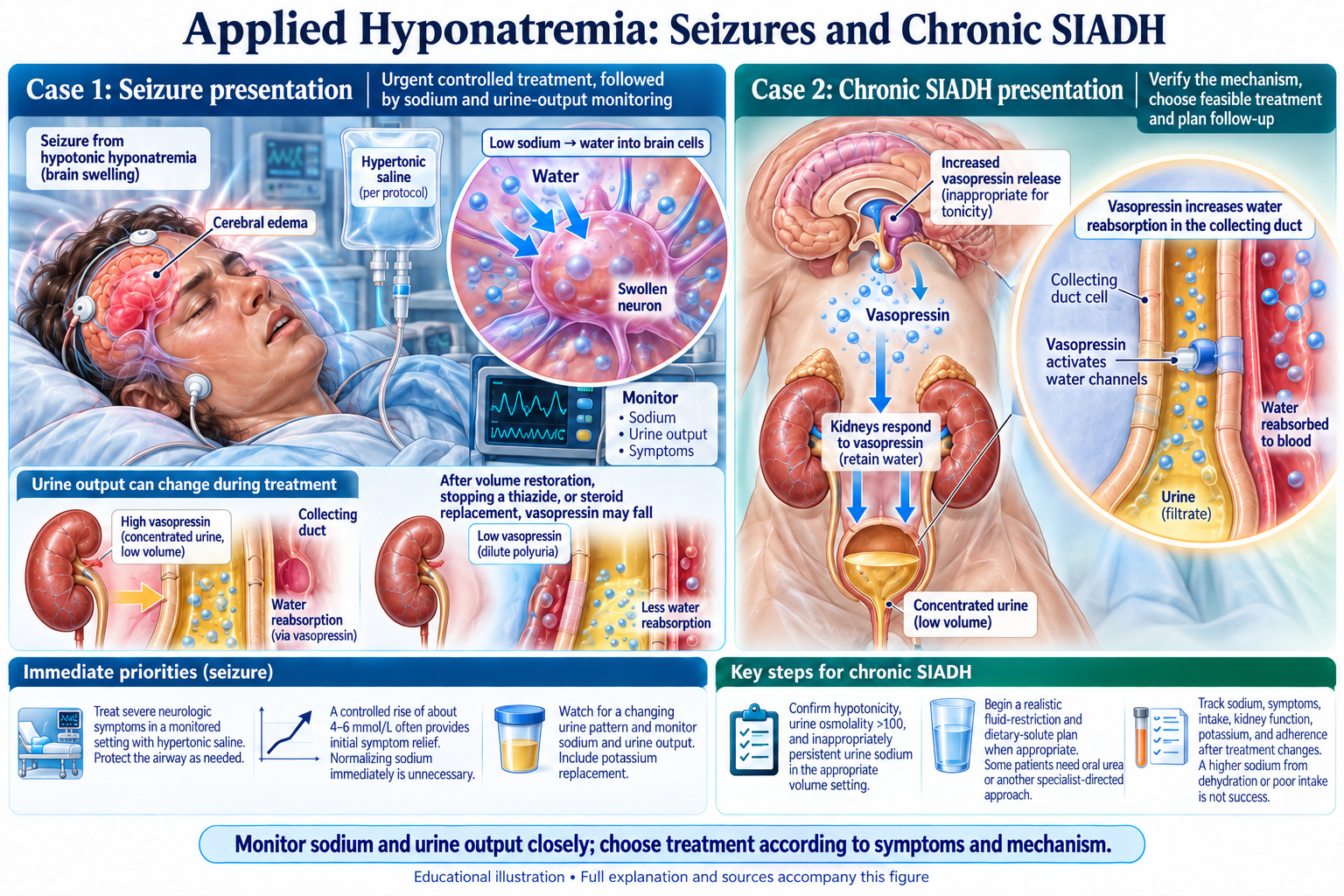
If the patient's cancer progresses and sodium drops to 115 mEq/L with new-onset confusion, how should you approach this situation differently than the outpatient management described in this case?
Learning Point: Symptomatic hyponatremia (confusion, altered mental status) requires emergency management regardless of chronicity. The approach changes from chronic outpatient to acute inpatient: (1) Admit to monitored setting, (2) 3% hypertonic saline 150 mL bolus over 20 minutes for symptom relief, (3) Target 4-6 mEq/L rise in first 6 hours, (4) Limit to 6-8 mEq/L per 24 hours (high risk for ODS given chronic adaptation), (5) Monitor sodium q2-4h, (6) DDAVP clamp strategy if correction approaches the limit. After stabilization, resume the outpatient multi-target regimen and consider palliative care consultation given cancer progression.
📚 Reference: Emergency Hyponatremia Protocols
Comparing the cost-effectiveness of treatment strategies for this patient's chronic SIADH, which analysis best represents the real-world value proposition?
Learning Point: The multi-target approach demonstrated in this case is designed to achieve comparable sodium correction to tolvaptan at a fraction of the cost. Approximate cost breakdown (Andy's clinical practice numbers, US 2024-2025 retail prices): empagliflozin approximately $15/day + CorePower shake approximately $3/day + NaCl tablets approximately $0.10/day + furosemide approximately $0.15/day = approximately $18/day or approximately $540/month vs tolvaptan at $300-plus/day or approximately $9,000-plus/month. Beyond cost, the multi-target approach offers: (1) Better safety (no hepatotoxicity risk, no need for inpatient initiation), (2) Additional cardiorenal benefits from SGLT2 inhibitor, (3) Nutritional benefit from protein supplementation, (4) Patient preference (CorePower shakes are palatable vs urea powder).
📚 Reference: Cost-Effective SIADH Management
Treatment Response & Long-term Management
Week 1-2: Initiation Phase
- Started: Empagliflozin 10mg daily, 1 CorePower shake daily (15g urea equivalent)
- Sodium response: 122 → 126 mEq/L (4 mEq/L increase)
- Clinical: Improved alertness, no falls this week
- Monitoring: Sodium q3 days, daily weights, renal function stable
- Cost: SGLT2i (approximately $15/day) + CorePower (approximately $3/day) = approximately $18/day total (Andy's clinical practice estimate)
Week 3-4: Optimization Phase
- Added: NaCl 1g TID with meals, furosemide 20mg every other day
- Continued: 1 CorePower shake daily (well tolerated, good compliance)
- Sodium response: 126 → 131 mEq/L (additional 5 mEq/L increase)
- Clinical: Significant improvement in cognition, family reports better function
- Cardiac: No worsening of HFpEF, slight improvement in exercise tolerance
Month 2-3: Maintenance Phase
- Sodium stability: 129-133 mEq/L range maintained
- Quality of life: Marked improvement, no falls in 6 weeks
- Cost analysis: Monthly therapy cost approximately $540 vs approximately $9,000-plus for tolvaptan (Andy's clinical practice estimate; not from a published cost-effectiveness analysis)
- Patient satisfaction: CorePower shakes well-tolerated, easy to incorporate
- Long-term plan: Continue current regimen, monitor tumor response
Case Reflection & Multi-Module Integration
🌊 Hyponatremia Module Integration
- Chronic SIADH pathophysiology and correction principles
- Alternative therapies when traditional approaches fail
- Cost-effective strategies using protein-to-urea conversion
❤️ Cardiorenal Disease Integration
- SGLT2 inhibitors in HFpEF management
- Dual benefits: aquaresis and cardiovascular protection
- Integration with nephrology care plans
💊 Clinical Pharmacology Integration
- Cost-effectiveness analysis of therapeutic options
- Drug combination synergies and mechanisms
- Safety considerations in elderly with CKD
🔬 Geriatric Medicine Integration
- Falls prevention through sodium optimization
- Cognitive impact of chronic hyponatremia
- Quality of life considerations in treatment selection
🎯 Key Integration Concepts
This case demonstrates how chronic hyponatremia management requires integration across multiple medical domains. The optimal approach combines understanding of kidney physiology, cardiac pathophysiology, pharmacoeconomics, and geriatric principles to develop cost-effective, patient-centered care plans that address the underlying disease while managing complications and optimizing quality of life.
📝 Case Summary & Clinical Pearls
🔑 Key Clinical Pearls from This Case:
- Protein-to-Urea Strategy: High-protein diet generates endogenous urea at fraction of commercial urea cost, providing equivalent therapeutic effect
- SGLT2 Dual Benefits: In HFpEF patients with hyponatremia, SGLT2 inhibitors provide both aquaresis for sodium correction and cardiovascular protection
- Combination Synergy: NaCl tablets + furosemide work synergistically - salt provides osmotic substrate while loop diuretic enhances free water excretion
- Demeclocycline Limitations: Unpredictable nephrotoxicity and variable efficacy make it inappropriate for elderly patients with existing CKD
- Fluid Restriction Failure: High-grade SIADH (UOsm >400) rarely responds to conservative measures alone, requiring targeted pharmacotherapy
- Cost-Effectiveness: Thoughtful combination of lower-cost therapies can achieve similar efficacy to expensive options like tolvaptan